Palaeocharinus looks like it should be easy to summarize: small, low, eight-legged, spider-like. That first impression is useful only if it is treated as a warning. The animal was not a modern spider moved backward into the Devonian. It was a trigonotarbid, part of an extinct order of arachnids that helps make the early land ecosystem visible at body scale.[2][4]
The reason Palaeocharinus matters is not only that it is old. It matters because the Rhynie chert preserved it in a way that makes old land anatomy unusually inspectable. Instead of a flattened outline with a few suggestive limbs, the Scottish chert record can retain three-dimensional detail from an Early Devonian hot-spring ecosystem roughly 408 million years old.[1][2][4] That lets researchers ask a better question than "was this a spider ancestor?" The better question is how a small terrestrial predator kept water inside, air moving, prey controlled, and its evolutionary identity distinct from the spiders it superficially resembles.
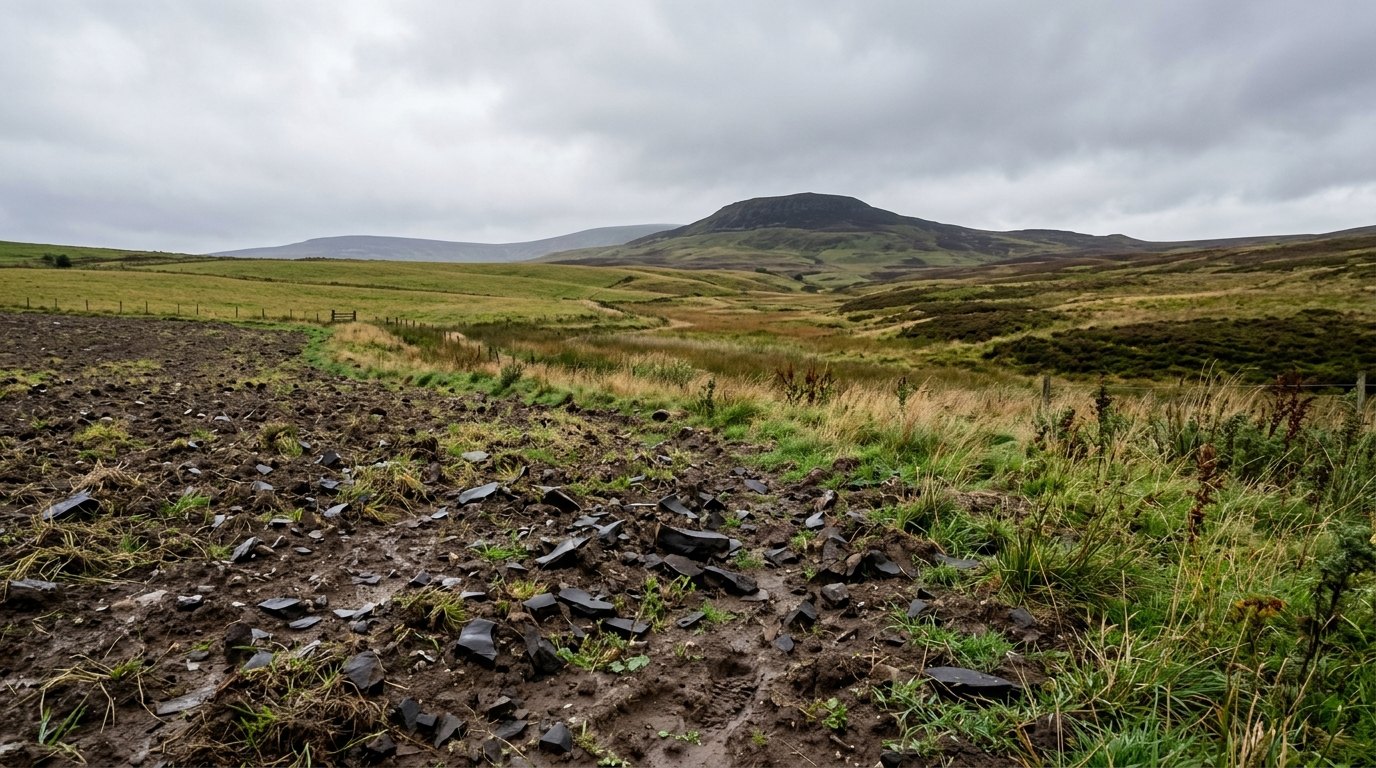
Image context: the lead image is a real field photograph from the fossil landscape rather than a cleaned-up restoration.[6] It is used because the article's evidence comes from fossil anatomy, microscopy, and specimen context. The Rhynie landscape keeps the reader close to the preservational setting that makes cuticle, mouthparts, lungs, and phylogenetic boundaries available for argument.
The chert is the first method
The Rhynie chert is not just a locality label. It is the method that made this animal legible. The Scottish Geology Trust's GeoGuide describes the cherts as fossilized sinters in a hot-spring setting on the Old Red Sandstone continent, within a dominantly fluvial environment.[2] That setting matters because it could entomb small terrestrial organisms with a fidelity that ordinary compression fossils rarely grant.
For Palaeocharinus, that preservation changes the claim type. Most trigonotarbids are limited by compression or mould preservation, which keeps the animal recognizable but makes fine morphology hard to test.[4] Rhynie and Windyfield material is different: the genus is preserved in three dimensions, with enough detail to support work on cuticle ultrastructure, book lungs, tendons, mouthparts, and feeding surfaces.[1][4]
That is why a method deep dive is the right mode here. A spider-like fossil can be marketed as an icon. Palaeocharinus is more valuable as an imaging problem. Confocal laser scanning microscopy, three-dimensional modelling, and specimen thin sections do not simply decorate the story with technology. They decide what kind of biological question can be asked.[1][4]
The skin is not surface decoration
The 2024 cuticle study by Long, Edgecombe, Kenrick, and Ma treats the outer covering as a terrestrial innovation rather than as a passive shell.[1] That is the correct starting point. On land, an arthropod's cuticle has to do more than hold shape. It has to resist water loss, carry sensory structures, accommodate glands, and still remain flexible enough for movement.
The paper reports polygonal surface scales, sensilla, small pores interpreted as openings of dermal glands and wax canals, and internal pore canals arranged in ways that imply a Bouligand, or twisted-plywood, architecture.[1] Those details are small, but they are not trivial. They move the animal out of silhouette and into materials engineering. A 408-million-year-old arachnid is no longer only a shape in stone; it is a body surface with layered organization, permeability questions, and land-life constraints.[1]
The thick cuticle matters for the same reason. Long and colleagues describe Palaeocharinus cuticle as characteristically thick relative to many fossil and living chelicerates, with that thickening interpreted as a possible adaptation to terrestrial life.[1] The safe word here is possible. A thick cuticle does not single-handedly prove one exact behavior or microhabitat. But it does tell us that the fossil preserves a plausible physical solution to the oldest terrestrial problem: how to live in air without drying out.
The lungs keep the animal on land
The GeoGuide summary is blunt about a key boundary: Rhynie trigonotarbids looked spider-like, but they lacked definitive spider features such as venom and silk glands; well-preserved book lungs removed doubt that they were terrestrial air-breathers.[2] That sentence is doing two jobs at once. It prevents over-identification with spiders, and it keeps the terrestrial claim grounded in anatomy rather than in resemblance.
This is the useful middle category. Palaeocharinus was not a water arthropod merely caught near a wet spring system, and it was not a true spider. It was an early land arachnid whose breathing equipment belongs inside the broader tetrapulmonate story.[2][4] Once that is clear, the fossil becomes more interesting. It shows that early terrestrial ecosystems were not waiting for modern spider anatomy before small arachnid predators could operate there.
It also makes the Rhynie fauna feel less like a cabinet of isolated firsts. Trigonotarbids, mites, springtails, crustaceans in ephemeral pools, myriapods, plants, and microbial hot-spring settings all sit in the same early land archive.[2] Palaeocharinus is one body in that archive, but its body records the larger transition: air breathing, surface protection, prey capture, and terrestrial food-web formation had already become concrete anatomical problems.
The mouthparts make it a predator, not just a lookalike
The strongest recent reset comes from the feeding apparatus. A loose public phrase like "spider-like arachnid" tends to leave the animal suspended between resemblance and ancestry. Mouthpart work makes it do something.
Long, Edgecombe, Clark, Hatch, Ball, and Ma re-examined Palaeocharinus mouthparts and reconstructed a tiered filtration apparatus: a coarse outer mesh of interlacing plumose setae and a fine inner filter of pinnate setae.[4] Set beside clasp-knife chelicerae and cheliceral teeth, that system makes Palaeocharinus a sophisticated terrestrial predator rather than a generic primitive arachnid.[4] Haug's broader euchelicerate feeding study makes the same kind of correction at clade scale: fossil groups such as trigonotarbids and eurypterids should not be treated as simply primitive; their feeding systems are often highly specialized.[3]
That matters because predation on early land was not only a question of having fangs. It was a handling problem. Small prey had to be seized, brought toward the mouth, held, filtered, and processed. In Palaeocharinus, the mouthpart evidence suggests a controlled system with division of labor among structures.[3][4] The animal becomes less like a flat spider emblem and more like a working machine in miniature.
The method boundary is equally important. These feeding claims depend on exceptional preservation and modern imaging. They are strongest for the preserved mouthpart architecture and comparative functional analogy. They are weaker if pushed into a full behavioral film of exactly how each prey item was hunted. The right conclusion is precise enough: Palaeocharinus had a more elaborate feeding apparatus than the "early arachnid" shortcut suggests.[3][4]
The spider boundary is the point
The temptation with Palaeocharinus is to ask whether it was almost a spider. That question is too blunt. Trigonotarbids are spider-like, and they sit near the spider side of arachnid history, but the diagnostic spider package is not there.[2][4]
Selden, Shear, and Sutton's work on Attercopus and Permarachne helps define the boundary from the other direction.[5] Their 2008 paper argues that silk-producing spigots in Attercopus were not borne on true spinnerets; instead, the fossils represent a primitive silk-producing condition before the fully spider-style spinning apparatus.[5] That is not a Palaeocharinus claim directly, but it is the correct comparative caution. Early arachnid evolution contains spider-like bodies, silk-related experiments, segmented abdomens, flagella, book lungs, and mouthpart systems that do not collapse into one clean ladder toward modern spiders.[2][5]
So the absence of spider features in Palaeocharinus should not be treated as disappointment. It is part of the evidence. The animal shows that terrestrial arachnid success was already underway outside the true-spider solution. Land did not have to wait for orb webs, modern spinnerets, or modern spider venom systems to have small predatory arachnids.[2][4][5]
What Palaeocharinus can carry
The best current reading of Palaeocharinus keeps four layers together. The Rhynie chert provides the preservational window.[1][2] The cuticle records material adaptations relevant to land life.[1] The lungs and body plan place the animal among terrestrial arachnids without turning it into a modern spider.[2][4] The mouthparts make it a specialized predator, not a primitive outline waiting for later evolution to become interesting.[3][4]
That stack is why the taxon deserves attention in 2026. It is not the biggest, strangest, or most cinematic fossil in the early land story. Its value is resolution. A small Devonian arachnid becomes scientifically large because the chert lets researchers read the body at multiple scales: whole animal, organ system, cuticle surface, pore canal, mouthpart setae.
Read that way, Palaeocharinus turns the phrase "spider-like" into the beginning of the article, not the conclusion. The resemblance catches the eye. The anatomy does the work.
Sources
- Emma J. Long, Gregory D. Edgecombe, Paul Kenrick, and Xiaoya Ma, "Cuticle ultrastructure of the Early Devonian trigonotarbid arachnid Palaeocharinus," Arthropod Structure & Development (2024).
- Scottish Geology Trust GeoGuide, "Rhynie Chert, Aberdeenshire" - geological setting, Rhynie fauna, trigonotarbid terrestriality, and spider-boundary context.
- Carolin Haug, "The evolution of feeding within Euchelicerata: data from the fossil groups Eurypterida and Trigonotarbida illustrate possible evolutionary pathways," PeerJ 8:e9696 (2020).
- Emma J. Long, Gregory D. Edgecombe, Brett Clark, Callum Hatch, Alexander D. Ball, and Xiaoya Ma, "Mouthpart morphology and feeding structures in the palaeocharinid trigonotarbids of the Rhynie chert: insights from comparisons to modern arachnids," Palaeontology 67 (2024), DOI 10.1111/pala.12717.
- Paul A. Selden, William A. Shear, and Mark D. Sutton, "Fossil evidence for the origin of spider spinnerets, and a proposed arachnid order," PNAS 105, no. 52 (2008).
- Wikimedia Commons file page for the Rhynie-area field photograph used as the lead image: "File:Rhynie Chert from Scotland 1409.jpg".