Coelacanths are easiest to misunderstand when they are reduced to a slogan. The phrase "living fossil" is sticky because Latimeria really does look old in the most theatrical way: a deep-water fish with lobed fins, a hinged skull, and a public history that seems to leap straight from Paleozoic textbooks into the twentieth century.[1][5] The problem is not that the phrase is wholly empty. The problem is that it shrinks a long and uneven lineage into one surviving image. Once that happens, the fish starts to look as if it sat outside evolution and waited.
The fossil record does not support that lazy picture.[2][3][4] Coelacanths first appear in the Lower Devonian, more than 410 million years ago, and the lineage includes over 175 fossil taxa spread across the Paleozoic and Mesozoic, with especially high disparity in the Devonian and Triassic.[3] Modern Latimeria is therefore not a frozen relic that explains the whole clade by itself. It is one late-surviving branch whose meaning sharpens only when the older archive, the long missing intervals, and the living anatomy are kept in the same frame.
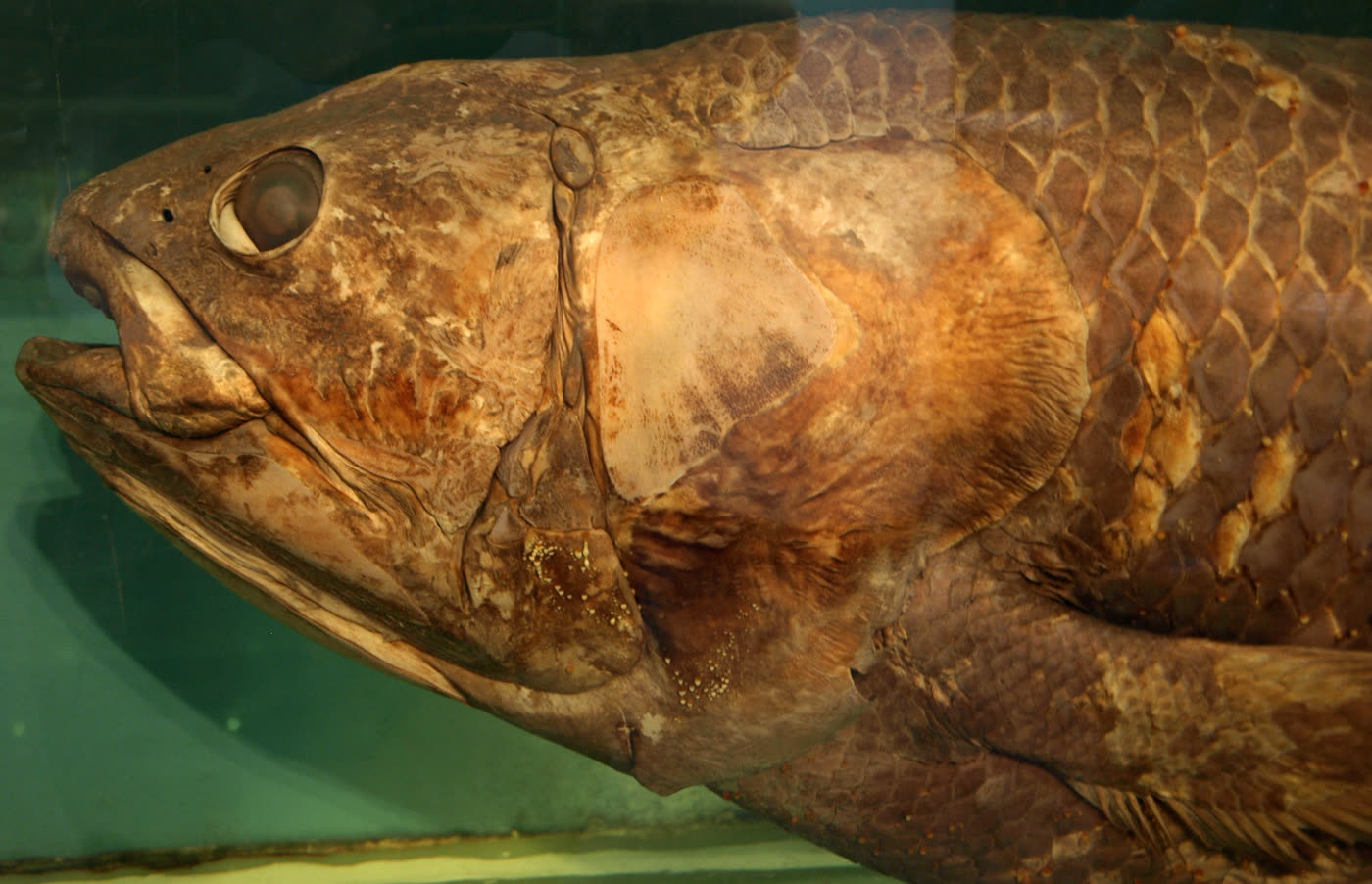
Image context: the cover uses a real photograph of a preserved coelacanth specimen at the Paleozoological Museum of China. That choice matters because this article is not trying to romanticize disappearance and return. It is trying to keep the surviving fish materially present while the argument expands backward through the fossil record.[6]
1) The 1938 rediscovery made the lineage famous, but it also bent the story toward survival theater
The rediscovery of a living coelacanth off South Africa in 1938 deserved the shock it caused.[1] Before that moment, western science knew coelacanths only from fossils and treated them as extinct.[1] The surprise was real. A line that seemed gone after the end-Cretaceous extinction suddenly had living representatives in deep marine caves and steep volcanic-island waters, later joined by the Indonesian species Latimeria menadoensis in the late 1990s.[1]
That public drama, however, imposed a narrative cost. Once the modern fish became the star, the deeper lineage was too often retold as a simple tale of stasis: ancient fish appears, ancient fish barely changes, ancient fish survives.[5] Smithsonian's overview gives the living animal its proper anatomical weight: the rostral organ, the intracranial joint, the fleshy paired fins, and the deep-water ecology are all real and unusual.[1] But those living traits do not authorize the stronger and sloppier claim that coelacanth history is mostly non-history.
The better sequence runs the other way. The rediscovery matters because it returned a surviving actinistian to direct observation. It does not erase the fact that paleontology already had a large fossil archive behind it, nor that this archive contains diversity, disparity shifts, and long stretches of missing information that no single living species can flatten.[2][3][4]
2) The Devonian archive shows that early coelacanth history was broader than the modern body plan suggests
The strongest correction comes from the oldest end of the record. Zhu and colleagues' 2012 Nature Communications paper described the earliest known coelacanth skull and pushed anatomically modern-looking coelacanth cranial structure back into the Early Devonian.[2] That result mattered because it told paleontologists two things at once. First, the coelacanth line was already established early in vertebrate history. Second, familiar-looking coelacanth architecture had deep roots rather than being a late decorative flourish.
That still does not make the lineage static. Clement and colleagues' 2024 Nature Communications study is useful precisely because it measures change instead of repeating the myth.[3] Their paper treats coelacanths as a large fossil radiation, not as a single museum mascot. It identifies a major shift in morphological disparity between Devonian and post-Devonian coelacanths, shows that the clade's peak diversity sat in the Triassic, and argues that discrete character innovation dropped sharply after the mid-Cretaceous even while continuous and meristic characters kept evolving.[3] In other words, later conservatism was real in a bounded sense, but it came after earlier experimentation and restructuring.
This is the point that the phrase "living fossil" usually hides. The living fish resembles some of its later fossil relatives closely enough to encourage shorthand, yet the larger record shows a clade with earlier bursts, different morphospaces, and evolutionary pacing that changed over time.[3][5] A modern coelacanth is not false evidence. It is incomplete evidence when pulled away from the rest of the lineage.
3) The Lower Cretaceous gap matters because it sits right where the road toward Latimeria should become clearer
The new 2026 paper on Macropoma gombessae makes that incompleteness visible in a particularly useful way.[4] Norton and colleagues describe the first diagnostic latimeriid from the Lower Cretaceous, from the Albian Gault Formation of southern England, and use XCT data to show a form that helps narrow a long 50-million-year Mesozoic gap in the fossil record of the family that includes Latimeria.[4] This is not just another named coelacanth. It occupies a strategically important place in the lineage.
The paper's value lies in the kind of transition it documents. Macropoma gombessae already sits close to the latimeriid branch leading toward the living fish, yet it preserves cranial and dermal details that make the path look worked through rather than magically continuous: changes in dermal ornamentation, a narrowed and repositioned supraorbital sensory canal, and increased dentary reduction toward the condition seen in Latimeria.[4] That is exactly what a serious lineage context article needs. It replaces a blank interval with anatomy.
The result also sharpens a useful boundary. Saying that coelacanths are conservative is one thing. Pretending that no informative transitions exist between older Mesozoic forms and living Latimeria is another. The Lower Cretaceous specimen shows that the modern-looking branch still has history inside it.[4]
4) The phrase can still be used, but only if it keeps rate, richness, and survival in balance
The 2022 Frontiers opinion piece by Cavin and Alvarez is helpful here because it takes the term seriously without surrendering to it.[5] Their point is that Darwin's phrase has often been misunderstood as meaning that some organisms somehow do not evolve. Coelacanths fit the label only in a qualified way: they have few living species, a long geological range, and relatively slow morphological rates in important parts of the record, but none of that cancels evolution.[5]
That qualified use is the one worth keeping. Coelacanths did not become famous by fraud. Latimeria really does preserve a body plan that remained conservative in some important respects, especially compared with the explosive experimentation seen elsewhere in vertebrate history.[1][3][5] But the fossil archive insists on better discipline. Early Devonian material shows deep roots for the lineage.[2] Broad disparity studies show that coelacanth history includes distinct phases rather than one endless plateau.[3] The Lower Cretaceous Macropoma paper shows that even the branch nearest the living fish still contains missing transitions that can be recovered and interpreted.[4]
That is the best way to keep the fish and the fossils together. A coelacanth is not a loophole in evolution. It is a lineage in which survivorship, conservatism, and missing data interact so strongly that one surviving species can distort the whole picture if it is allowed to speak alone.[1][3][4][5] Read against the Devonian archive and the Cretaceous gap, Latimeria becomes more interesting than the slogan. It stops being a magical leftover and becomes what paleontology actually needs it to be: one late witness inside a much larger history.
Sources
- Smithsonian Ocean, "Coelacanth" - overview of living coelacanth anatomy, 1938 rediscovery, Indonesian species, and deep-water ecology.
- Min Zhu, Xiaobo Yu, Jing Lu, Tuo Qiao, Wenjin Zhao, and Liantao Jia, "Earliest known coelacanth skull extends the range of anatomically modern coelacanths to the Early Devonian," Nature Communications 3 (2012).
- Alice M. Clement et al., "A Late Devonian coelacanth reconfigures actinistian phylogeny, disparity, and evolutionary dynamics," Nature Communications 15 (2024).
- Jack L. Norton, Emma L. Bernard, Charles Wood, David M. Martill, and Samuel L. A. Cooper, "Oldest Cretaceous latimeriid elucidates cranial evolution in derived and extant coelacanths (Actinistia, Latimeriidae)," Papers in Palaeontology 12(2) (2026).
- Lionel Cavin and Nadir Alvarez, "Why Coelacanths Are Almost 'Living Fossils'?" Frontiers in Ecology and Evolution 10 (2022).
- Wikimedia Commons file page for the preserved coelacanth specimen photograph used as the lead image.