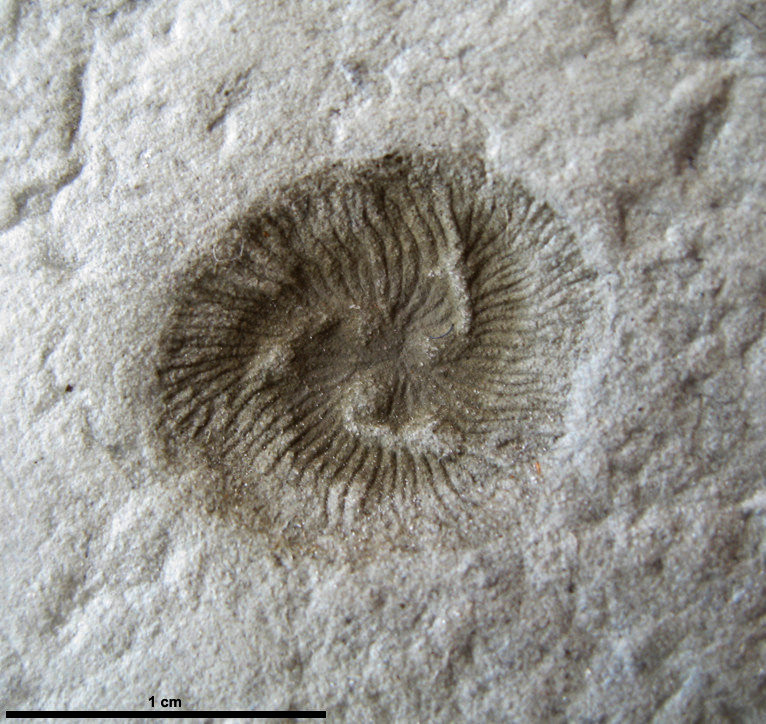
Tribrachidium heraldicum looks like a symbol before it looks like an animal. A small circular Ediacaran fossil, usually only a few centimeters across, carries three curved arms that spiral around a low dome. The pattern is memorable enough that it can trick the eye into finishing the story too early: threefold symmetry, vanished body plan, deep-time oddity. That is the weak version.
The stronger version begins with method. Tribrachidium matters because its strangeness became testable. Paleontologists could ask whether the arms and pits were decorative remnants of a body nobody can classify, or whether they did work in water moving just above an Ediacaran seafloor. Recent computational fluid dynamics did not turn the fossil into a familiar animal. It did something better: it made a weird body plan behave like a physical hypothesis.[1][2]
That is why an anatomy-and-method reading is more useful than a curiosity profile. The point is not simply that Tribrachidium had threefold symmetry, which no living animal phylum neatly repeats. The point is that its anatomy can be broken into parts, modeled, removed, and tested: curved triradial arms, apical pits, bullae, low hemispherical relief, and an inferred position in shallow-marine current regimes.[1][3] The fossil becomes most interesting when the body is treated as a small machine for changing flow, not as a logo from a lost world.
Image context: the cover uses a photographed fossil of Tribrachidium heraldicum from the Arkhangelsk Regional Museum via Wikimedia Commons.[6] That choice keeps the article anchored to the real evidence. The specimen is not a clean diagram; it is a rock surface with enough preserved relief and pattern to invite functional claims, but not enough to let those claims escape testing.
1. Threefold symmetry is the starting problem, not the answer
The 2024 Paleobiology functional-morphology paper describes Tribrachidium as a late Ediacaran organism restricted to the White Sea interval, roughly 558-550 million years ago, best known from South Australia and Russia.[1] It also gives the crucial body description: a broad, low dome, commonly around 2-4 centimeters in diameter, with three curved arms meeting near the apex and spiraling clockwise toward the margin.[1] Between those arms sit three pit-like depressions, called apical pits, and some specimens show additional bulbous structures called bullae.[1]
Those details matter because "triradial" alone is too coarse. The fossil is not merely a circle divided into thirds. Its arms are curved rather than straight. Its pits are positioned between the arms. Its relief is low enough to sit close to the sediment-water interface. Its known occurrences include shallow-marine settings that would have exposed the body to currents rather than to a still laboratory tank.[1][3]
That combination makes the old classification itch less important than the functional question. If an organism has no direct living analogue, it is tempting to spend all the attention asking what modern group it most resembles. Tribrachidium resists that shortcut. The more productive question is narrower: given the shape preserved on the slab, what could this body have done in moving water?
2. The 2015 model made feeding a physical claim
Rahman, Darroch, Racicot, and Laflamme's 2015 Science Advances paper was the first major modern turn in that direction. Using micro-CT-based reconstruction and computational fluid dynamics, they argued that Tribrachidium could have fed by passive suspension feeding. In their model, water flow interacted with the three arms and was redirected toward apical pits, where lower flow could let suspended particles settle out.[2]
That argument was important because it shifted Tribrachidium from "enigmatic Ediacaran body" to "testable hydrodynamic form." Passive suspension feeding is not a personality assigned to the fossil. It is a mechanical proposal: particles in water meet a low-relief body, flow slows or recirculates in particular regions, and food can be collected without an animal actively chasing prey.[2]
The ecological implication is large but bounded. If the model is right, the late Ediacaran seafloor already supported macroscopic animals or animal-grade organisms exploiting suspended food in a structured way. That means the ecosystem was not only a mat-grazing surface or a quiet display of soft-bodied forms. It included organisms interacting with moving water, particulate food, and near-bottom flow regimes.[2][5]
Still, the 2015 result did not close the case. The model depended on reconstructed anatomy, assumptions about flow, and simplifications needed to make the simulation manageable. That is not a flaw unique to this fossil; it is the price of turning compressed deep-time anatomy into physics. The useful standard is not whether the first model was final. It is whether later work could test which parts of the body actually mattered.
3. The 2024 reset asked which structures did the work
The 2024 Paleobiology study is valuable because it did not merely rerun the old idea with more computing power.[1] It built more anatomically accurate digital models and then used a series of hypothetical versions, removing or altering features such as the apical pits, arms, and bullae. That makes the logic sharper. If the whole organism changes flow, which features are responsible?
The answer is not evenly distributed. The authors found that apical pits were crucial for producing slow countercurrent flow that helped particle deposition, while the precise pit shape mattered less.[1] The triradial arms interrupted ambient flow and helped create the hydrodynamic conditions needed for particles to settle.[1] The bullae, by contrast, did not appear to influence feeding flow in a major way.[1]
That is exactly the kind of result paleontology needs for an organism like this. It separates visible structures from functional structures. A feature can be conspicuous and still not drive the main feeding interpretation. Another feature can be small, like the apical pits, and turn out to be central because it changes flow at the scale where food capture would occur.[1]
The methodological lesson is portable. Famous fossils often get reduced to one visual hook: a dome, a frond, a shell, a claw, a tooth row. Tribrachidium shows why that is too rough. Anatomy has to be partitioned. The fossil should be asked not only "what do you look like?" but "which preserved parts change the physical model when they are removed?"
4. Paleoecology keeps the model from floating free
Functional models become weaker when they detach from rock context. Tribrachidium is useful because the paleoecological data pull the simulation back to a real seafloor. Hall, Droser, and Gehling's 2015 study of South Australian material describes Tribrachidium as common in the Ediacara Member, patchily distributed across the seafloor, and able to occur across a wide variety of environments.[3] The same work treated body-size distributions as evidence for population cohorts, which keeps the fossil from reading as a few isolated oddities.[3]
The 2024 functional paper also emphasizes that Tribrachidium occurs in multiple shallow-marine depositional settings at Nilpena, including shoreface sands, wave-base sands, delta-front sands, and sheet-flow sands.[1] That range matters. A low dome that can feed without needing a fixed orientation to current would make sense in settings where flow direction and energy changed. A triradial body may have been a way to remain physically stable and still exploit suspended food close to the microbial mat surface.[1][5]
This is where the fossil becomes less alien, not because it resembles a living animal, but because it solves recognizable environmental problems. Stay low enough not to be easily dislodged. Interrupt flow enough to create settlement zones. Collect particles at repeated loci. Function in shifting current directions. The body plan is extinct, but the engineering pressures are ordinary.
5. A second species makes the body plan less like a one-off trick
The newer taxonomy also matters. Botha and García-Bellido described Tribrachidium gehlingi from Nilpena Ediacara National Park in 2024, arguing that its differences from T. heraldicum were statistically significant and not simply the product of taphonomic distortion.[4] That result changes the tone of the genus. Tribrachidium is no longer only an iconic single form with a famous geometry. It becomes a small diversity problem inside the Ediacaran record.
The article's implications section makes the functional point explicit: a spiraling triradial body plan may have contributed to the genus's success by directing water flow to localized regions without requiring the organism to orient itself to current direction.[4] That sentence is powerful because it joins taxonomy and function. More than one species within the same general body plan suggests that the shape was not just a freak preservation accident or an evolutionary dead scribble. It may have been a working morphology with enough ecological payoff to diversify locally.[4]
The boundary remains important. This does not prove that all triradial Ediacaran organisms fed the same way. The 2024 functional paper says broader application of the model should be tested with additional CFD analyses, facies work, and reexamination of well-preserved specimens.[1] That caution is the right ending. Tribrachidium should expand the question, not become a universal key.
Why the fossil still matters
The best current reading of Tribrachidium is therefore neither mystery worship nor overconfident solution. It was a low-relief, triradial Ediacaran organism, probably living on shallow-marine seafloors where microbial mats, currents, and suspended particles shaped opportunity.[1][2][3][5] Its three curved arms and apical pits are not just visual oddities. In modern models, they are the parts that make passive suspension feeding physically plausible.[1][2]
That makes Tribrachidium a compact example of mature paleontology. A strange fossil becomes stronger when it is made less vague: specimen relief, sedimentary setting, population distribution, digital modeling, feature-removal experiments, and taxonomic revision all constrain one another. The animal remains hard to place in a familiar branch of life. But it no longer has to sit as a decorative enigma. Its threefold symmetry becomes a working problem in flow.
Sources
- A. Olaru et al., "Functional morphology of the Ediacaran organism Tribrachidium heraldicum," Paleobiology 50, no. 3 (2024) - CFD feature-testing of apical pits, arms, bullae, and particle settling.
- Imran A. Rahman, Simon A. F. Darroch, Rachel A. Racicot, and Marc Laflamme, "Suspension feeding in the enigmatic Ediacaran organism Tribrachidium demonstrates complexity of Neoproterozoic ecosystems," Science Advances 1, no. 10 (2015).
- Mary L. Hall, Mary L. Droser, and James G. Gehling, "Paleoecology of the enigmatic Tribrachidium: New data from the Ediacaran of South Australia," Precambrian Research 269 (2015).
- Tory L. Botha and Diego C. García-Bellido, "A new species of the iconic triradial Ediacaran genus Tribrachidium from Nilpena Ediacara National Park, Flinders Ranges (South Australia)," Journal of Paleontology 98, no. 1 (2024).
- Kelsie Cracknell et al., "Pentaradial eukaryote suggests expansion of suspension feeding in White Sea-aged Ediacaran communities," Scientific Reports 11 (2021) - broader context for low-tier Ediacaran suspension feeding and hemispherical body plans.
- Wikimedia Commons, "File:Tribrachidium.jpg" - source page for the real photographed fossil of Tribrachidium heraldicum from the Arkhangelsk Regional Museum used as the article image.