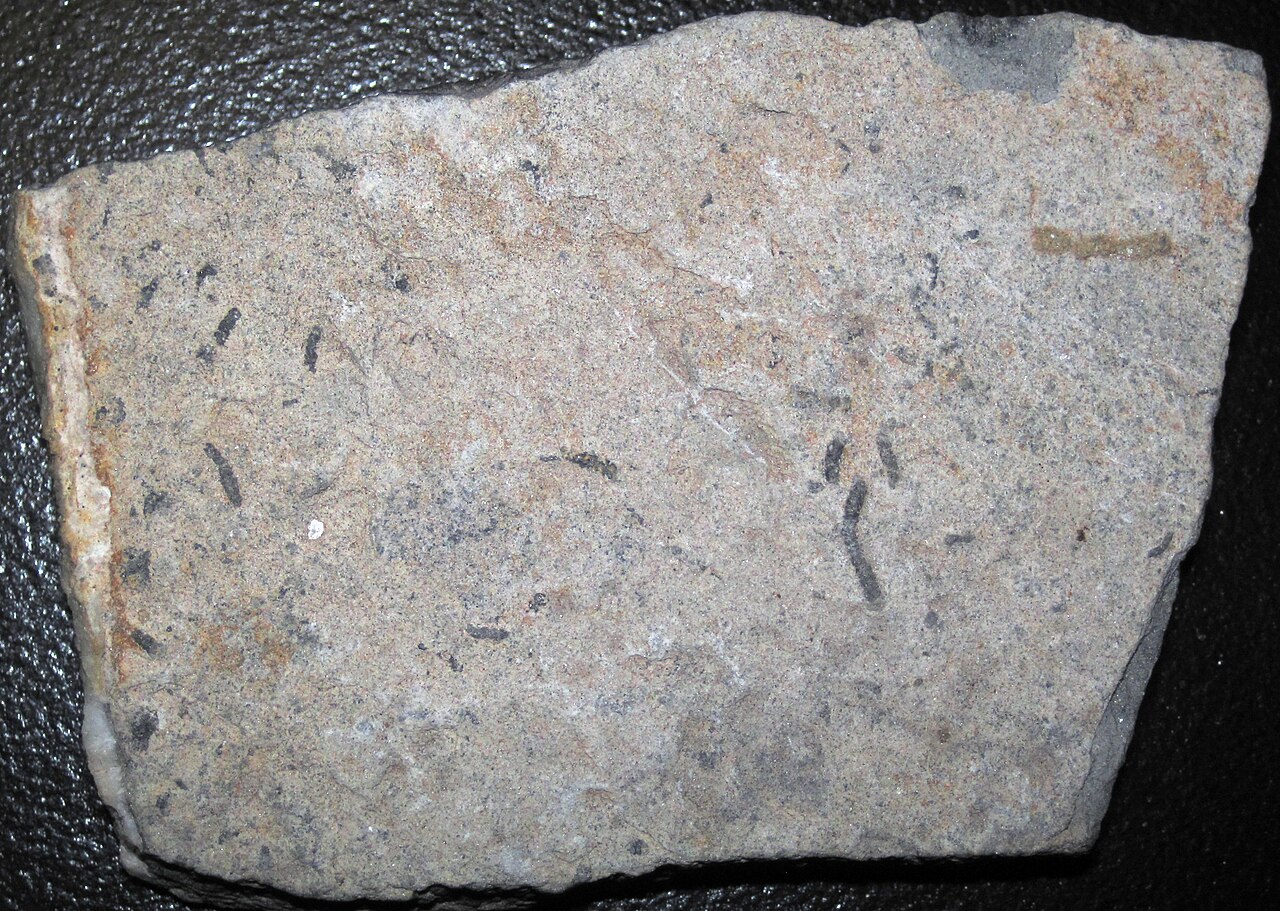
Cloudina is easy to overstate because it arrives at a spectacular boundary. It lived near the end of the Ediacaran Period, roughly around the last ten million years before the Cambrian, when animal life was becoming easier to see in rock because bodies, traces, and shells were beginning to leave more durable records.[1][4] That makes the fossil tempting to turn into a slogan: first shells, first armor, first arms race.
The better reading is narrower and more interesting. Cloudina matters because it sits exactly where biology and preservation begin to interfere with each other. Its tube was real structure. Its shell or shell-like wall helped make a small animal unusually visible in late Precambrian limestone. But the same mineralization, cement, breakage, transport, and replacement that saved it also complicate every claim about how it lived.[1][5]
So the strongest theme is not "armor appears and the Cambrian begins." It is that one small tubular fossil forces paleontology to keep three questions in the same frame: what did the animal build, what was acting on it, and how much of what we see is a later geological edit?
Image context: the cover uses a photographed Cloudina-bearing slab from Brazil.[6] It is intentionally specimen-first rather than reconstruction-first. The article's argument depends on seeing Cloudina as small, embedded, and preservationally mediated: dark tubular traces inside carbonate, not a clean creature floating free of rock.
1. The tube made the animal global, but not simple
The classic reason Cloudina became important is its distribution and architecture. Grant's 1990 treatment, indexed by NASA, describes Cloudina-bearing deposits in Namibia and notes related occurrences from Brazil, Spain, China, and Oman, making the animal useful as a terminal Proterozoic marker rather than a local curiosity.[1] That matters because paleontology rarely gets global visibility for late Ediacaran animals. Soft-bodied impressions can be spectacular, but they are strongly tied to particular modes of preservation. Cloudina traveled through carbonate systems.
The animal's famous construction also matters. Grant described curved to sinuous, multi-layered tubular shells built from successive slightly flaring layers, with open and closed ends arranged in a nested way.[1] Later work by Shore and Wood keeps the basic image but adds more caution: Cloudina has a tubular funnel-in-funnel form built of thin laminae, yet wall thickness, curvature, and internal cements vary across environments and preservational histories.[5]
That is the first boundary. The fossil is not a vague smear. It has repeatable architecture. But it is also not a clean engineering drawing of a living animal. The tube entered the record through carbonate precipitation, early cement, deformation, breakage, and replacement. The shell made Cloudina readable; the shell also became the place where the reading can go wrong.
2. The holes are real evidence, not just drama
The most vivid reason Cloudina keeps returning to origin-of-skeleton debates is predation. Hua, Pratt, and Zhang's 2003 study of Chinese material reported that nearly one-fifth of almost one hundred Cloudina tubes were pierced by small predatory borings, while co-occurring Sinotubulites specimens were not affected in the same way.[2] The point is not just that something made holes. The point is selectivity: a trace-maker interacted with one kind of tube differently from another.
That is a stronger claim than a generic "danger made shells" story. The boring sizes, their placement, and the contrast with Sinotubulites make the evidence behavioral enough to matter.[2] They imply an ecological world in which one organism was targeting another with enough consistency that the fossil record caught the interaction. The predator is still unknown, and the exact mechanics remain limited by preservation. But Cloudina is not merely a passive first shell. It carries a trace of pressure.
Brazilian material keeps that pressure inside a broader habitat rather than isolating it as a single dramatic event. Becker-Kerber and colleagues linked Cloudina from the Tamengo Formation to microbial mats, close organismal associations, and possible shell damage, arguing that the rise of biomineralization should be read through ecological interactions as well as mineral chemistry.[3] That context matters. A shell is not only a shield. It is also a way to occupy space, attach, stand in currents, endure sediment, and persist in microbial-carbonate settings.
The armor myth fails because it asks one function to explain the whole fossil. Predation may have been a real selective pressure. The borings make that hard to ignore.[2][3] But the tube was also part of feeding posture, growth, settlement, and the chemistry of a carbonate seafloor. Cloudina becomes more convincing when the shell is allowed to be multifunctional.
3. The body inside the tube keeps changing the question
For a long time, Cloudina and its relatives were difficult because the tube did almost all the speaking. External architecture could suggest an animal-grade organism, but it did not by itself settle affinity. Schiffbauer and colleagues state the problem plainly in their 2020 Nature Communications paper: interpretations had largely centered on external tubes because diagnostic internal features were scarce.[4]
Their tomographic work on cloudinomorphs from Nevada reported internal cylindrical structures that may be digestive tracts. The authors were careful: alternative interpretations remain possible. But if the structures are correctly read as one-way through-guts, they would provide important evidence for bilaterian affinity in these terminal Ediacaran tube dwellers.[4] That is exactly the right kind of caution for Cloudina-adjacent fossils. The finding does not magically turn every old tube into a modern worm. It changes the kind of question one can ask.
This is where Cloudina becomes a preservation problem in the productive sense. A tube alone can make a fossil abundant and index-like. Internal anatomy, when preserved, can shift the biological interpretation. But both are filtered by mineral replacement and taphonomy. Shore and Wood emphasize that it can be difficult to decide whether particular cements formed during life, after death, or in regions abandoned by soft tissue as the animal grew.[5] That ambiguity is not a weakness to hide. It is the discipline the fossil demands.
4. Taxonomy is part of the evidence, not housekeeping
Because late Ediacaran tubular fossils look deceptively similar, naming is not just administrative cleanup. The 2022 taxonomic revision of Cloudina, Sinotubulites, and Conotubus proposed a Cloudina hartmannae Interval Zone for the terminal Ediacaran, but it did so after sorting type material and separating superficially similar collared or annulated tubes.[7] That is a useful reminder: global index value depends on taxonomic discipline.
If the fossil is misassigned, the ecological story can drift. A predatory boring pattern on one taxon cannot be casually transferred to another. A tube cluster that looks like reef framework may prove to be transported material. A wall texture that looks primary may carry a diagenetic overprint.[2][5][7] Cloudina is powerful exactly because it forces those distinctions into the open.
That makes it a better fossil than the mythic version. The simplified story says: animals invented hard parts because predators arrived. The more useful story says: by the terminal Ediacaran, some animals or animal-grade tube dwellers were building repeated mineralized structures, living in carbonate-microbial settings, facing traceable biological interactions, and entering a fossil record that could preserve them widely but not transparently.[1][2][3][4][5]
That is why Cloudina still matters. It is not a mascot for a single first. It is a boundary object. It sits between soft Ediacaran worlds and the shell-rich Cambrian, between ecology and diagenesis, between global correlation and local rock texture. Read that way, the fossil does not make early animal evolution simpler. It makes the right complications visible.
Sources
- S. W. Grant, "Shell structure and distribution of Cloudina, a potential index fossil for the terminal Proterozoic," NASA Technical Reports Server record for American Journal of Science reprint (1990).
- H. Hua, B. R. Pratt, and L. Zhang, "Borings in Cloudina Shells: Complex Predator-Prey Dynamics in the Terminal Neoproterozoic," Palaios 18 (2003), Geokirjandus reference page with abstract and DOI.
- B. Becker-Kerber et al., "Ecological interactions in Cloudina from the Ediacaran of Brazil: implications for the rise of animal biomineralization," Scientific Reports 7 (2017).
- James D. Schiffbauer et al., "Discovery of bilaterian-type through-guts in cloudinomorphs from the terminal Ediacaran Period," Nature Communications 11 (2020).
- Amy Shore and Rachel Wood, "Environmental and diagenetic controls on the morphology and calcification of the Ediacaran metazoan Cloudina," Scientific Reports 11 (2021).
- Wikimedia Commons, "File:Cloudina fossils (Neoproterozoic; Corumba, Brazil) (45453979394).jpg" - source page for the real fossil photograph used as the article image.
- Ben Yang, Lucas V. Warren, Michael Steiner, Emily F. Smith, and Pengju Liu, "Taxonomic revision of Ediacaran tubular fossils: Cloudina, Sinotubulites and Conotubus," Journal of Paleontology 96 (2022).