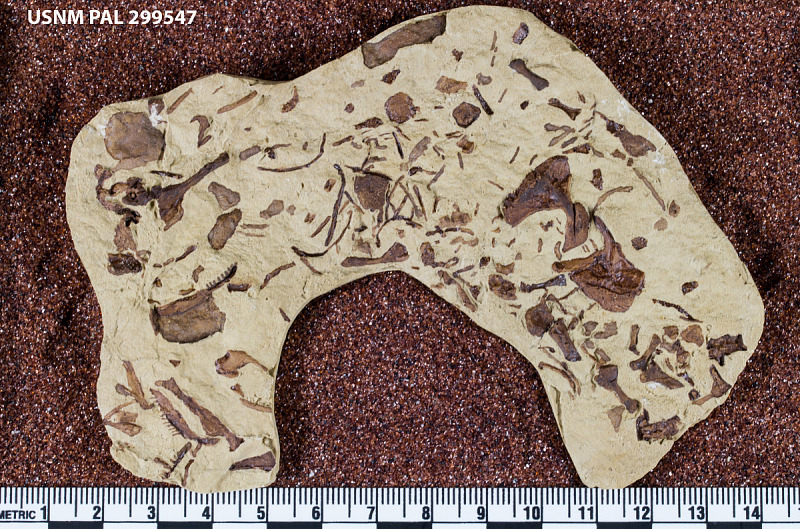
Hylonomus lyelli is often introduced as if it were a medal pinned to deep time: the earliest reptile, the little animal that made land finally belong to amniotes. That version is memorable, but it makes the fossil too clean. Hylonomus matters more when it is kept inside the place that preserved it. The animal is not just a name on the reptile family tree. It is a Joggins fossil, tied to upright coal-forest trunks, hollow lycopsid stumps, seasonal disturbance, and the awkward evidentiary problem of recognizing the first amniotes from bones alone.[1][2][4]
The official Joggins history page gives the discovery its nineteenth-century frame: in 1859, William Dawson reported Hylonomus lyelli, the "forest dweller" named for Charles Lyell, from the Coal Age cliffs of Nova Scotia.[1] Later work on Dawson's collections and related Joggins material made the site's small tetrapods central to the early amniote story.[1] That is the durable public hook. Yet the better profile begins one step lower, with the fossil setting. These animals came from a world of standing fossil trees and sediment-filled hollows, not from a complete skeleton laid out on an open bedding plane like a textbook diagram.[1][2]
Image context: the cover uses a photographed Smithsonian specimen of Hylonomus lyelli via Wikimedia Commons.[5] The image is deliberately a fossil photograph rather than a life reconstruction, because the article's argument depends on scale, preservation, and evidentiary limits. The slab keeps the animal small and partial, which is exactly how the early amniote signal should be read.
1. The tree hollow is part of the specimen's meaning
Joggins is famous because erosion along the Bay of Fundy exposes a long, layered Carboniferous archive. A review of recent research describes the site as preserving more than 200 recovered species, including the world-famous Hylonomus, the land snail Dendropupa, Arthropleura tracks, upright lycopsid and cordaite trees, and a wider food web of plants, invertebrates, and tetrapods.[2] That context matters because Hylonomus did not become important as an isolated curiosity. It became important because Joggins preserved a terrestrial ecosystem in enough detail to make the first amniote problem environmental rather than purely anatomical.
The tree hollows are the crucial part. The same review explains that upright, sediment-filled trunks contain some of the best-known Joggins discoveries, including Hylonomus.[2] Several scenarios have been proposed for how animals entered those hollows: they may have used them as dens, been washed in after death, or fallen into partially buried trunks as pitfall traps.[2] None of those options should be turned into a tiny drama with too much certainty. The point is stronger and simpler: the animal's preservation was controlled by forest architecture and floodplain process. A coal-forest trunk became a container, and that container made a small vertebrate legible across more than 300 million years.
That is why "forest dweller" is not just a charming name. It is an interpretive warning. A small amniote in a hollow stump is not evidence for a triumphant conquest of dry land by itself. It is evidence for an animal living within a complex terrestrial setting: rotting trunks, standing trees, fires or floods, invertebrate prey, and sediment pulses that could seal a microhabitat quickly enough to preserve bones.[1][2]
2. The reptile label is useful, but it should not do all the work
The public phrase "earliest reptile" is not wrong as a historical framing, but it can flatten the science. Smithson's 1989 Nature article opens by noting why early amniotes are hard to identify: the living group is defined by embryonic membranes, while fossils usually give paleontologists bones, not soft reproductive biology.[4] That gap is the central difficulty. The earliest amniote boundary has to be inferred from skeletal characters, stratigraphy, and comparison, even though the defining living trait is not directly fossilized.[4]
That is where Hylonomus becomes scientifically interesting. The fossil sits near the base of the reptile or sauropsid side of the amniote radiation in many discussions, but its real value is not that it lets a reader chant "first reptile" and move on.[3][4] Its value is that it shows how small and unspectacular the early amniote body could be. This was not a sail-backed predator, a giant lizard, or a dinosaur ancestor in any useful popular sense. It was a small Carboniferous tetrapod whose body plan has to be read through the cautious grammar of early amniote anatomy.[3][4]
The 2021 review of reptile origins is helpful because it keeps track and body-fossil evidence in conversation. It notes that Hylonomus lyelli and the oldest reptile-footprint discussion both come from the Joggins Formation, while also showing why trackmaker attribution is difficult when similar foot morphologies can occur across early reptile-grade groups.[3] That caution should carry back to the skeleton. Early reptile history is not a single specimen handing over a finished identity card. It is a sparse record where bones, footprints, and local stratigraphy each narrow the answer without making the origin moment perfectly tidy.[3][4]
3. Small body, large evolutionary boundary
The scale of Hylonomus is part of its force. It does not announce itself like a later reptile radiation. It asks a subtler question: what changes when a small tetrapod belongs to a lineage that no longer has to tie reproduction to water in the amphibian way? The fossil cannot show an egg or an amnion directly, but it sits in the skeletal and geological neighborhood where that evolutionary shift becomes visible enough to discuss.[3][4]
This is the boundary that the species profile should protect. Hylonomus is not important because it looks modern. It is important because it lets paleontologists place a small, land-living amniote-grade animal inside a real Carboniferous ecosystem.[1][2][3] Once that happens, the origin of reptiles stops being an abstract branching diagram. It becomes a set of practical problems: how small vertebrates moved through forest-floor spaces, how they interacted with invertebrate-rich habitats, how flooding and hollow trunks filtered the record, and how sparse skeletal traits can be used to recognize a lineage whose key reproductive innovation is almost never preserved.[2][3][4]
That also keeps the animal from becoming a mascot for inevitability. Nothing about the Joggins fossil says that reptiles, birds, dinosaurs, and mammals were already waiting in miniature inside one stump. The better reading is less theatrical. Hylonomus shows that early amniote history began in animals small enough to disappear into forest debris and preservation traps, yet consequential enough that their bones now anchor one of vertebrate evolution's major thresholds.[1][2][4]
4. Why Hylonomus still holds up
The strongest modern profile of Hylonomus is therefore a profile of scale and context. It is a named Dawson fossil from Joggins, historically tied to Lyell and to the development of Carboniferous geology.[1] It is part of a tree-hollow fauna shaped by upright lycopsids, sediment-filled trunks, flooding, fire-prone landscapes, and several plausible pathways into preservation.[2] It is also an early reptile or sauropsid signal whose classification matters precisely because early amniotes are difficult to recognize from skeletal remains alone.[3][4]
Put those layers together and the slogan improves. Hylonomus is not merely "the first reptile." It is a small fossil that makes the first-reptile claim answer to a place, a trap, and a method. The tree stump keeps the story honest. It reminds us that major evolutionary boundaries often reach us through ordinary-looking accidents of preservation: a hollow trunk, a flood pulse, a few bones, and enough anatomical signal to make a tiny forest animal carry a very large piece of vertebrate history.
Sources
- Joggins Fossil Cliffs, "Historical research" - official history page covering Dawson, Lyell, Hylonomus lyelli, and the Joggins tetrapod record.
- Melissa Grey and John H. Calder, "The Joggins Fossil Cliffs UNESCO World Heritage site: a review of recent research," Atlantic Geology 47 (2011) - site ecology, tree-hollow fauna, and preservation scenarios.
- Lorenzo Marchetti et al., "Tracking the Origin and Early Evolution of Reptiles," Frontiers in Ecology and Evolution 9 (2021) - early reptile body and footprint evidence, including Joggins context.
- T. R. Smithson, "The earliest known reptile," Nature 342 (1989) - amniote-recognition problem and historical placement of Hylonomus in the early fossil record.
- Wikimedia Commons file page, "Hylonomus lyelli.jpg" - photographed Smithsonian specimen used as the article image.