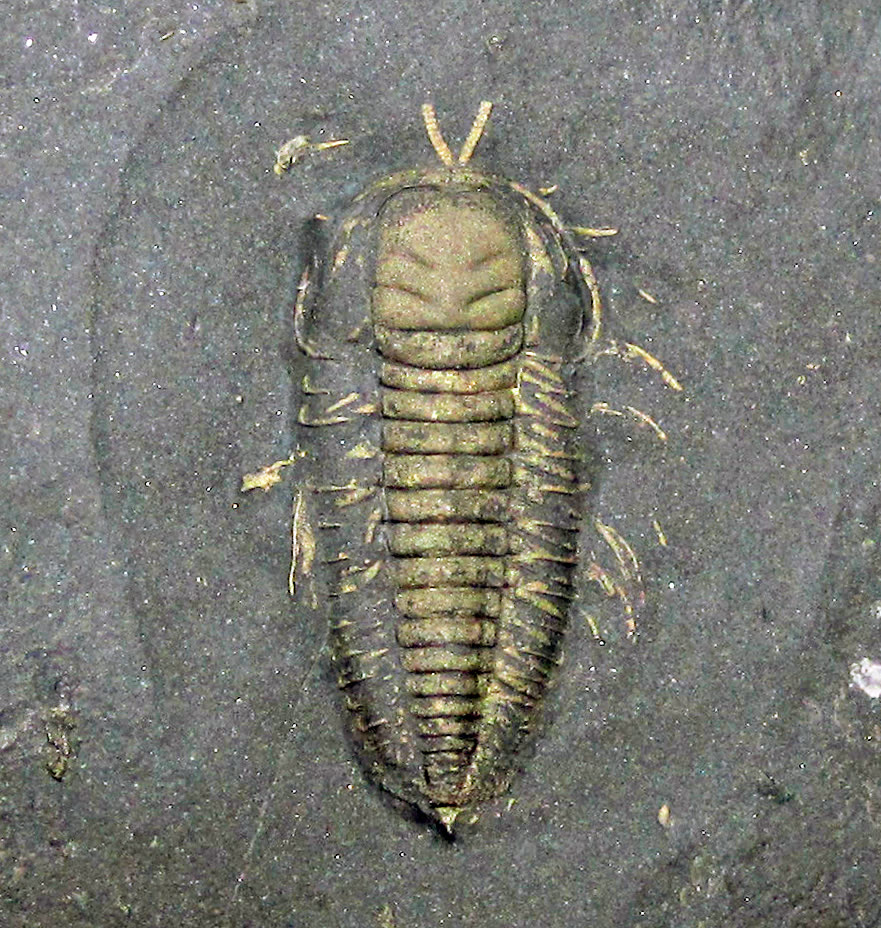
Triarthrus eatoni is not the trilobite to choose if the goal is size, armor drama, or museum spectacle. Its power is smaller and sharper. At Beecher's Trilobite Bed and related New York horizons, pyrite preserved parts of the animal that ordinary trilobite fossils almost always lose: antennae, legs, gill branches, delicate filaments, and traces of the soft underside.[1] That makes Triarthrus one of the clearest cases where the fossil record did not merely add another trilobite species. It changed what a trilobite could be anatomically.
The shell had never been the whole animal. Trilobite exoskeletons are common because calcite survives well; the underside, appendages, and respiratory surfaces usually do not. The usual fossil therefore invites a dorsal reading: head shield, thoracic segments, pygidium, spines, eyes, enrollment, and moulting. Triarthrus breaks that habit. The useful question is not simply what its shell looked like, but what happened when pyrite made the hidden operating system visible.[1][2]
The specimen in the lead image is a real photographed Triarthrus eatoni fossil from the Upper Ordovician Whetstone Gulf Formation of New York, a Beecher-type pyritized preservation setting. Its axial length is only about 1.2 centimeters, yet the bright mineral traces around the body turn it into a whole-animal document rather than a shell plate.[6] That scale is part of the point. The fossil is not impressive because it is large. It is impressive because tiny structures survived with enough contrast to be argued over.
The first method lesson is chemical
Beecher's Bed is famous because preservation moved fast enough, and chemically enough, to replace soft anatomy with pyrite before decay and collapse erased it.[1][3] Yale Peabody summarizes the locality as a thin shale layer in central New York, only a few centimeters thick, where mainly Triarthrus eatoni specimens preserve soft parts by pyritization.[1] The bed and related sites are Ordovician, about 450 million years old.[1] That is not just a date. It is a reminder that this is not Cambrian exceptional preservation doing the usual Burgess Shale work. This is a later Paleozoic record with its own chemistry.
The classic 1991 geochemical study by Briggs, Bottrell, and Raiswell treated Beecher's Bed as a problem in sulfur, iron, decay, and early mineral replacement.[3] The broader lesson is that pyrite preservation is not a magic coating applied after the fact. It depends on microbial decay, available iron, sulfur chemistry, burial conditions, and the timing of mineral growth relative to tissue breakdown.[3][5] If the mineral forms too late, the legs and gill filaments are gone. If the sedimentary setting is wrong, the animal returns to the normal trilobite record: shell, fragments, moult pieces, and silence underneath.
That chemical gate matters because it defines the evidence. The golden appendages are not decorative shine. They are a preservational event. Every anatomical claim about Triarthrus has to pass through that event, which means the article cannot treat the fossil as a transparent living body. It is a mineralized record of soft parts, produced under unusual conditions. Strong inference begins there.
The second lesson is that legs and gills share the frame
Whittington and Almond's 1987 study remains central because it used the preserved appendages to reconstruct how Triarthrus worked as an animal.[2] Their radiographic work on more than 100 specimens let them examine the exoskeleton, soft anatomy, and habits rather than relying on the dorsal shield alone.[2] This is exactly why Triarthrus became a textbook anatomy fossil. It allowed the same body to be read from above and below.
The basic package is an arthropod one: antennae at the front, repeated limbs along the body, and a segmented trunk. But the important detail is that those limbs are not simple walking sticks. Trilobite appendages are biramous, with a lower walking branch and an upper branch historically discussed as a gill-bearing structure.[2][4] In Triarthrus, pyritization made that upper branch visible enough for later workers to return to the old respiratory question with new imaging.
That question sharpened in 2021, when Hou, Hughes, and Hopkins argued in Science Advances that the trilobite upper limb branch was a well-developed gill.[4] Their study used exceptionally preserved Triarthrus eatoni and other material to show that dumbbell-shaped filaments in the upper limb branch are morphologically comparable with respiratory structures that aerate blood in living arthropods.[4] The conclusion matters because it turns an old phrase, "gill branch," into a better-supported functional claim.
The point is not that Triarthrus suddenly became modern. It did not. The point is stricter: the upper limb branch was not just a vague fringe or a swimming ornament. It carried repeated fine structures in the right anatomical position and form to support a respiratory interpretation.[4] That makes the animal easier to understand as a working seafloor arthropod. Walking, feeding, and breathing were crowded into a repeated limb system tucked under the shield.
The third lesson is ecological, but only after anatomy
It is tempting to turn Triarthrus immediately into a low-oxygen specialist. Olenid trilobites are often associated with deep-water, low-oxygen environments, and Yale's account emphasizes that the Beecher setting had low diversity and fluctuating bottom-water oxygen conditions.[1] Farrell, Briggs, and Gaines extended that ecological discussion by comparing Beecher's Bed with other pyritized sites and testing how Triarthrus fits into low-oxygen, possibly borderline sulfidic settings.[5]
The anatomical evidence gives that ecology teeth. If the upper limb branches really functioned as gills, then the location and structure of those respiratory surfaces matter for how the animal lived close to the sediment-water interface.[4] But the article should not overreach. Preserved gill filaments do not prove a single lifestyle by themselves. Low-oxygen tolerance, possible chemosymbiotic ideas, sediment disturbance, rapid burial, and community composition are separate claims that have to be handled with the bed's sedimentology and geochemistry, not with one body part alone.[1][5]
That is why Triarthrus is best read as an anatomy-and-method fossil rather than as a simple ecology mascot. Its body makes ecological hypotheses possible, but the strongest claims keep the levels separate: pyritization explains why soft anatomy is available; appendage studies explain what the limbs were doing; sedimentology and fossil assemblages explain the environmental setting.[1][2][3][4][5]
Why the small fossil still matters
The most durable value of Triarthrus eatoni is that it disciplines trilobite imagination. Trilobites are easy to picture as armored ovals, elegant eyes, and segmented backs. Those features are real, but they bias the reader toward the mineralized side of the animal. Triarthrus pulls the underside back into view. The antennae matter. The walking legs matter. The upper limb branches matter. The gill filaments matter. The chemistry that preserved them matters just as much.[1][2][4]
The boundary is equally important. A pyritized fossil is not a living animal returned without loss. It is a selective record made by decay and mineral growth. Some tissues are emphasized, others are blurred, and the specimen's golden clarity can make interpretation feel easier than it is. The correct lesson is not "pyrite solves trilobites." The correct lesson is that pyrite gives paleontologists a rare chance to test trilobite anatomy against structures that are usually absent.
That chance changed the animal. Once the legs and gills enter the argument, Triarthrus stops being another Ordovician shell and becomes a compact model of how paleontology improves. A fossil that looked like a small dark slab with golden traces became evidence for limb organization, breathing surfaces, burial chemistry, and low-oxygen seafloor life. The body was always there. Beecher-type pyritization made it readable.
Sources
- Yale Peabody Museum, "Beecher's Bed Trilobites" - institutional overview of the locality, pyritized soft tissues, Triarthrus eatoni, Ordovician age, and low-oxygen setting.
- H. B. Whittington and J. E. Almond, "Appendages and habits of the Upper Ordovician trilobite Triarthrus eatoni," Philosophical Transactions of the Royal Society B 317 (1987), Crossref DOI record.
- Derek E. G. Briggs, Simon H. Bottrell, and Robert Raiswell, "Pyritization of soft-bodied fossils: Beecher's Trilobite Bed, Upper Ordovician, New York State," Geology 19 (1991), University of Bristol publication record.
- Jin-bo Hou, Nigel C. Hughes, and Melanie J. Hopkins, "The trilobite upper limb branch is a well-developed gill," Science Advances 7 (2021), PubMed record.
- Una C. Farrell, Derek E. G. Briggs, and Robert R. Gaines, "Paleoecology of the olenid trilobite Triarthrus: new evidence from Beecher's Trilobite Bed and other sites of pyritization," PALAIOS 26 (2011).
- Wikimedia Commons file page for the photographed pyritized Triarthrus eatoni fossil used as the article image.