Halszkaraptor escuilliei is the kind of fossil that can get ruined by a nickname. Call it a duck-raptor and the animal becomes a punchline: a little predatory dinosaur with a long neck, a flattened snout, and a body plan that seems to have wandered into the wrong ecosystem. The better reading is stricter and more interesting. Halszkaraptor matters because every tempting story about it has to pass through the fossil's chain of evidence: illegal-market provenance, an articulated skeleton, synchrotron scanning, snout anatomy, forelimb and shoulder structure, and a debate over how far aquatic behavior can be inferred from bone.[1][2][3]
That makes this a fossil-find close reading rather than a species-card profile. The specimen is not merely unusual. It is unusual in a way that forces method into the foreground. Before anyone can ask whether this Late Cretaceous Mongolian dromaeosaur was comfortable near water, the specimen itself has to be made trustworthy. Before the flattened snout can be treated as a feeding signal, it has to be separated from damage, montage, and wishful comparison. Before the long neck becomes a swan-like silhouette, it has to remain a cervical series in a real dinosaur skeleton.[1][2]
The fossil had to earn its integrity first
The 2017 description by Andrea Cau and colleagues placed Halszkaraptor inside Dromaeosauridae, the group that includes more familiar animals such as Velociraptor and Deinonychus, but it did not arrive through the comfortable path of a documented museum excavation. The ESRF account describes the specimen as a Mongolian fossil that had passed through private hands before it was returned to Mongolia, a provenance problem that matters because spectacular fossils on the commercial market can be altered, combined, or stripped of field context.[2]
That history is not a side issue. It is part of why the scan matters. The Nature paper used synchrotron multi-resolution X-ray microtomography to inspect the specimen internally and test whether the bones belonged together rather than to a fabricated composite.[1] The point was not to make a prettier picture. It was to establish that the strange body plan could be argued from hidden anatomy, not just from surface display. In a fossil this odd, authenticity is not background paperwork. It is the first anatomical claim.
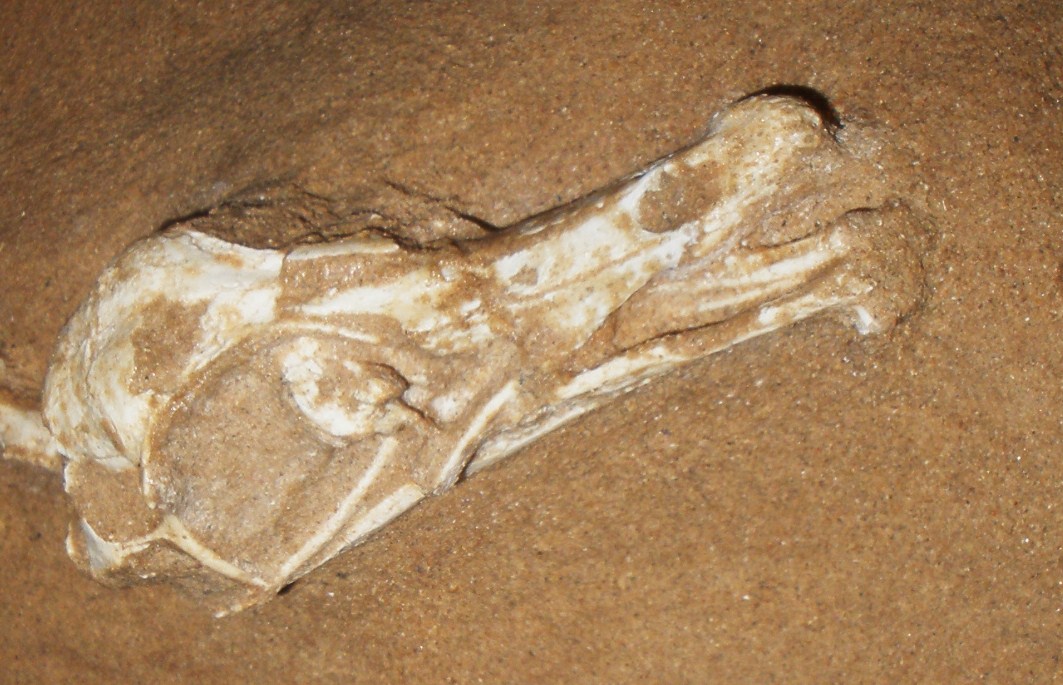
The image used here keeps that discipline visible. It is a photograph of the fossil skull, not a digital restoration or a swimming scene. That matters because Halszkaraptor is easiest to oversell when the interpretation comes before the object. The fossil itself is compact, compressed, and specific. The article's job is to keep the interpretation attached to that object.
The snout pulls the argument toward water
The feature that makes Halszkaraptor hard to ignore is the head-and-neck package. The original description emphasized a long neck, a flattened snout, numerous small teeth, and an enlarged neurovascular network in the rostrum.[1] Those traits led Cau and colleagues to argue for an amphibious ecology, with the snout and sensory system potentially useful for detecting prey in water and the body combining terrestrial and aquatic signals.[1]
That inference is plausible enough to matter, but it is not the same as watching the animal swim. The fossil does not preserve behavior. It preserves structures that resemble useful parts of aquatic or semi-aquatic feeding systems: a low, elongated snout; dense tooth rows; sensory channels; a neck that could reach and strike differently from the short-necked predator stereotype.[1] Those features change the range of possible lifestyles, but they do not give permission to turn Halszkaraptor into a Cretaceous cormorant with sickle claws.
This boundary is where the fossil becomes useful. Dromaeosaurs are often introduced through running, grasping, slashing, and predation on land. Halszkaraptor keeps the predatory dinosaur frame, but it bends the front end of the animal toward a different feeding problem. The mouth does not look built for the same mechanics as a deep-snouted hypercarnivore. The neck and snout make small prey, probing, snapping, and water-edge behavior much easier to consider than if the animal were known only from a foot claw or a jaw fragment.[1][4]
The body is a mosaic, not a single lifestyle label
The danger in reading Halszkaraptor is to make one feature explain all the others. A long neck plus flattened snout can invite a simple water-bird analogy. But the animal is still a paravian theropod, and its body plan works as a mosaic: dromaeosaurid ancestry, halszkaraptorine oddities, unusual forelimb proportions, and a chest and shoulder apparatus that later work had to describe in more detail.[1][3][5]
Brownstein's 2019 work on the paravian body plan is useful here because it treats Halszkaraptor as part of a broader question about how bird-like dinosaurs experimented with shape, not as a standalone freak fossil.[3] The animal's value is comparative. It says that small predatory dinosaurs could move through more anatomical space than the familiar raptor template suggests. Some of that space may have been ecological. Some may have been phylogenetic inheritance, growth pattern, or lineage-specific experiment.
Cau's later 2020 analysis also sharpens the caution. Its title alone states the corrective: the body plan of Halszkaraptor should not be treated as a simple transitional form along the evolution of dromaeosaurid hypercarnivory.[4] In other words, the animal is not a missing step from ordinary predator to some final raptor design. It is a specialized side branch that forces the tree to become bushier.
The 2021 work on the pectoral apparatus adds the same kind of complexity from another direction. It focused on the unusual shoulder and chest region and used the specimen to address avian furcula, or wishbone, homology in predatory dinosaurs.[5] That does not turn Halszkaraptor into an early bird. It shows why the fossil keeps attracting method-heavy papers: the specimen packages multiple anatomical problems in one animal, and each region can shift a different evolutionary argument.
Later comparisons make the claim narrower, not weaker
The best afterlife for a spectacular fossil is not universal agreement. It is better-bounded disagreement. Later comparative work on dromaeosaurid skull form and structural performance placed Halszkaraptor inside a broader mechanical landscape of predatory dinosaur skulls rather than leaving it as a lone oddity.[6] That kind of analysis matters because an animal's ecology should not rest on resemblance alone. Shape needs to be compared across relatives, performance needs to be modeled cautiously, and function needs to stay separate from cartoon analogy.
That does not erase the original amphibious interpretation. It makes it more disciplined. The strongest claim is not that Halszkaraptor was "a swimming raptor" in the full dramatic sense. The stronger claim is that it preserves a real dromaeosaurid body plan with head, neck, forelimb, and sensory features that pull part of the lineage toward water-edge foraging, while leaving room for uncertainty about exactly how often it swam, how it captured prey, and how much of the aquatic signal belongs to behavior rather than inherited or lineage-specific anatomy.[1][3][4][6]
This is why the fossil's oddness should not be flattened into whimsy. The animal is not interesting because it looks like several modern animals at once. It is interesting because those resemblances are incomplete. The neck suggests reach. The snout suggests a different feeding surface. The tooth rows suggest small prey rather than bone-cracking force. The shoulder and chest raise separate anatomical questions. The scan tells us the oddity belongs to the specimen, but the interpretation still has to move one structure at a time.[1][2][5]
What the close reading changes
Read closely, Halszkaraptor changes the raptor story in two ways. First, it expands ecological imagination without abandoning evidence. Dromaeosaurs were not all versions of the same land predator scaled up or down. Some lineages could become small, long-necked, sensory-faced animals whose anatomy points toward feeding experiments outside the standard pursuit-and-grapple script.[1][3]
Second, it makes provenance and imaging part of the science rather than an appendix to it. A fossil with a commercial-market history and a body plan this strange cannot be treated as self-evident. The scan, return to Mongolia, and detailed anatomical work are not decoration around the discovery. They are the conditions that let the discovery become usable.[1][2]
The right conclusion is therefore modest and stronger than the nickname. Halszkaraptor escuilliei was not a joke, not a bird in disguise, and not proof that every raptor stereotype was wrong. It was a Late Cretaceous Mongolian dromaeosaur with a strange, internally checked skeleton and a body plan that makes aquatic inference plausible while keeping behavior bounded. The fossil works when the scan keeps the duck-raptor joke under control.
Sources
- Andrea Cau et al., "Synchrotron scanning reveals amphibious ecomorphology in a new clade of bird-like dinosaurs," Nature 552 (2017).
- European Synchrotron Radiation Facility, "Synchrotron sheds light on the amphibious lifestyle of a new raptorial dinosaur" (December 6, 2017).
- Chase D. Brownstein, "Halszkaraptor escuilliei and the evolution of the paravian bauplan," Scientific Reports 9 (2019).
- Andrea Cau, "The body plan of Halszkaraptor escuilliei is not a transitional form along the evolution of dromaeosaurid hypercarnivory," PeerJ 8:e8672 (2020), PubMed record.
- Andrea Cau, "An unusual pectoral apparatus in a predatory dinosaur resolves avian wishbone homology," Scientific Reports 11 (2021).
- Yuen Ting Tse et al., "Morphological disparity and structural performance of the dromaeosaurid skull informs ecology and evolutionary history," BMC Ecology and Evolution 24 (2024).
- Wikimedia Commons file page for "Halszkaraptor escuilliei skull.jpg," the fossil photograph used as the article image.