Fossil teeth look like hard facts before they become chemical evidence. A molar can identify a lineage, imply a feeding apparatus, and survive in sediments long after softer tissues are gone. But the enamel is the part that turns a tooth into something more precise: a record of food and water incorporated while the tooth was forming. That is why stable-isotope work on enamel has become one of paleontology's most useful methods for reconstructing diet, habitat, and hydrology without pretending that fossils are little time machines.[1][2]
The basic appeal is durability. Biological apatite in enamel is not immune to alteration, but it is more resistant than bone, dentine, collagen, hair, or blood over long fossil timescales.[1][2] That resistance matters because isotope analysis is only as good as the tissue being sampled. If burial fluids have rewritten the chemistry, the instrument may still produce beautiful numbers, but the numbers will describe diagenesis rather than life. Enamel gives researchers a better starting point, not an automatic guarantee.
Read that way, a tooth is not just an anatomical object. It is a mineralized growth record. Carbon isotopes help constrain what kinds of plants entered an herbivore's diet, directly or through food webs. Oxygen isotopes help track body water, which is shaped by drinking water, plant water, evaporation, physiology, season, and climate. The method works because those signals are incorporated into enamel as the animal lives. It fails when the interpreter forgets how many steps sit between a lab value and a reconstructed landscape.[1][2]
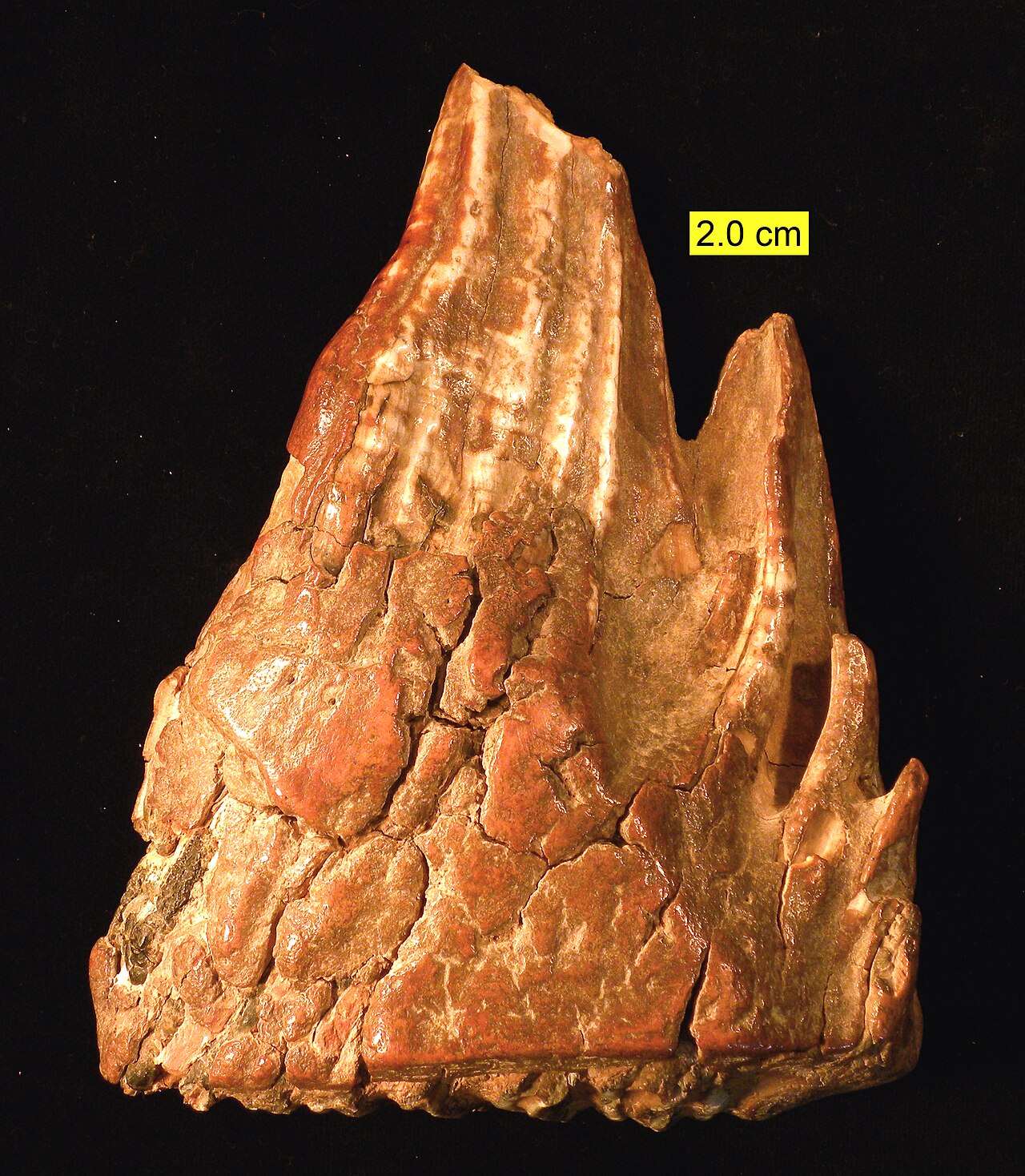
Image context: the cover uses a real Wikimedia Commons photograph of a Pleistocene Mammuthus tooth from Ohio.[5] It belongs here because the article is about tooth tissue as a material archive inside fossil anatomy. The ridged molar surface keeps attention on enamel as sampled body material rather than on an abstract chemistry diagram.
1) Carbon is the diet signal, but not a menu
Carbon isotope work is often introduced through the C3 and C4 plant divide. That shorthand is useful. Many trees, shrubs, and cool-season plants use the C3 photosynthetic pathway; many warm-season grasses use C4. Because those plant groups carry different carbon-isotope signatures, herbivore enamel can record whether an animal leaned toward browsing, grazing, or mixed feeding.[2]
The crucial word is "leaned." Enamel carbon does not name the exact plant species in the mouth. It constrains the broad vegetation pathway that entered the animal's diet. The 2022 Frontiers review on artiodactyl enamel makes this method boundary clear: enamel carbon values in herbivorous mammals reflect ingested plants, and C3, C4, and mixed diets can be separated in useful ways, but interpretation still depends on modern analogs, habitat structure, and the local ecology of the animals being compared.[2]
That is why enamel isotope work is strongest at assemblage scale. One tooth may be suggestive. A set of teeth from several taxa, horizons, and ecological roles can reconstruct a food landscape. In the Dikika study from Ethiopia, Bedaso, Wynn, Alemseged, and Geraads analyzed 210 mammalian herbivore teeth across 15 taxa from Pliocene deposits associated with Australopithecus afarensis context.[3] The result was not one tidy habitat label. The enamel data pointed to a range of foraging strategies and shifting proportions of open grassland, wooded grassland, woodland, and forest through time.[3]
That is exactly the right kind of result for the method. Enamel did not say "this hominin lived in a single postcard environment." It made the surrounding mammal community into a habitat instrument. The power came from comparison: grazers, browsers, mixed feeders, and their changing carbon values together narrowed what the landscape could have been.
2) Oxygen is the water signal, but water has many routes into a body
Oxygen isotopes are more tempting to overread because water feels like a direct climate archive. In reality, enamel oxygen values are filtered through drinking behavior, plant water, evaporation, temperature, humidity, physiology, and tooth-growth timing.[1][4] A browser eating leaves in a dry setting may record a different water signal from a grazer drinking regularly, even if both animals live in the same basin. That difference can be useful only if physiology and ecology remain in the frame.
The Tule Springs work in southern Nevada shows the value of that caution. Kohn, Springer, and colleagues used late Pleistocene herbivore enamel from Tule Spring Fossil Beds National Monument, compared with modern animals and waters, to ask about precipitation seasonality and wet hydroclimate conditions in the Las Vegas Valley.[4] Their abstract reports lower oxygen-isotope values in Pleistocene Equus, Bison, and Mammuthus enamel than in modern equids, implying lower water isotope values and supporting a different hydroclimate baseline.[4]
The same study also shows why oxygen cannot be treated as a single climate dial. Camelops, interpreted as a browser, yielded higher enamel oxygen values that may reflect drought tolerance or different water-use behavior.[4] The method becomes sharper precisely because it does not flatten those differences. Oxygen values can illuminate water source and climate, but animal ecology decides how the climate enters the tooth.
3) Sampling turns a tooth into time
Bulk enamel sampling gives a blended signal for the period of tooth mineralization. Sequential sampling along a tooth can turn that same object into a seasonal or developmental record, depending on growth pattern and sampling resolution.[1] That distinction is easy to miss. A tooth is not a whole life compressed into one number. It is a tissue formed over a particular interval.
For high-crowned herbivore teeth, that interval can be especially useful. A long-growing tooth may preserve changes along its crown that relate to seasonality, diet shifts, or water changes during formation. But the extra resolution brings extra responsibility. Researchers have to know which part of the tooth formed when, whether enamel maturation re-equilibrated parts of the signal, and whether the sampled track crosses comparable tissue in each specimen.[1]
This is why method papers matter in paleontology. The analytical machine is not the method by itself. The method includes sampling location, pretreatment, screening for diagenesis, calibration against modern animals, and a clear statement of what the isotope system can and cannot distinguish.[1][2] Without that chain, isotope numbers can acquire a false authority.
4) The best interpretations combine chemistry with anatomy and context
Enamel isotopes are most convincing when they join other evidence instead of replacing it. Tooth shape tells us about feeding mechanics. Wear can suggest how food was processed. Sediment and associated fossils constrain habitat. Enamel chemistry then adds a different layer: what kinds of plants and waters were actually incorporated into bodies.[1][2][3][4]
That layered approach keeps the proxy honest. If enamel carbon suggests open-habitat feeding but the animal's anatomy, wear, and associated fauna point toward browsing in a mosaic landscape, the answer is not to discard one signal immediately. The answer is to ask whether the animal mixed foods, moved across habitats, fed seasonally, or sampled a different ecological niche from the one its silhouette implies.
The strongest sentence, then, is not "isotopes reveal what extinct animals ate." It is narrower and better: tooth enamel can preserve carbon and oxygen signals from diet and body water well enough to constrain ancient ecology when the tissue is screened, the sampling interval is understood, and the result is compared against anatomy, sediments, and living analogs.[1][2]
That is why fossil teeth remain such good instruments. They are common enough to compare, durable enough to preserve, and biologically intimate enough to carry traces of meals and water. But they reward disciplined reading. Enamel turns extinct life into chemistry, not certainty. The chemistry is powerful because it reduces the number of possible stories, not because it removes interpretation from the work.
Sources
- Matthew J. Kohn and Thure E. Cerling, "Stable isotope compositions of biological apatite," in Phosphates: Geochemical, Geobiological and Materials Importance 48, 455-488.
- Bian Wang and Catherine Badgley, "Carbon-isotope composition of artiodactyl tooth enamel and its implications for paleodiets," Frontiers in Ecology and Evolution (2022).
- Zelalem K. Bedaso, Jonathan G. Wynn, Zeresenay Alemseged, and Denis Geraads, "Dietary and Paleoenvironmental Reconstruction Using Stable Isotopes of Herbivore Tooth Enamel From Middle Pliocene Dikika, Ethiopia," Journal of Human Evolution 64(1), 21-38 (2013).
- Matthew J. Kohn, Kathleen B. Springer, and colleagues, "Seasonality of precipitation in the southwestern United States during the late Pleistocene inferred from tooth enamel isotopes," Quaternary Science Reviews 296 (2022).
- Wikimedia Commons, "File:Mammuthus Tooth Side View Pleistocene Ohio.jpg" - photographic source for the article image.