Florissant is easy to misread from the trail. The big petrified redwood stumps are the obvious spectacle: rooted-looking cylinders on a Colorado hillside, broad enough to make deep time feel muscular. But the stronger field report begins lower and quieter, in the paper shales. Florissant is not simply a fossil forest. It is a late Eocene lake system made by volcanic interruption, and the stumps are only one register of a basin that also preserved insects, flowers, leaves, fish, pollen, diatoms, and the small mechanics of a vanished upland ecosystem.[1][2]
The National Park Service frames the monument as one of the richest fossil deposits in the world, spread across 2,427 hectares, or 5,998 acres, in central Colorado. Its geologic units include volcanic rocks, river gravels, lahars, and finely laminated fossiliferous paper shales. That mix matters. A postcard version of Florissant would let the forest stand alone. The field version makes the forest depend on a sequence: streams in a valley, volcanic debris flows that blocked drainage, Lake Florissant forming behind those dams, ash and clay settling into quiet water, and organic remains entering the sediment before decay erased their fine details.[1][2]
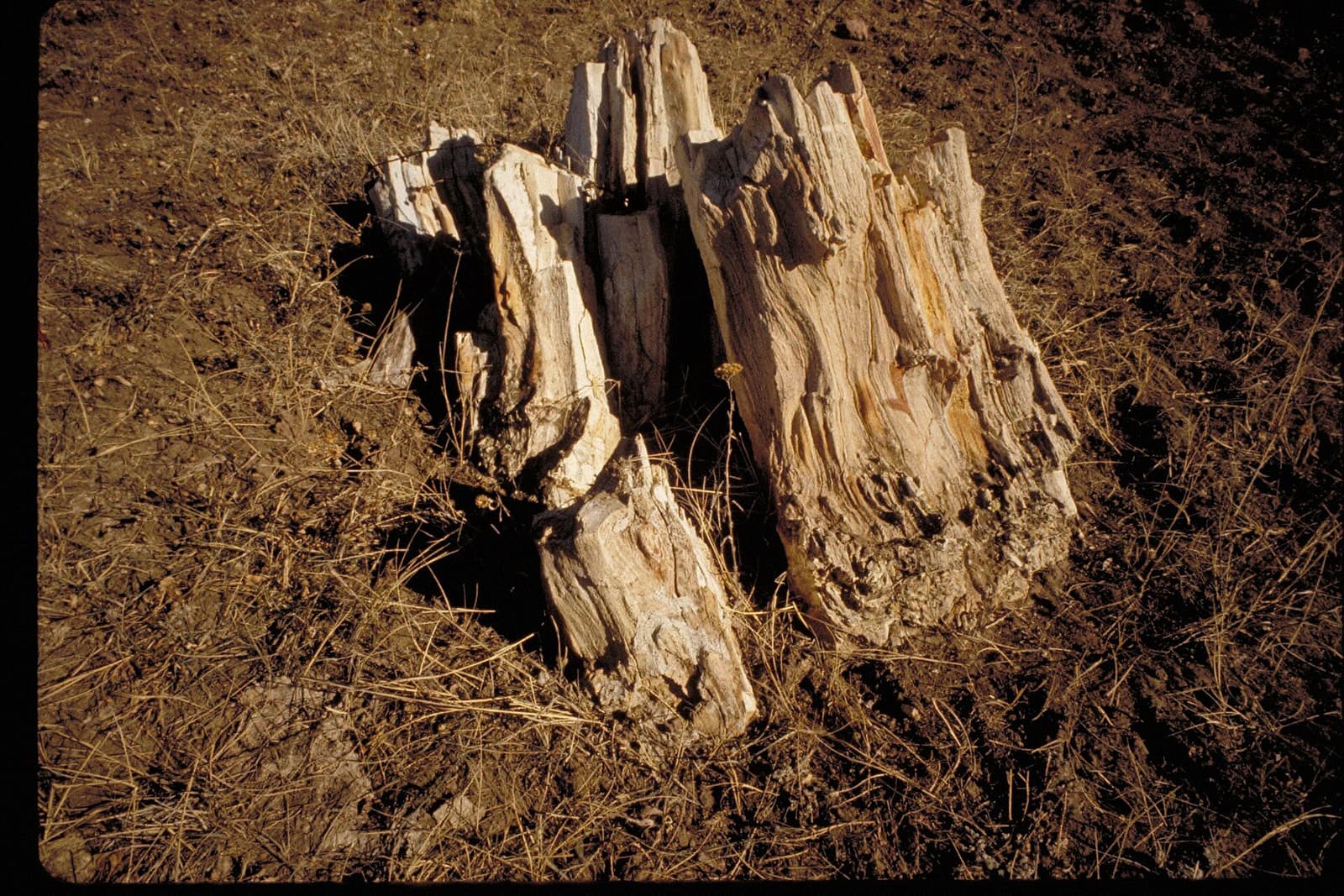
The first local rule is that a fossil bed is an event system, not a display case. During the late Eocene, giant redwoods grew along streams in the Florissant valley. A lahar buried the bases of trunks, killing and fossilizing the stumps. Later debris flows helped dam drainage again, creating lake conditions in which the middle shale unit accumulated; that unit is the main shale visitors encounter at the monument today.[2] The result is a site where upright-looking tree bases and thin lake beds belong to the same story, even though they preserve different kinds of evidence.
That distinction changes how a visitor should look. A petrified stump preserves position, diameter, and the material drama of silica replacing wood. A paper-shale fossil preserves compression, outline, venation, wing shape, body attitude, and the chance survival of delicate organisms that would normally disappear. Together they give Florissant a rare double scale: large rooted plants on the valley floor and small bodies settling through lake water.
The second rule is that volcanic ash helped preservation both violently and indirectly. NPS fossil guidance describes Lake Florissant as a basin formed after lahars dammed a river, while continued volcanic activity washed ash into the lake. Silica from that ash supported diatom blooms; when the diatoms died and settled, their silica-rich remains alternated with clay to form the paper-shale couplets that preserved delicate insects and flowers.[3] In other words, the volcano did not simply bury life in one catastrophic blanket. It helped build the chemistry and sediment rhythm of preservation.
That is why Florissant is a good antidote to the phrase "frozen in time." The phrase is convenient and usually wrong. The lake floor was not a camera shutter. It was a repeated filter: seasonal or episodic input, settling particles, microbial activity, oxygen conditions, water chemistry, and burial depth all shaped what became legible. Some organisms entered the archive cleanly. Others rotted, broke, floated, sank, or vanished. The fossil record is rich because the system was unusually good at preserving certain things, not because the whole ecosystem passed into rock without bias.
Recent paleolimnology work sharpens that point. Benson, Smith, and Spaulding used diatom and sedimentary evidence from Clare's Quarry to characterize Florissant lake conditions and preservation processes. The USGS summary calls the late Eocene Florissant Formation a rich continental Lagerstatte with well-preserved assemblages from lacustrine and fluvial facies; the study focused on the lake facies and the host rock processes that accumulated and preserved fossils.[4] That makes the lake itself an instrument. Its depth, chemistry, sediment supply, and microscopic life are not background scenery. They are part of the fossil-making apparatus.
The third rule is ecological: Florissant records a forest that should feel familiar only until it does not. The latest Eocene flora has been used to estimate climate and reconstruct paleoecology just before the Eocene-Oligocene boundary, a global transition into cooler Cenozoic conditions. A 2020 study of Florissant's flora estimated mean annual temperature at 11.6 +/- 3.3 degrees Celsius and mean annual precipitation at 740 +608/-334 millimeters per year, while emphasizing a diverse lacustrine flora and fauna in central Colorado.[5] Those numbers do not turn the ancient valley into a modern Colorado analogue. They help locate an upland ecosystem with no simple living replacement.
That non-analog quality is the reason Florissant deserves a field-report reading rather than a greatest-hits reading. Redwood relatives, insects, flowers, fish, mammals, birds, pollen, and leaves do not merely make a long species list. They expose a community assembled under late Eocene climate, altitude, hydrology, and volcanic disturbance. Some plant relatives point toward warmer or wetter associations than a casual glance at present-day central Colorado would predict. The point is not that Florissant was tropical, or that it was simply a redwood forest moved inland. The point is narrower and better: the site catches a particular mountain-basin community before the rules of the Cenozoic shifted again.[5]
For a visitor, the best sequence is therefore mental as much as physical. Start with the stumps because they are immediate. Then move the story outward: a valley with streams, a volcanic field close enough to send lahars and ash, a blocked drainage turning into a lake, lake-bottom couplets accumulating in fine layers, and small bodies entering an archive that favored delicate compression. The stumps show that the forest stood here. The shales explain why the vanished air above that forest can still be sampled through wings and leaves.
Florissant also clarifies a broader paleontology habit: spectacular fossils become stronger when they are tied back to ordinary sediment. A fossil insect with preserved wing venation is beautiful, but its scientific force depends on the shale that held it, the lake that made the shale, and the volcanic system that fed the lake. A petrified stump is monumental, but its meaning changes when it is read with lahar timing and lake formation rather than as a freestanding relic.
That is the field lesson. Florissant is not a static petrified forest plus a separate collection of pretty compression fossils. It is a basin archive, assembled by water, ash, mudflows, silica, diatoms, plants, and insects under late Eocene conditions. The stumps get you to stop. The paper shale teaches you how the place worked.
Sources
- National Park Service, "NPS Geodiversity Atlas--Florissant Fossil Beds National Monument, Colorado" (park geologic overview and fossil-resource context).
- National Park Service, "Geologic History of Florissant" (late Eocene lahars, redwood burial, lake formation, and shale units).
- National Park Service, "Volcanoes and Fossils" (volcanic ash, diatoms, and Florissant paper-shale preservation).
- Mary Ellen Benson, Dena M. Smith, and Sarah A. Spaulding, "Perspectives on the paleolimnology of the late Eocene Florissant lake from diatom and sedimentary evidence at Clare's Quarry, Teller County, Colorado, USA," USGS publication page for Geological Society of America chapter (2021).
- Penn State research record for Sarah E. Allen, Alexander J. Lowe, Daniel J. Peppe, and Herbert W. Meyer, "Paleoclimate and paleoecology of the latest Eocene Florissant flora of central Colorado, U.S.A.," Palaeogeography, Palaeoclimatology, Palaeoecology 551 (2020).
- Wikimedia Commons, "File:Petrified plants and fossils at Florissant Fossil Beds National Monument, Colorado (e429ca6e-bbfb-4bb3-babb-89fd9f9c7468).jpg" - NPS staff photograph used for the article image.