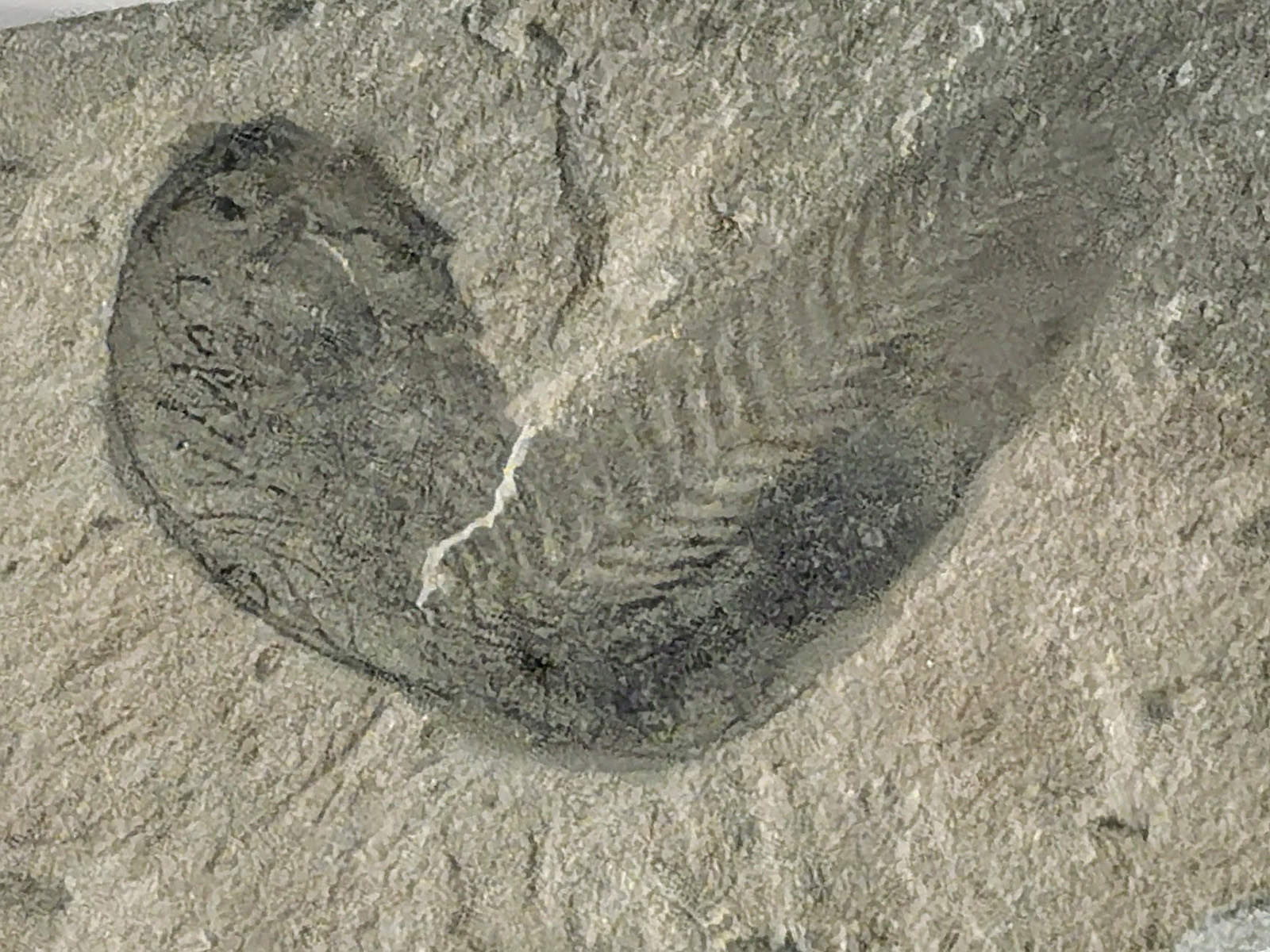
Metaspriggina walcotti is easy to oversell if the sentence begins with "first fish." The phrase is memorable, and the animal does belong near one of vertebrate history's most consequential thresholds. But the better close reading starts smaller. The fossil matters because its soft body preserves a set of structures that make early vertebrate anatomy arguable: myomeres, a notochord, a post-anal tail, eyes in the richer material, and, most importantly, a branchial region with bars that changed how paleontologists picture the primitive vertebrate throat.[1][2]
The lead photograph keeps that problem honest. It shows a real Metaspriggina fossil from the Royal Ontario Museum collection, not a diagram and not a fantasy reconstruction. The animal appears as a slender, dark impression on stone, which is exactly the point: this is a fossil whose scientific force comes from extracting anatomy from compression, lighting, preservation, and comparison.[5]
The old specimen was too rare to carry the whole story
The Royal Ontario Museum's Burgess Shale page describes Metaspriggina as a very rare eel-like chordate from the Middle Cambrian, about 505 million years ago, with the Walcott Quarry specimens held in the Smithsonian's National Museum of Natural History.[1] Those two original specimens already mattered because the Burgess Shale is famous for soft-bodied animals, while clearly vertebrate-grade fossils are much harder to find there.
Rarity shaped the early interpretation. ROM summarizes the research history as a sequence of cautious re-readings: Charles Walcott had set the material aside, Simonetta and Insom described the species in 1993 with uncertainty about its relationship to Spriggina, later work favored a chordate interpretation, and Simon Conway Morris's 2008 redescription pulled both known specimens into the same genus and species.[1][3]
That history is not a footnote. It explains why Metaspriggina should not be treated as a single clean discovery moment. At first, the animal had too little specimen depth and too much preservational ambiguity. The larger of the two classic specimens reached about 69 millimeters, and ROM notes V-shaped or zig-zag segments interpreted as myomeres, a narrow central gut-like structure, and a poorly preserved anterior region.[1] That was enough to make the fossil interesting. It was not enough to make every "first fish" claim secure.
Marble Canyon changed the evidentiary weight
The decisive shift came when Metaspriggina stopped being only a two-specimen Walcott Quarry rarity. The 2014 Nature Communications paper on the Marble Canyon assemblage reported a new Burgess Shale-type fauna about 40 kilometers from Walcott's original locality, with high-density soft-bodied preservation and new anatomical information in several taxa, including Metaspriggina.[4]
That matters because early soft-bodied vertebrates punish overconfident reading. A line that looks like a gut in one specimen may be clearer in another. A muscle block that looks chevron-shaped under one orientation may look different in a compressed counterpart. A head region that is too poorly preserved in the old material may become much more legible when additional specimens appear.
Conway Morris and Caron's 2014 Nature paper made exactly that move. It redescribed Metaspriggina using new Burgess Shale material, exceptional Marble Canyon material, and additional Laurentian Burgess Shale-type deposits. The result was no longer just "possible chordate." The paper identified unambiguous vertebrate features: a notochord, prominent camera-type eyes, paired nasal sacs, possible cranium and arcualia, W-shaped myomeres, and a post-anal tail.[2]
The specimen count therefore changed the kind of article one can write. The fossil moved from interesting hint to evidence stack. It still remains soft-bodied and delicate, but its anatomy no longer depends on squeezing a vertebrate story out of two ambiguous slabs.
The gill bars are the real close-reading problem
The most important part of Metaspriggina is not that it looks vaguely fish-like. It is the branchial area. The 2014 Nature study described an array of bipartite bars, with each bar interpreted as having upper and lower elements, and argued that this arrangement has implications for reconstructing the primitive vertebrate branchial region.[2]
That is a sharper claim than "early fish." Gill bars sit at the boundary between respiration, feeding, head support, and later jaw evolution. In living vertebrates, the pharyngeal region is not just plumbing. It is one of the deep architectural zones from which major head structures were modified through time. If Metaspriggina preserves a bipartite branchial arrangement near the base of vertebrates, then the fossil is helping constrain what the ancestral condition may have looked like.[2]
The care is in the word "constrain." Metaspriggina does not show a finished jaw. It does not solve every relationship among early jawless vertebrates, lampreys, hagfish, and gnathostomes. What it does is force a more anatomical question: were early vertebrate gill supports already arranged in a way closer to a two-part bar system than to some simple modern-lamprey template? Conway Morris and Caron argued that the Metaspriggina arrangement reinforces the view that the lamprey branchial basket is probably derived rather than a direct picture of the primitive state.[2]
That is why the fossil is strongest when read throat-first. The dramatic evolutionary issue is not merely that a small Cambrian swimmer existed. The issue is that its preserved branchial anatomy gives paleontologists a testable alternative to assuming living jawless fishes preserve the original vertebrate condition unchanged.
The body plan is familiar only after the evidence is sorted
Once the branchial region is placed in context, the rest of the body becomes easier to read without making it too modern. ROM describes an elongate animal with a small anterior cranial region, a long laterally flattened trunk, numerous myomeres, and no evidence of fins in the classic Walcott material.[1] The 2014 redescription adds the richer vertebrate package from the newer material, including eyes and a post-anal tail.[2]
That combination is enough to make Metaspriggina look like a primitive fish, but "fish" is a dangerous everyday word. It can make the animal sound more familiar than it was. There is no armored skeleton, no modern jaw, no ordinary fin plan to lean on. The fossil sits before many later vertebrate defaults had stabilized. Its value is that it shows some parts of the vertebrate program already recognizable while other parts remain absent, soft, or difficult to infer.
This is the main boundary a good fossil-find close reading should protect. Metaspriggina is not important because it lets readers imagine a tiny modern fish swimming through the Cambrian. It is important because it makes the early vertebrate body visible before that modern package fully exists. Muscle blocks organize the trunk. A notochord stiffens the axis. The tail extends past the gut. The head region begins to show sensory and branchial architecture. Each feature narrows the interpretation, but none turns the animal into a miniature version of later vertebrates.
Why Metaspriggina still matters
The best version of the Metaspriggina story is a correction to two weak habits. One habit is mascot thinking: pick a fossil, call it the first fish, and let the slogan do the work. The other is living-animal backfill: use lampreys, hagfish, or modern fish as if they were simple windows into the Cambrian.
The fossil resists both. Its early history shows why rare, compressed specimens can be under-read or misread.[1][3] The Marble Canyon material shows why new localities matter even when they sit near famous old ones: they can turn a taxonomic whisper into a comparative sample.[4] The 2014 anatomical work shows why the branchial region is not a detail but the center of the argument.[2]
That leaves Metaspriggina in a better place than the slogan. It is a small soft-bodied Cambrian vertebrate-grade animal whose importance depends on preserving just enough anatomy to make early fish history less conjectural. The fossil does not hand over the origin of vertebrates in one perfect slab. It does something more useful: it makes the first-fish problem specific enough to argue about, one gill bar at a time.
Sources
- Royal Ontario Museum, "Metaspriggina walcotti," Burgess Shale fossil page with taxonomy, specimen history, morphology, age, locality, and ecological notes.
- Simon Conway Morris and Jean-Bernard Caron, "A primitive fish from the Cambrian of North America," Nature 512 (2014).
- Simon Conway Morris, "A redescription of a rare chordate, Metaspriggina walcotti Simonetta and Insom, from the Burgess Shale (Middle Cambrian), British Columbia, Canada," Journal of Paleontology 82 (2008), Cambridge Core record.
- Jean-Bernard Caron et al., "A new phyllopod bed-like assemblage from the Burgess Shale of the Canadian Rockies," Nature Communications 5 (2014).
- Wikimedia Commons, "Metaspriggina.jpg," file page for the photographed Royal Ontario Museum Metaspriggina fossil used as the article image.