The fish-to-tetrapod transition is often told as though evolution had a single direction of travel: fins become limbs, water gives way to land, and every close relative of Tiktaalik becomes interesting mainly because it seems to approach the shoreline. Qikiqtania wakei makes that story less tidy and more useful. The fossil sits near the same evolutionary neighborhood as Tiktaalik, but its best-known bone points the other way.[1][2]
That is the reason Qikiqtania deserves lineage context rather than a simple species-profile treatment. It is not just another Devonian "fishapod" added to a famous cast. It is a reminder that transitions are not escalators. Near a major ecological boundary, lineages can experiment, specialize, reverse emphasis, and occupy adjacent ways of life while sharing much of the same anatomical inheritance.[1][3]
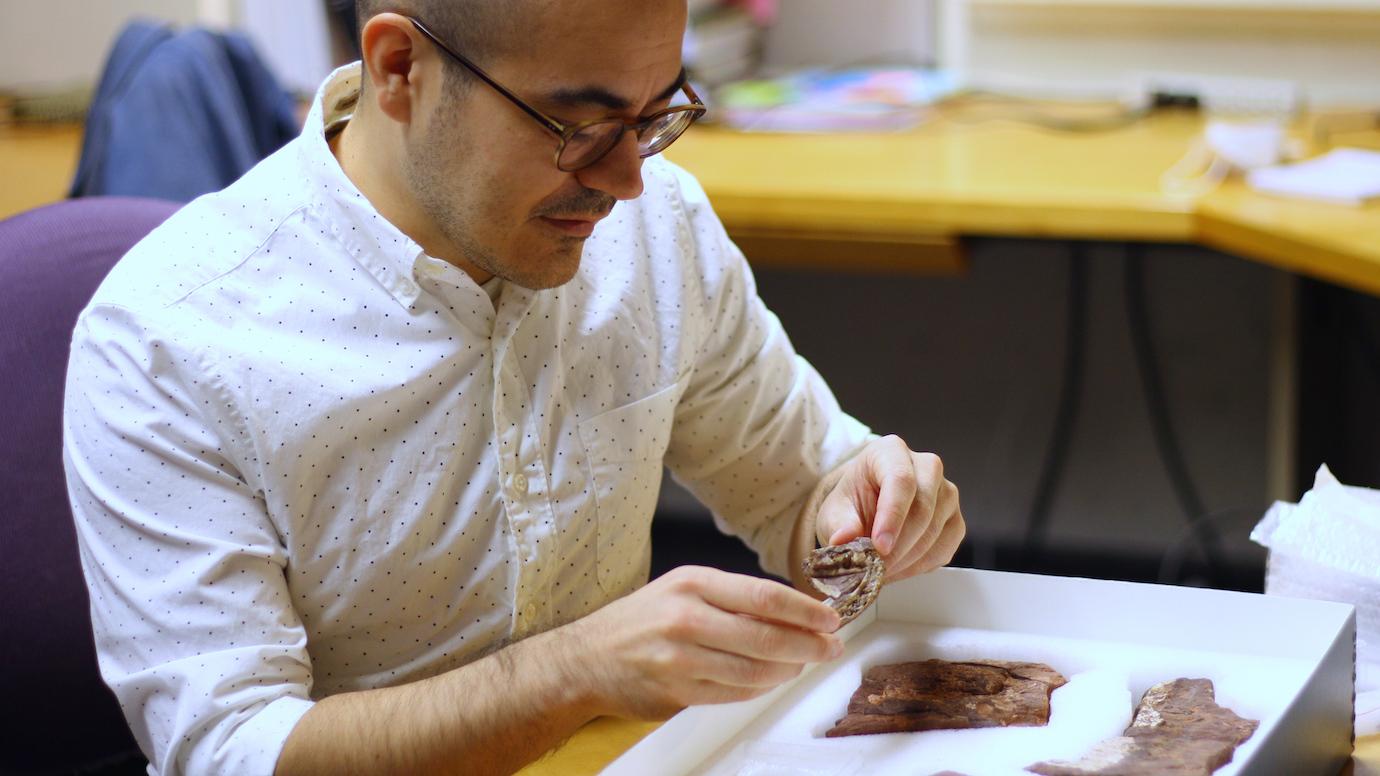
Image context: the lead image is a real photograph of Tom Stewart holding the fossil specimen, published by University of Chicago News.[2] The photograph matters because the article turns on a physical block, not a polished life reconstruction. The specimen was initially modest on the surface, then became important when CT work revealed a nearly complete pectoral fin inside the rock.[2]
A close relative that refuses the straight path
The 2022 Nature description by Thomas Stewart, Justin Lemberg, Neil Shubin, and colleagues placed Qikiqtania wakei among elpistostegalians, the finned relatives close to the origin of limbed vertebrates.[1] That placement is what makes the animal interesting. If Qikiqtania had been a distant fish with ordinary swimming fins, it would not put pressure on the public transition story. Its force comes from proximity. It belongs near the animals usually recruited to explain how vertebrate bodies began solving shallow-water and substrate-support problems before true limbs fully emerged.[1][3][4]
Yet the actual fossil does not read like a rehearsal for walking. University of Chicago's account summarizes the preserved material as partial upper and lower jaws, parts of the neck, scales, and a complete pectoral fin with a distinctive humerus.[2] That humerus is the hinge of the whole argument. Instead of showing the strong ridges and processes expected for muscles that brace an appendage against a surface, it is smooth, curved, and boomerang-shaped.[1][2]
The tempting mistake would be to treat that as a failure to become Tiktaalik. The better reading is that Qikiqtania was solving a different problem. Its pectoral fin suggests specialization for underwater paddling after its lineage had already moved into the anatomical neighborhood where support-bearing appendages were possible.[1][2] In other words, the animal does not sit before the transition in a simple sequence. It sits beside it, showing that a close relative could redirect inherited equipment toward a more aquatic role.
Tiktaalik still matters, but no longer gets to flatten the whole interval
Tiktaalik roseae remains central because it made the shoreline body plan visible in a finned vertebrate. The original 2006 Nature papers described a Late Devonian animal with fish traits and tetrapod-like features in the skull, neck, ribs, and pectoral fin.[3] Later work sharpened the same point. The 2014 pelvic paper showed that the hind appendage and pelvis were more robust and mobile than earlier forelimb-heavy transition stories had implied.[4] The 2024 axial-skeleton study added rib regionalization and pelvic linkage to the picture, making Tiktaalik look even more like a body assembled for mixed support, steering, and shallow-water mechanics.[5]
Those findings are not weakened by Qikiqtania. They are clarified by it. If Tiktaalik shows that some elpistostegalians were developing appendage systems relevant to substrate engagement, Qikiqtania shows that the same broader evolutionary neighborhood also contained a lineage leaning back into swimming. The transition interval therefore looks less like one fossil line pointing at one destination and more like an ecological spread. Some bodies became better at propping, biting, steering, and moving in marginal habitats. Another close body could keep the same historical inheritance while emphasizing a smooth, paddle-like fin.[1][3][4]
That matters because the phrase "water-to-land transition" can quietly smuggle in a teleology. It can make every anatomical change sound like a down payment on dry land. Qikiqtania blocks that habit. A humerus near the tetrapod stem is not automatically a proto-leg. A pectoral fin with a recognizable upper-arm bone is not automatically an argument for walking. Function has to be read from shape, muscle attachment, joint logic, and comparative context, not from where the lineage seems to be headed in hindsight.[1][2]
The boomerang humerus changes the question
The most valuable thing about Qikiqtania is the way it changes the question from "How close is this animal to walking?" to "What was this appendage doing in its own body?" That is a healthier paleontological question. It keeps the specimen from being forced into a progress chart.
In Tiktaalik, pectoral anatomy became famous because the fin could be interpreted as part of a support-capable system.[3] In Qikiqtania, the pectoral fin is important for the opposite reason. Stewart and colleagues argue that the humerus lacks the bony landmarks associated with weight-bearing musculature and instead supports a more pelagic, swimming-oriented interpretation.[1] The same general anatomical region therefore tells two different stories in two nearby taxa.
That contrast is exactly what lineage context is for. Evolutionary transitions are not defined only by the forms that continue toward a familiar endpoint. They are also defined by side branches that reveal which traits were flexible, which functions were still unsettled, and which ecological opportunities remained open. Qikiqtania shows that the fin-limb boundary was not simply a one-way ramp from water to land. It was a zone where appendages could be reworked in more than one direction.[1][2]
The discovery process also reinforces the methodological lesson. The fossil was collected near the region made famous by Tiktaalik, then sat largely unexamined while attention focused elsewhere.[2] Only later did CT scanning reveal the pectoral fin hidden inside the block, and further trimming allowed higher-resolution imaging.[2] The result is a nice corrective to dramatic discovery mythology. The fossil did not announce itself as a grand transition specimen on day one. It became informative because preparation, scanning, and comparison exposed the bone that mattered.
A branching transition is a stronger transition
The strongest conclusion is not that Qikiqtania replaces Tiktaalik in the transition story. It is that Qikiqtania makes the story more mature. Tiktaalik remains a central fossil for understanding how finned vertebrates began assembling neck mobility, rib support, appendage strength, pelvic contribution, and mixed feeding mechanics near the origin of tetrapods.[3][4][5] Qikiqtania adds the missing caution: near that same boundary, a related animal could carry a tetrapod-near inheritance while specializing its pectoral fin for swimming.[1][2]
That is a more realistic picture of deep time. Major transitions rarely behave like straight ladders. They are better understood as branching experiments around new habitats and old constraints. Some branches become ancestors of later dominant forms. Some become side paths. Some teach most clearly by refusing the direction that hindsight expects.
Read that way, Qikiqtania wakei is not the fishapod that went backward in a joke version of evolution. It is a fossil that keeps the water-to-land story honest. The boomerang-shaped humerus says that being close to the origin of limbs did not require moving steadily toward land support. It could also mean taking a familiar anatomical toolkit and making it swim again.
Sources
- Thomas A. Stewart, Justin B. Lemberg, A. Elizabeta Morozova, Mark Webster, Edward B. Daeschler, and Neil H. Shubin, "A new elpistostegalian from the Late Devonian of the Canadian Arctic," Nature 608 (2022) - original description of Qikiqtania wakei, including the pectoral-fin anatomy and aquatic-specialization interpretation.
- University of Chicago News, "New fossil shows four-legged fishapod that returned to the water while Tiktaalik ventured onto land" (2022) - discovery account, fossil image source, CT-scanning sequence, locality, size, and public description of the smooth boomerang-shaped humerus.
- Neil H. Shubin, Edward B. Daeschler, and Farish A. Jenkins Jr., "A Devonian tetrapod-like fish and the evolution of the tetrapod body plan," Nature 440 (2006) - original Tiktaalik body-plan context.
- University of Chicago News, "Discovery of new fossils reveals key link in evolution of hind limbs" (2014) - institutional summary of the Tiktaalik roseae pelvic-girdle and hind-fin evidence.
- University of Chicago Knowledge, record for Thomas A. Stewart and colleagues, "The axial skeleton of Tiktaalik roseae" (2024) - repository record for axial and rib evidence near the fish-tetrapod transition.