The mouth is where Titanichthys becomes difficult to read. Its lower jaws are long and slender, with none of the toothlike projections or working edges expected of an animal cutting or crushing a substantial meal. Above them sat a broad, flattened shield of bony plates. This was an armored fish with a surprisingly delicate feeding apparatus.[1]
The combination invites a different picture of strength. A jaw can be useful because it holds a mouth open across a large volume of water. Under that interpretation, the impressive dimensions of Titanichthys become part of a system for gathering tiny prey. The challenge is to establish how much of that picture the surviving bones actually support.
A broad head, incompletely recovered
Titanichthys belonged to the arthrodires, an extinct group of armored fishes. Its Late Devonian record includes the Famennian Cleveland Shale of Ohio, from near the end of the Devonian, roughly 360 million years ago. Much of the material is fragmentary. An unusually informative specimen, CMNH 50319, was excavated beside the Rocky River west of Cleveland in 2007.[1]
James Boyle and Michael Ryan described it in 2017. The connected head and dorsal trunk armor clarified previously poorly known plates. Its head shield was more than a meter wide, yet many plates were only millimeters thick. The authors provisionally referred it to Titanichthys cf. T. clarki: an identification expressing affinity while leaving room for revision.[1]
That qualification matters to the portrait. A genus assembled from partial specimens can acquire a deceptively tidy silhouette in an illustration. Keeping the museum number beside the description helps preserve the distinction between one recovered individual and the larger animal reconstructed from several finds.
How large is a giant?
Older accounts placed Titanichthys above five meters.[4] In 2023, Russell Engelman reassessed arthrodire body lengths using the relationship between a head measurement—running from the eye region toward the rear of the gill cover—and total length in other fishes. His study chiefly concerned Dunkleosteus, but also examined Titanichthys.[2]
For AMNH FF 7134, the largest Titanichthys specimen he located, one model returned about 4.15 meters. Restricting the comparison to large filter-feeding sharks produced about 3.34 meters. Those are alternative estimates for the same individual, not measurements of two different fish. Engelman also emphasized that the genus's size range remains poorly defined because its remains are often incomplete.[2]
The animal remains imposing at either estimate. What changes is the confidence with which a full body can be extended behind a fossil head. The choice of living comparison affects the result; a precise decimal does not turn the missing tail into an observed fossil. Size belongs in the profile as an estimate with an explanation, rather than as the animal's principal achievement.
A jaw built for another task
In 2020, Samuel Coatham and colleagues tested a Moroccan lower jaw of Titanichthys termieri, specimen PIMUZ A/I 4716. They compared its response to loading with jaws of the predatory Dunkleosteus and the presumed hard-prey feeder Tafilalichthys. With models standardized for length, material properties and applied force, the Titanichthys jaw experienced greater stress. Its shape resisted the simulated biting loads less well.[3]
This was a comparison of shapes under controlled assumptions, not a measurement of the living animal's bite force. The models treated the jaws as internally uniform; surface scans could not capture their internal construction. The authors explicitly cautioned against reading the absolute stress values as those experienced in life.[3]
Comparisons with living sharks and whales broadly supported the interpretation: suspension feeders had less mechanically resistant jaws than their biting relatives. The result strengthened the case that Titanichthys gathered small prey from water rather than processing large or hard food.[3]
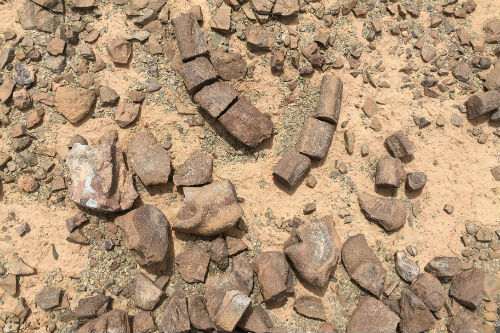
The proposed behavior is continuous ram feeding: swimming with the mouth open so that water carrying plankton passes through it. Bristol's account locates the studied fossils in the Moroccan Sahara, where Christian Klug found them during fieldwork. The photograph above brings that reconstruction back to exposed rock and recoverable fragments.[4]
The crucial missing part is the filter. No fossilized suspension-feeding structure has been identified in Titanichthys. The jaws provide evidence about the loads they could accommodate; they do not preserve the apparatus that would have separated food from water.[4]
That leaves a compelling, unfinished animal. Its mouth makes sense as an entrance through which food-bearing water flowed, and mechanical comparisons give that reading substance. A future find preserving the filtering structures could bring the portrait into much sharper focus. Until then, the open mouth is a well-supported hypothesis about a life whose smallest meals have left the largest question.
Sources
- James Boyle and Michael J. Ryan, “New information on Titanichthys (Placodermi, Arthrodira) from the Cleveland Shale (Upper Devonian) of Ohio, USA,” Journal of Paleontology 91 (2017), 318–336 — anatomy and specimen CMNH 50319.
- Russell K. Engelman, “A Devonian Fish Tale: A New Method of Body Length Estimation Suggests Much Smaller Sizes for Dunkleosteus terrelli (Placodermi: Arthrodira),” Diversity 15 (2023), 318 — discussion of Titanichthys size; publisher PDF.
- Samuel J. Coatham, Jakob Vinther, Emily J. Rayfield and Christian Klug, “Was the Devonian placoderm Titanichthys a suspension feeder?” Royal Society Open Science 7 (2020), 200272 — jaw models, comparisons and limitations.
- University of Bristol, “Ancient giant armoured fish fed in a similar way to basking sharks” (20 May 2020) — field context, proposed feeding behavior and Christian Klug's fossil photograph.