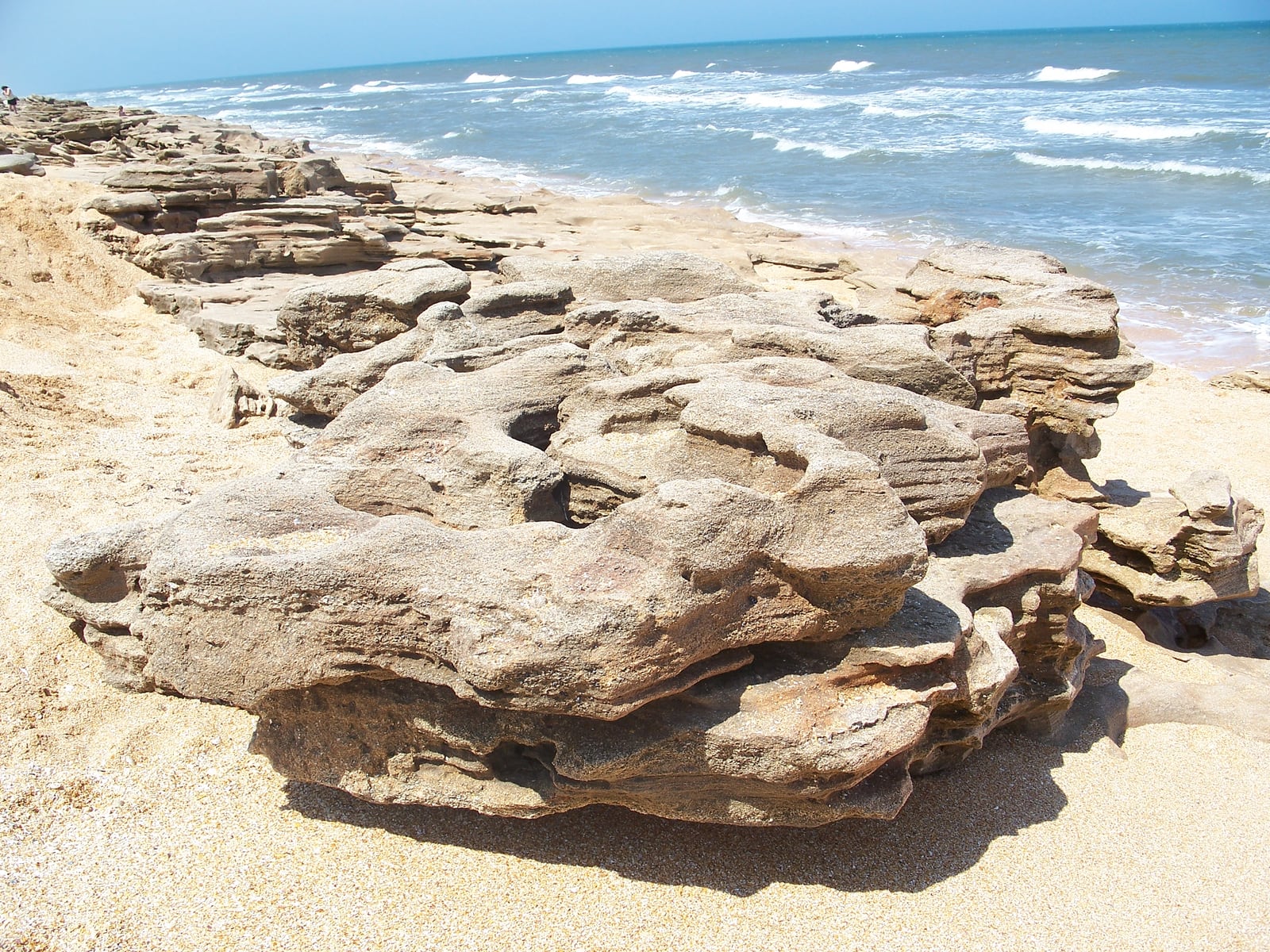
On Florida's Atlantic coast, coquina makes the beach's loose material look permanent: shells and fragments cemented into rock. At Washington Oaks Gardens State Park, the outcrops expose this accumulated debris beside the surf. The National Park Service describes the regional deposits as the product of shell material building up through successive generations, then becoming bound together by calcium carbonate.[1] The rock has gathered many lives into one surface.
That closeness is easy to mistake for simultaneity. A shell bed invites us to imagine its animals alive together, occupying one stretch of seabed at one moment. Yet durable remains can accumulate through many generations. Paleontologists call this time averaging. Its consequences reach beyond reconstructing ancient seas: an accumulation of dead shells can retain evidence of a community that disappeared before anyone began counting its living inhabitants.[2]
How much time fits inside a handful?
One answer came from the Colorado River delta, at the northern end of the Gulf of California. In a 1998 study, Michał Kowalewski, Glenn Goodfriend and Karl Flessa dated 165 shells of the bivalve Chione fluctifraga from nine samples in four Holocene shell ridges. They used changes in shell amino acids, calibrated against radiocarbon dates. Within individual samples, the shells' age ranges averaged 661 years.[4]
The spread was much greater than either the dating uncertainty or the animal's lifespan. It therefore recorded a history of accumulation. A collector could carefully separate one layer and still recover centuries of deaths. Pooling material from several layers would add a further mixture created by the sampling itself.[4]
There was a useful surprise. At a resolution of 50 years, the dated samples were consistent with fairly even representation across their time spans. Those ridges could preserve a sustained record of prevailing conditions, despite being poorly suited to reconstructing a brief ecological episode.[4] The question asked of the shells determines whether their long memory is helpful.
The seabed keeps moving its archive
An animal's death does not fix its shell permanently in place. A 2019 study led by Adam Tomašových dated 849 shells from cores on the Palos Verdes and San Pedro shelves in southern California. Within sediment units only 10–25 centimetres thick, age offsets between two bivalve species reached 1,000–4,000 years.[5]
The authors identified a mechanism involving burial, survival and return. Shells can persist below the near-surface zone where destruction is rapid. Deep burrowers, including shrimps, can reach those older deposits and move their contents upward. Ancient survivors then join younger shells in the actively mixed seabed.[5]
The two species also had different histories of abundance. Their contributions to the accumulating deposit rose and fell at different times, increasing the separation between their shell-age distributions. An apparently shared layer could therefore combine animals whose populations flourished in different periods.[5]
Those measured offsets belong to particular sites and species. They are no universal conversion from centimetres to centuries. Their broader implication is straightforward: physical proximity alone cannot establish that fossil individuals were contemporaries.
When disagreement becomes evidence
Comparing living animals with nearby dead shells initially seems like a test the shells ought to pass. If their species and abundances disagree, perhaps transport or selective destruction has distorted the record. But the living community may itself have changed.
Susan Kidwell tested that possibility in 2007 using 73 molluscan datasets from estuaries and lagoons. Average agreement between living and dead assemblages was poorer in settings with documented human-driven nutrient enrichment. The dead shells could retain the composition of an earlier community while the living fauna responded to altered conditions.[6]
This was an association, with other human pressures potentially contributing. It did not make every mismatch a pollution diagnosis. Equally, a close match could not certify an undisturbed environment: enough time might have passed for the older shells to disappear or be overwhelmed by remains from the replacement community.[6]
The comparison gains meaning when shell ages, species' ecological requirements and independent environmental history support the same explanation. Disagreement then becomes something to investigate, rather than simply a reason to discard the archive.
A community older than the monitoring record
Southern California supplied a striking example in 2017. Tomašových and Kidwell examined dead Laqueus brachiopods—shelled animals distinct from bivalve mollusks—on a mainland shelf now dominated by muddy habitats. Together with dead scallops, they indicated a formerly extensive shell-gravel ecosystem with animals living attached above the seabed.[7]
Dating 190 brachiopod shells revealed a presence extending back at least 4,000 years, followed by a sharp decline in shell production during the nineteenth century. At the time of that study, the dated sample contained no shells younger than approximately a century. The authors linked the decline to increased siltation associated with intensified coastal land use, especially livestock grazing. That causal explanation rests on the timing and environmental evidence; the shells do not directly measure grazing's effect.[7]
The loss preceded twentieth-century scientific surveys. Starting the baseline with those surveys would therefore begin after a major transformation. Surviving shells made an earlier ecosystem visible.[7]
A time-averaged assemblage sacrifices some ability to distinguish short events while extending the period we can observe.[2] Reading it well requires both scales: how long its remains accumulated, and how quickly the change under investigation happened. The shells touching in a rock may have lived centuries apart. That separation can be precisely what makes them valuable.
Sources
- National Park Service, “Geologic Activity,” Fort Matanzas National Monument—regional coquina formation and the exposures at Washington Oaks Gardens State Park.
- Susan M. Kidwell and Adam Tomašových, “Implications of Time-Averaged Death Assemblages for Ecology and Conservation Biology,” Annual Review of Ecology, Evolution, and Systematics 44 (2013), 539–563—temporal pooling and historical ecological information.
- Ebyabe, “Washington Oaks Gardens coquina01.jpg” (2007), Wikimedia Commons—original photograph, locality and attribution, licensed CC BY 2.5.
- Michał Kowalewski, Glenn A. Goodfriend and Karl W. Flessa, “High-resolution estimates of temporal mixing within shell beds: the evils and virtues of time-averaging,” Paleobiology 24 (1998), 287–304—dated shells from Colorado delta ridges.
- Adam Tomašových and colleagues, “Millennial-Scale Age Offsets Within Fossil Assemblages: Result of Bioturbation Below the Taphonomic Active Zone and Out-of-Phase Production,” Paleoceanography and Paleoclimatology 34 (2019), 954–977—southern California core dating and shell mixing.
- Susan M. Kidwell, “Discordance between living and death assemblages as evidence for anthropogenic ecological change,” PNAS 104 (2007), 17701–17706—live–dead comparisons and limits of their environmental interpretation; full text via PubMed Central.
- Adam Tomašových and Susan M. Kidwell, “Nineteenth-century collapse of a benthic marine ecosystem on the open continental shelf,” Proceedings of the Royal Society B 284 (2017), 20170328—brachiopod dating and the inferred loss of a shell-gravel ecosystem; NOAA-hosted paper.