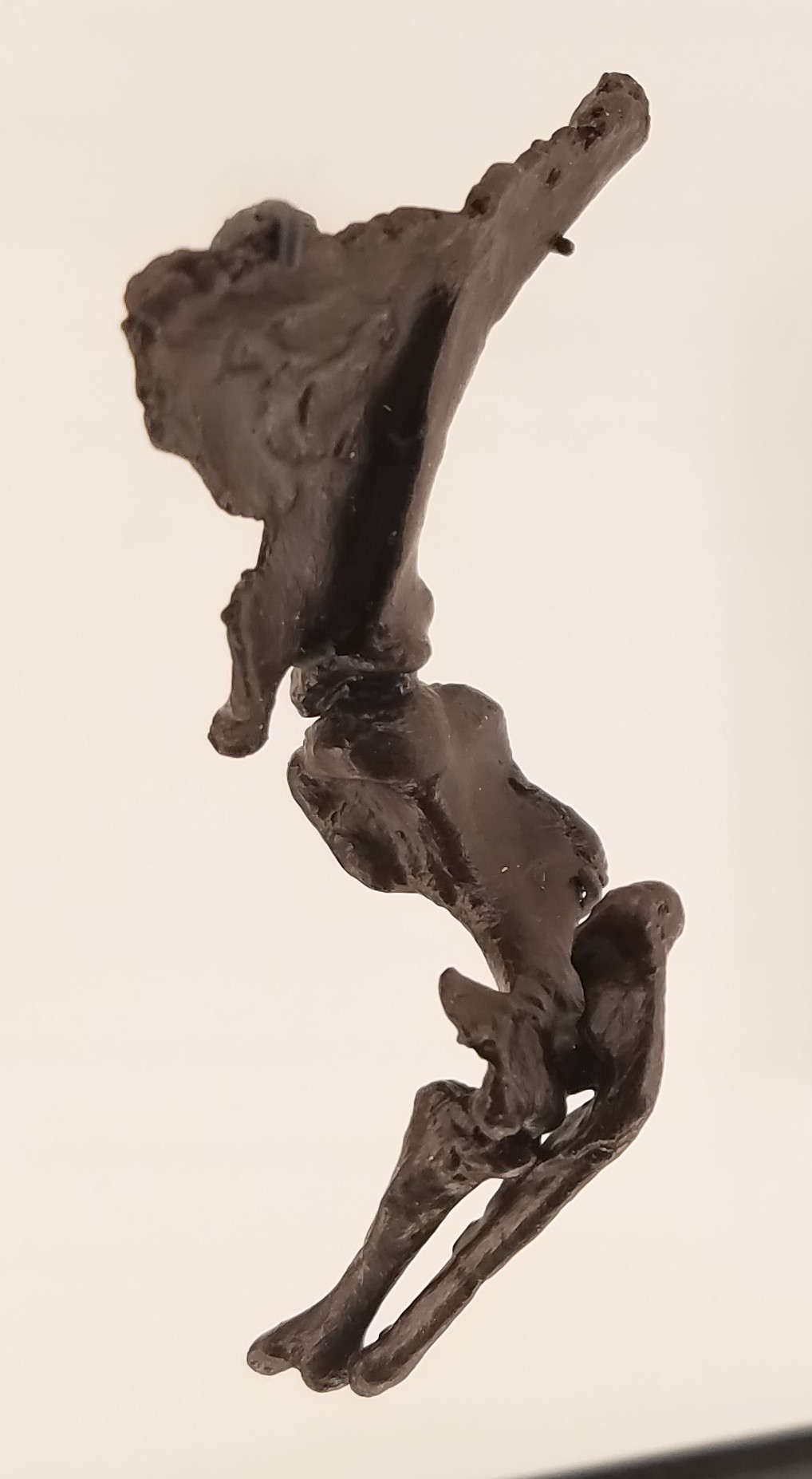
The forelimb looks almost too substantial for the animal that carried it: a broad shoulder blade, a heavily built upper arm, and paired forearm bones below. In a museum display, that equipment invites a movement—claws entering soil, an arm pulling back. Fruitafossor windscheffeli gives paleontologists good reasons to reconstruct a digging mammal. Naming what it dug for takes another step.[1]
The starting point is specimen LACM 150948, the holotype described by Zhe-Xi Luo and John Wible in 2005. From the Morrison Formation near Fruita, Colorado, roughly 150 million years old, it preserves lower jaws, an incomplete cranium, and about 40 percent of the skeleton behind the head. This is enough to connect mouth and limbs in one individual, while leaving much of the animal unrecovered.[1]
Start at the shoulder
A digging interpretation becomes stronger when several parts of the limb tell a compatible story. In his 2015 account of mammalian shoulder evolution, Luo singled out Fruitafossor's specialized forelimb and its shoulder blade's prominent attachment area for the teres major muscle. That muscle helps move the upper arm. The bone preserves its attachment site; the muscle's size and action have to be reconstructed through comparison.[3]
The joint also matters. Fruitafossor retained an obliquely oriented, partly saddle-shaped shoulder socket with a surface facing sideways. Its arrangement differed from the familiar shoulder of living placental mammals. Luo placed these features within a history of shoulders assembled through repeated changes in individual bones and their connections.[3]
This makes the animal more interesting to imagine in motion. Giving it a modern mole's complete movement pattern would skip over its own joint geometry. The defensible reconstruction begins with the preserved attachment surfaces and articulations, then asks which movements they permit. Strong evidence for a task can coexist with uncertainty about the exact stroke used to perform it.
Follow the arm to the teeth
The cheek teeth supply a second clue. A 2019 comparative study by Patrick O'Connor and colleagues describes Fruitafossor's tubular, enamel-free crowns, each supported by a single root open at its lower end. That is an unusual arrangement for a Jurassic mammal. The authors compared it with the later African mammal Galulatherium, which also had simple, enamel-free cheek teeth, while documenting substantial differences elsewhere in their jaws.[4]
The comparison is useful because it prevents one conspicuous feature from swallowing the whole animal. Similar teeth can evolve independently. The 2019 study explicitly treats these resemblances as convergence, consistent with the original interpretation of Fruitafossor's similarities to armadillos and aardvarks.[4]
Those living animals helped generate the dietary proposal. In Carnegie's 2007 account, Luo envisaged Fruitafossor digging for termites and other invertebrates, with plants available as supplementary food. Even that reconstruction allowed a menu broader than termites alone. Teeth that resemble an insect eater's, combined with limbs suited to excavation, make an insect-feeding hypothesis plausible; neither feature records an actual meal.[5]
A useful distinction follows: digging describes access to food, while diet describes what was consumed. Soil can conceal several kinds of edible material. The arm and jaw must constrain the same reconstruction without being made to answer the same question.
A termite eater needs termites to spare
A 2025 study by Thomas Vida and colleagues adds an ecological test. Drawing on dietary information for 4,099 living mammal species alongside the social-insect fossil record, the researchers examined repeated origins of specialization on ants and termites. They questioned how reliably early ecosystems could supply such consumers, explicitly discussing Fruitafossor among the proposed early specialists.[6]
Their concern was availability. A colony can take years to mature; the presence of termites does not establish an abundant, renewable food supply. The authors found mixed support for these early dietary interpretations, while allowing that extinct social insects might have formed large colonies.[6]
There is a limit to that challenge. Their mammal analysis included no fossil insect specialists, so it did not directly reconstruct Fruitafossor's diet. It also did not establish that Jurassic termites were absent. It identifies a missing ecological condition that an anatomical comparison alone cannot supply.[6]
That leaves a coherent animal with a partly open life history. The original analysis placed Fruitafossor on an early mammalian branch, with similarities to living placental diggers interpreted as independently evolved features.[1] Its specialization helped change how researchers pictured mammals sharing the world with dinosaurs.[5] At the display case, the arm still suggests a forceful stroke into the ground. What came back with it remains a question worth keeping open.
Sources
- Zhe-Xi Luo and John R. Wible, “Fruitafossor windscheffeli,” University of Texas DigiMorph (2006)—holotype, locality, preservation, CT record, and abstract of the 2005 original description.
- Neil Pezzoni, “Fruitafossor forelimbs Deep Time.jpg” (photographed 2020), Wikimedia Commons—photograph of the twice-life-size cast USNM PAL 618346, licensed CC BY 4.0.
- Zhe-Xi Luo, “Origin of the Mammalian Shoulder,” in Great Transformations in Vertebrate Evolution (University of Chicago Press, 2015), pp. 167–187, especially p. 177—author-hosted chapter on shoulder anatomy and function.
- Patrick M. O'Connor and colleagues, “A new mammal from the Turonian–Campanian (Upper Cretaceous) Galula Formation, southwestern Tanzania,” Acta Palaeontologica Polonica 64 (2019), pp. 65–84—section “Comparisons with Fruitafossor” on teeth, jaws, and convergence.
- Carnegie Museums of Pittsburgh, “Tales from the Supporting Cast” (Winter 2007)—Luo's account of the proposed diet and the discovery's influence on interpreting early mammal diversity.
- Thomas Vida, Zachary Calamari, and Phillip Barden, “Post K-Pg rise in ant and termite prevalence underlies convergent dietary specialization in mammals,” Evolution (2025)—study methods, ecological constraints, and discussion of proposed Mesozoic specialists; author-hosted PDF.