Most popular writing still frames Tiktaalik as a simple “missing link” between fish and tetrapods. That label is catchy, but it hides the better scientific lesson: this fossil became important because each new anatomical layer changed the mechanics of the transition story, not just the headline category.
If you read Tiktaalik roseae as one static icon from 2006, you miss the real value. The high-signal reading is stratified: first the original cranial and pectoral evidence, then the hind-appendage evidence, then the axial-column evidence. Together, those layers force a more specific model of how support, propulsion, and head mobility were assembled before true limbs evolved.
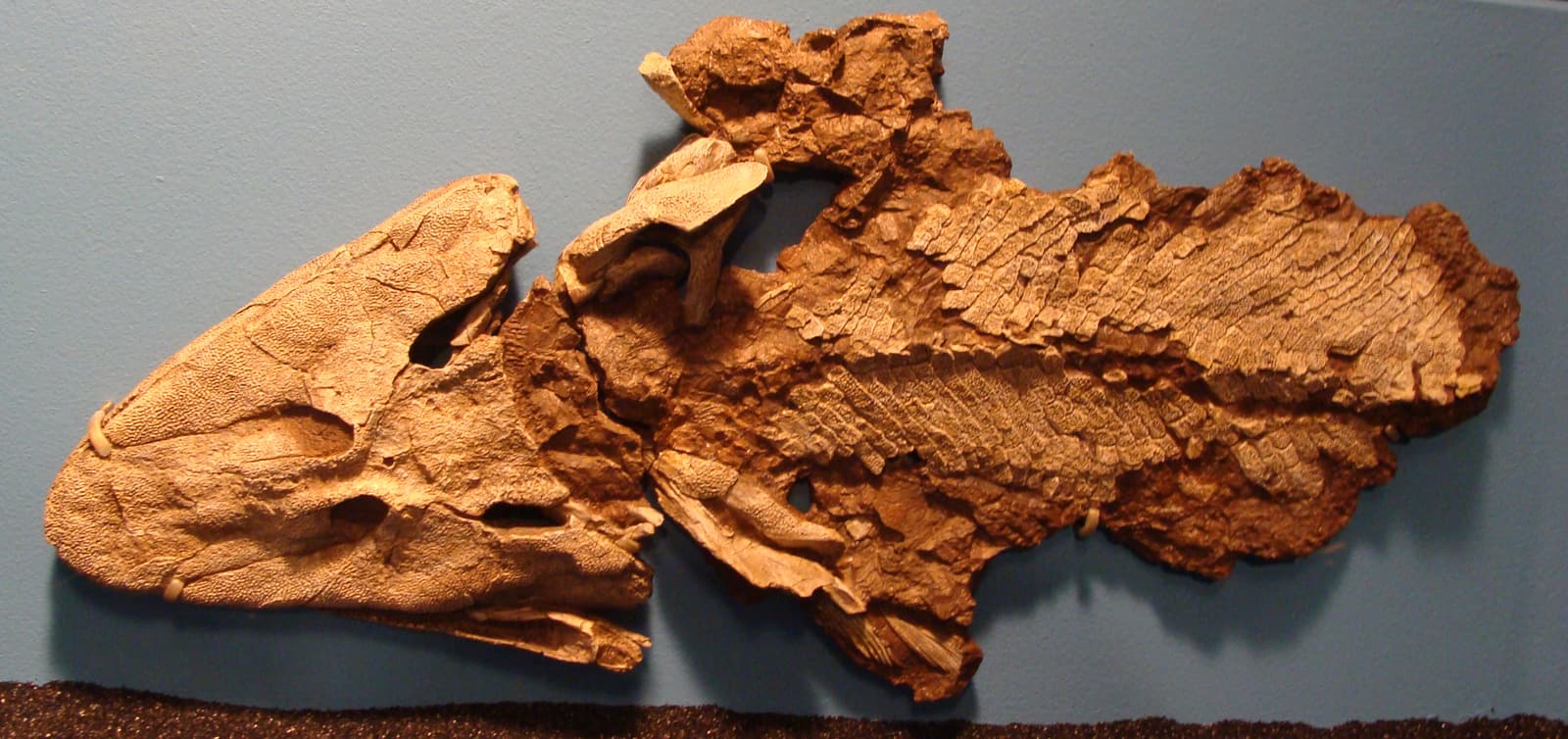
Image context: the cover image shows a Tiktaalik specimen cast on display in Chicago, used here as a direct visual anchor for the fossil find discussed throughout this article.
1) What the 2006 discovery actually locked in
The original 2006 Nature description did two things that matter more than the phrase “transitional fossil.” It placed a well-preserved elpistostegalian fish in the Late Devonian of Arctic Canada, and it documented a mosaic of traits that could not be reduced to either a “normal fish” or an “early tetrapod” template.[1]
The abstract-level evidence is still the backbone:
- geological context: Late Devonian, shallow-water marginal setting in Arctic Canada,
- primitive fish-like traits retained (for example, scales and fin rays),
- derived traits relevant to tetrapod evolution present in the same animal, including a mobile neck and a functional wrist-like joint.[1]
The companion paper in the same issue focused on the pectoral appendage and made the mechanical point explicit: distal endochondral elements and synovial joints supported limb-like postures, including substrate-supported stance mechanics.[2]
That is why Tiktaalik was never just “fish that looked weird.” From day one, the find mattered because it constrained sequence: some limb-related functional architecture emerged before digits.
2) Close-reading the find as an evidence stack, not a single claim
A useful way to avoid overclaim is to read the fossil in three stacked layers.
Layer A: direct preserved morphology
This is the strongest layer. From the 2006 and 2008 descriptions, readers can directly anchor on observed structures: skull proportions, jaw/palate architecture, pectoral-fin endoskeleton, and cranial elements that combine primitive and derived states.[1][2][3]
Layer B: functional interpretation with explicit mechanical constraints
Here evidence is still strong, but inferential. Wrist-like joints and robust pectoral architecture support arguments about substrate interaction and posture range; cranial restructuring supports changing feeding/head-use regimes.[2][3]
Layer C: macroevolutionary narrative
This is where caution is mandatory. “This is how vertebrates came onto land” is a broad claim built from many taxa and environments, not one specimen. Tiktaalik is a central constraint in that synthesis, but not the whole synthesis.
Keeping these layers separate is the difference between careful reconstruction and textbook myth.
3) The 2014 pelvis paper changed the transition model more than most summaries admit
For years, public explanations of the fish-to-limb transition leaned heavily on forelimb-first imagery. The 2014 PNAS study on Tiktaalik pelvic material forced a rebalancing.[4]
The paper reports multiple isolated pelves plus a complete pelvis with partial pelvic fin associated with the type specimen, and describes a greatly enlarged, robust pelvic architecture relative to other finned tetrapodomorphs.[4] At the same time, primitive features remained (including no sacral-rib attachment and no ischium).[4]
The crucial consequence is conceptual, not cosmetic: hind-appendage reinforcement and trends toward hind-fin-based propulsion were already underway in finned relatives of tetrapods.[4] In practice, that weakened simple narratives in which hindlimb-driven support appears only after “real limbs” arrive.
4) The 2024 axial skeleton evidence tightened the trunk–pelvis linkage question
The 2024 PNAS axial-skeleton study added another structural layer by describing specialized rib regionalization in Tiktaalik and proposing functional linkage between sacral-domain ribs and the expanded pelvis via ligamentous connection.[5]
This matters because transition stories are often told as “appendages changed, then trunk support caught up.” The new result argues that elements of axial support reorganization and pelvic coupling were already being assembled in finned vertebrates before limbs with digits.[5]
In other words, the transition may be less “appendage first, body later” than a coordinated package of partial changes distributed across skull, appendage, and trunk systems.
5) Feeding mechanics show the same mosaic logic
A 2021 PNAS study on Tiktaalik feeding system morphology and kinematics argued that the taxon combined cranial kinesis (associated with aquatic suction-feeding systems) with cranial restructuring that supported biting and snapping behaviors.[6]
That mixed configuration mirrors the locomotor story: not a binary swap, but overlapping functional regimes during transition. The broad methodological lesson is portable beyond Tiktaalik: when lineages cross major ecological boundaries, intermediate forms can carry incompatible-seeming features at the same time because they solve multiple demands simultaneously.
6) What this fossil still cannot settle by itself
Even with 2006–2024 evidence layers, Tiktaalik cannot independently answer several common overextended claims:
- Exact path to terrestrial gait: it constrains possibilities, but does not provide a full locomotor sequence for all near-tetrapod lineages.
- Single-environment origin story: shallow marginal settings are strongly implicated, yet broader Devonian ecological diversity means no one habitat model should be universalized from one taxon.
- One-line transition chronology: timing and character acquisition remain distributed across multiple taxa, not reducible to one branch.
This is not a weakness of the fossil; it is how good paleontology works. Strong fossils narrow model space, they do not replace model testing.
7) A better way to read future fish-to-limb discoveries
When the next high-profile tetrapodomorph paper appears, three checks keep interpretation disciplined:
- Anatomical check: what structures are directly observed versus reconstructed?
- Functional check: which claims are mechanically supported, and which are extrapolated?
- Sequence check: does the new fossil alter order of character acquisition or only add another example of known patterns?
By that standard, Tiktaalik remains unusually valuable in 2026. Not because it is a mascot fossil, but because each new paper on it has repeatedly shifted causal sequence in a testable way.
The best close reading is therefore not “fish became tetrapods here.” It is: this find and its later associated material keep refining the engineering pathway of vertebrate terrestrialization—joint by joint, rib by rib, and inference layer by inference layer.
Sources
- Daeschler, Shubin & Jenkins (2006), Nature: “A Devonian tetrapod-like fish and the evolution of the tetrapod body plan.”
- Shubin, Daeschler & Jenkins (2006), Nature: “The pectoral fin of Tiktaalik roseae and the origin of the tetrapod limb.”
- Downs et al. (2008), Nature: “The cranial endoskeleton of Tiktaalik roseae.”
- Shubin, Daeschler & Jenkins (2014), PNAS: “Pelvic girdle and fin of Tiktaalik roseae.”
- Stewart et al. (2024), PNAS: “The axial skeleton of Tiktaalik roseae.”
- Lemberg et al. (2021), PNAS: “The feeding system of Tiktaalik roseae: an intermediate between suction feeding and biting.”
- Wikimedia Commons image source (Tiktaalik Chicago specimen cast)