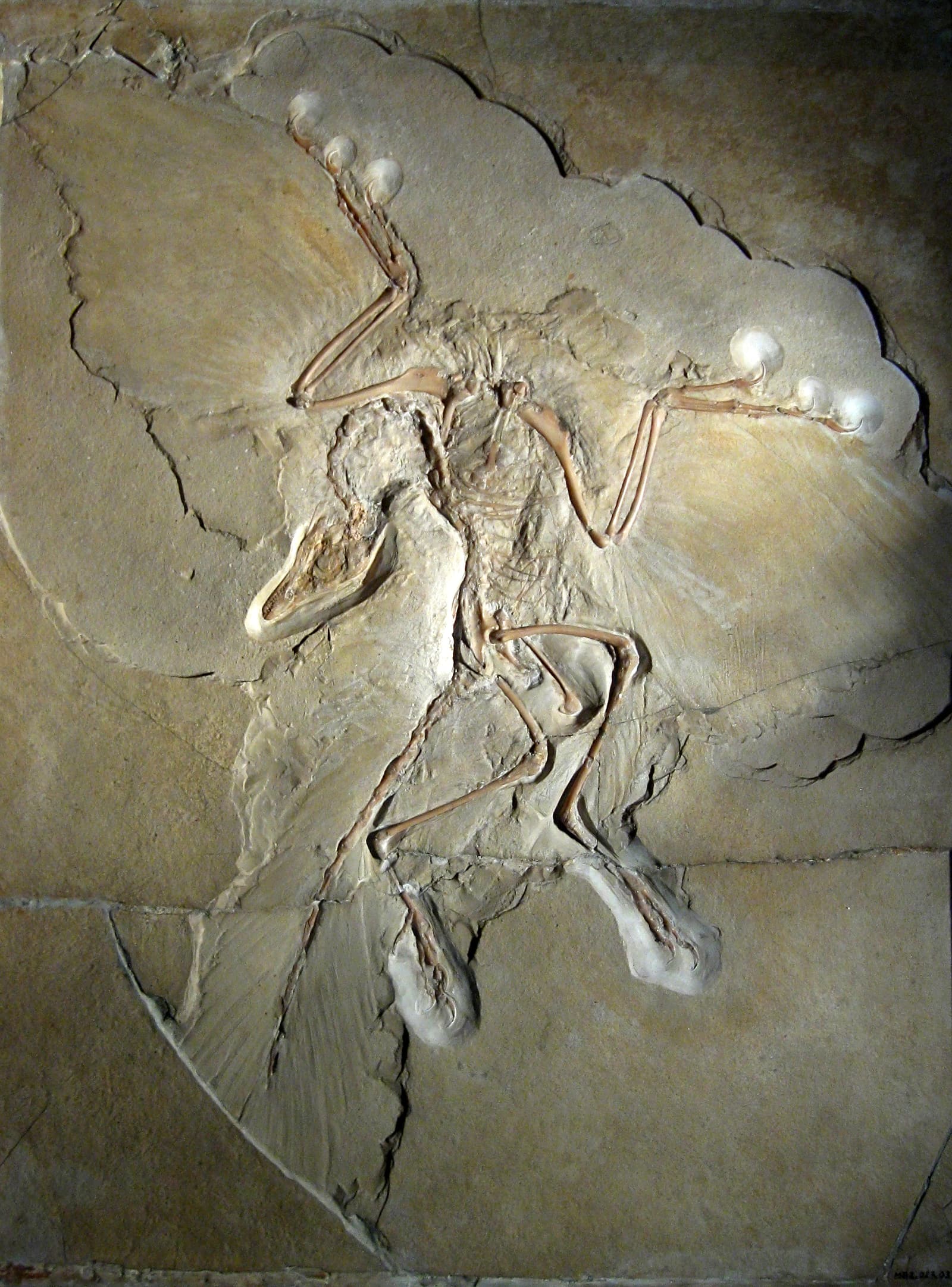
As of 2026-03-11 (UTC), the bird-origin conversation is no longer moving at one speed. In under 13 months, three papers shifted the map in different directions: one pulled derived avian anatomy deeper into the Jurassic, one upgraded the anatomical resolution of Archaeopteryx, and one argued that feeding mechanics were already being shaped by flight-related demands.[1][2][3]
That combination matters because the old argument structure—"find a birdlier skeleton, move the origin date"—is no longer enough. The current signal is multi-axis: tail architecture, wing and feather control surfaces, and cranial feeding mechanics are all being revised at once, but not always with the same confidence level.
Image context: the cover image shows the Berlin specimen of Archaeopteryx, used here as a stable visual anchor for the broader transition debate. The report itself focuses on newer 2025–2026 evidence layers added on top of this classic reference taxon.
Dispatch 1 (2025-02): a short-tailed bird appears in the Late Jurassic record
The Nature paper published on 2025-02-13 reports an "earliest short-tailed bird" from Late Jurassic deposits in China.[1] The headline implication is straightforward: features that many readers associate with later avian body plans may have emerged earlier than the classic Archaeopteryx-centric timeline suggested.
The more technical implication is about branching structure. If short-tail architecture is already present this early, then either:
- the avialan radiation had already diversified into multiple body-plan experiments by the Late Jurassic, or
- character acquisition was more mosaic than linear, with different systems reaching "derived" states on partially independent clocks.
Either way, this pushes against the comfortable teaching model in which one iconic taxon represents one clean midpoint.
Dispatch 2 (2025-05): the Chicago Archaeopteryx raises anatomical resolution
A second Nature paper, published on 2025-05-29, reports the nearly complete and uncrushed "Chicago" Archaeopteryx specimen and emphasizes exceptional preservation plus micro-CT-guided preparation.[2]
This is not just one more specimen count increment. Better preservation quality changes what researchers can ask:
- not only "which bones are present," but how they articulate in fine detail,
- not only "feathers existed," but how plumage arrangement and soft-tissue traces constrain functional interpretation,
- and not only "bird-like vs dinosaur-like," but which trait clusters are coupled versus decoupled.
That shift from coarse morphology to higher-resolution functional anatomy is exactly where transition debates get recalibrated.
Dispatch 3 (2026-02): feeding apparatus enters the flight-demand argument
A 2026 paper in The Innovation reframes part of the Archaeopteryx discussion around feeding apparatus features, arguing that avian-like oral structures reflect elevated demands linked to flight.[3]
Even if some details are debated, this paper expands the active evidence front from external skeletal form into oral functional anatomy. In practical terms, it asks the field to treat cranial-feeding systems as part of the same transition machinery as wings and tails, not as a side note.
This is a meaningful update because evolutionary narratives become more robust when independent systems converge. If locomotor and feeding adaptations both move in compatible directions, the inference corridor narrows.
What changed in the timeline, numerically
A compact way to read the update:
- 150.8–148.5 Ma: classic Archaeopteryx temporal window in the Late Jurassic remains central as a calibration anchor.[6]
- 2025-02-13: publication date of the short-tailed Jurassic bird report, pushing derived-tail discussion earlier in time.[1]
- 2025-05-29: publication date of the Chicago specimen analysis, improving anatomical resolution on a key transition taxon.[2]
- 2026-02: publication window of the feeding-apparatus paper, broadening the transition argument into oral functional anatomy.[3]
The key point is not one date replacing another, but a denser stack of constraints entering within a ~12-month research window.
Why this is a field report, not a verdict
A high-quality transition update should separate strong signals from open questions.
Stronger now
- The Jurassic avialan landscape appears more morphologically diverse than older simplified diagrams imply.[1][7]
- Archaeopteryx remains central, but specimen quality differences now matter as much as specimen count.[2][5]
- Functional interpretation is expanding beyond limb-and-tail framing into feeding mechanics and cranial systems.[3]
Still open
- Character polarity disputes are not gone: some traits may be convergent or variably expressed across close lineages.
- Phylogenetic placement can still shift depending on matrix construction and weighting choices.
- Functional claims from preserved structures still require careful boundaries between direct evidence and inference.
That uncertainty is not weakness; it is what a maturing evidence stack looks like.
Operational takeaway for readers tracking bird-origin science
If you want to follow this literature without getting trapped by headline churn, use a three-filter read:
- Chronology filter: track publication dates and geologic ages separately; do not collapse "new paper" into "younger fossil" automatically.
- System filter: note which anatomical system changed (tail, wing-feather system, feeding apparatus, etc.).
- Inference filter: mark whether the claim is direct observation, comparative interpretation, or broader evolutionary extrapolation.
That method keeps major progress visible while preserving uncertainty boundaries.
The current state of play is not "we solved bird origins," and it is not "everything is up for grabs." It is a tighter and more complex map: the Late Jurassic transition zone is now constrained by more independent evidence channels than it was even a year ago.
Sources
- Zhou et al. (2025), Nature: “Earliest short-tailed bird from the Late Jurassic of China.”
- Pittman et al. (2025), Nature: “Chicago Archaeopteryx informs on the early evolution of the avian bauplan.”
- Wang et al. (2026), The Innovation: “Avian features of Archaeopteryx feeding apparatus reflect elevated demands of flight.”
- Foth, Tischlinger & Rauhut (2014), Nature: “New specimen of Archaeopteryx provides insights into the evolution of pennaceous feathers.”
- Rauhut, Foth & Tischlinger (2018), PeerJ: “The oldest Archaeopteryx (Theropoda: Avialiae): a new specimen from the Kimmeridgian/Tithonian boundary of Schamhaupten, Bavaria.”
- Wikipedia synthesis page with specimen/timeline references: Archaeopteryx.
- Xu et al. (2023), Nature: “A new avialan theropod from an emerging Jurassic terrestrial fauna.”
- Wikimedia Commons source image (Berlin specimen)