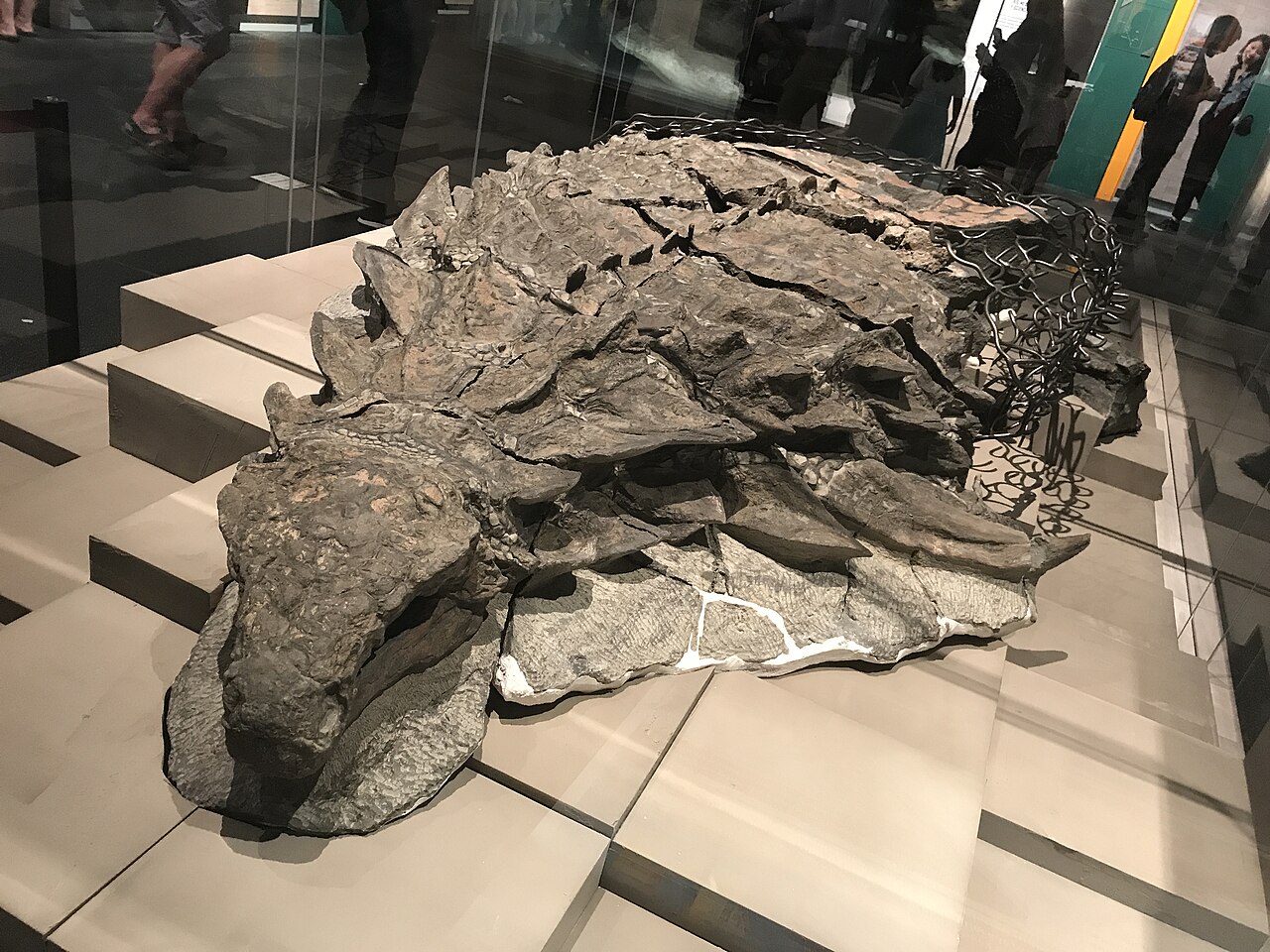
Most dinosaur species profiles end after body plan and phylogeny. Borealopelta markmitchelli is more valuable than that template allows. This animal is important not only because it is visually complete, but because the specimen preserves a linked evidence chain across anatomy, behavior-relevant signaling, and paleoecology.
That chain starts in the Albian of the Early Cretaceous (about 110–112 million years ago), in what is now Alberta. It runs through one of the best-preserved large armored dinosaur bodies yet recovered, and ends with direct data about what this individual actually ate shortly before death. For paleontology, that is unusually high-resolution.
Image context: the cover image shows the Borealopelta holotype on display at the Royal Tyrrell Museum, used here as the direct visual anchor for the species discussed in this profile.
1) Taxonomic identity is only the entry point
Brown and colleagues formally described Borealopelta markmitchelli in 2017 as a nodosaurid ankylosaur from the Lower Cretaceous of Alberta.[1] The paper’s headline result is often framed as “exceptional preservation,” which is true, but the deeper value is how that preservation constrains interpretation.
Because the body is preserved three-dimensionally with armor in life position, the specimen reduces the usual ambiguity around how much apparent shape is biology versus burial distortion. In many armored dinosaurs, that distinction stays fuzzy. Here, the signal-to-noise ratio is much better.
In other words, Borealopelta is not just a new taxon name in a crowded clade. It is a high-fidelity anchor for how nodosaur anatomy actually sat on a living body.
2) Armor in bone is one dataset; armor in life is another
A second 2017 study focused on osteoderms and their keratinous coverings.[2] This matters because “armor” is often reconstructed from bony cores alone, even though living function and visual profile depend heavily on the outer sheath.
The Borealopelta material preserved enough external structure to show that horn and spine profiles in life could differ substantially from what bare bone suggests.[2] That changes both defensive and display interpretation. If we only map combat or deterrence mechanics from skeletal cores, we can understate true reach, silhouette, and threat presentation.
This is also where species profiling gets more rigorous: the specimen lets us separate what is inferential in most taxa from what is directly constrained in this one.
3) Coloration evidence reframes predator-prey assumptions
The 2017 Current Biology analysis reported melanin-associated microbodies and interpreted the animal as countershaded.[1] The evolutionary implication is not cosmetic. Countershading tends to be selected when visual detection risk remains meaningful.
That creates an uncomfortable but productive tension: Borealopelta was heavily armored, yet still appears to have carried camouflage-relevant tonal structure.[1] Taken together, armor and countershading imply that defense was layered, not singular. The ecological story becomes “hard to kill and hard to detect,” not “invulnerable, so concealment no longer matters.”
For Cretaceous predator-prey dynamics, this is a stronger model than the old binary in which large armor equals near-total release from predation pressure.
4) The stomach-content record turns profile writing into ecology
The 2020 Royal Society Open Science paper on the specimen’s cololite (fossilized gut content) is what elevates this species profile from morphology to behaviorally relevant ecology.[3]
The authors reported a last meal dominated by fern material, with a measurable charcoal component (about 6%), supporting interpretation of feeding in a post-fire regrowth landscape.[3] They also argued the ingested plants were in a phenological stage consistent with early to mid growing season intake.[3]
Few dinosaur profiles can say anything this specific about diet in time and habitat context. Here we can.
A 2023 follow-up vegetation study in central Alberta sharpened this ecological frame by comparing regional Albian plant availability with the Borealopelta gut-content signal, reinforcing the interpretation of selective feeding or feeding concentrated in fern-rich disturbed patches.[4]
5) The marine burial problem is part of the species story
A standard reader question is straightforward: how did a large terrestrial armored dinosaur end up so completely preserved in marine sediments?
Taphonomic work on upside-down ankylosaur preservation supports a bloat-and-float pathway in which carcass buoyancy, transport, and inversion can produce the observed orientation and preservation geometry in offshore settings.[5]
This matters for interpretation discipline. The specimen is extraordinary, but it is not a random miracle. It is a rare outcome inside a physically plausible transport-and-burial sequence. Framing it that way protects against two common errors:
- treating the fossil as too unique to generalize from at all;
- treating it as a perfectly typical nodosaur body with no preservational bias.
The right stance is between those extremes: high informational value, with explicit taphonomic boundary conditions.
6) What Borealopelta does — and does not — settle
A strong species profile should separate locked findings from open questions.
What this specimen now anchors with high confidence:
- nodosaur external anatomy with unusual body-surface fidelity,[1][2]
- ecologically meaningful coloration evidence in a large armored dinosaur,[1]
- direct dietary evidence tied to habitat disturbance context.[3][4]
What it still does not solve alone:
- full nodosaur behavioral range across growth stages and regions,
- how representative this individual is for all contemporaneous nodosaurids,
- fine-grained seasonal or multi-year dietary flexibility beyond one preserved gut-content snapshot.
That boundary is exactly why Borealopelta remains valuable in 2026. It is a benchmark specimen: rich enough to test ecological hypotheses, constrained enough to keep those hypotheses honest.
Sources
- Brown et al. (2017), Current Biology: “An Exceptionally Preserved Three-Dimensional Armored Dinosaur Reveals Insights into Coloration and Cretaceous Predator-Prey Dynamics.”
- Brown et al. (2017), PeerJ: “An exceptionally preserved armored dinosaur reveals the morphology and allometry of osteoderms and their horny epidermal coverings.”
- Brown et al. (2020), Royal Society Open Science: “Dietary palaeoecology of an Early Cretaceous armoured dinosaur (Ornithischia; Nodosauridae) based on floral analysis of stomach contents.”
- Kalyniuk et al. (2023), Palaeogeography, Palaeoclimatology, Palaeoecology: “The Albian vegetation of central Alberta as a food source for the nodosaurid Borealopelta markmitchelli.”
- Mallon et al. (2018), Palaeogeography, Palaeoclimatology, Palaeoecology: “A ‘bloat-and-float’ taphonomic model best explains the upside-down preservation of ankylosaurs.”
- Wikimedia Commons image source (Borealopelta holotype photo)