Tiktaalik gets remembered as a celebrity fossil, the fish with a meme-ready face and a slogan attached to it. That memory is too small for what the animal actually did inside vertebrate history. The useful change was not that one specimen suddenly turned fish into land animal. The useful change was that Tiktaalik made the water-to-land transition look less like a single leap and more like a sequence of engineering problems solved in shallow water.[1][2]
Read that sequence closely and the order matters. In the 2006 description, the headline traits were already striking: a shortened skull roof, modified ear region, mobile neck, functional wrist joint, and geological context pointing toward shallow-water, marginal habitats in Late Devonian Arctic Canada.[1] Later work added more of the same logic, not less. The pelvis grew larger and more mobile than older models expected; the axial skeleton shows sacral-domain ribs and a linkage between the vertebral column and the pelvis before true limbs appear; the skull retained evidence for suction-related expansion even while becoming better at snapping and biting.[2][3][4]
That is why Tiktaalik remains more than a transition icon. It is one of the clearest demonstrations that the shoreline body plan arrived in pieces, with support, steering, and feeding reworked inside a finned vertebrate long before tetrapod feet began leaving a fully terrestrial signature.
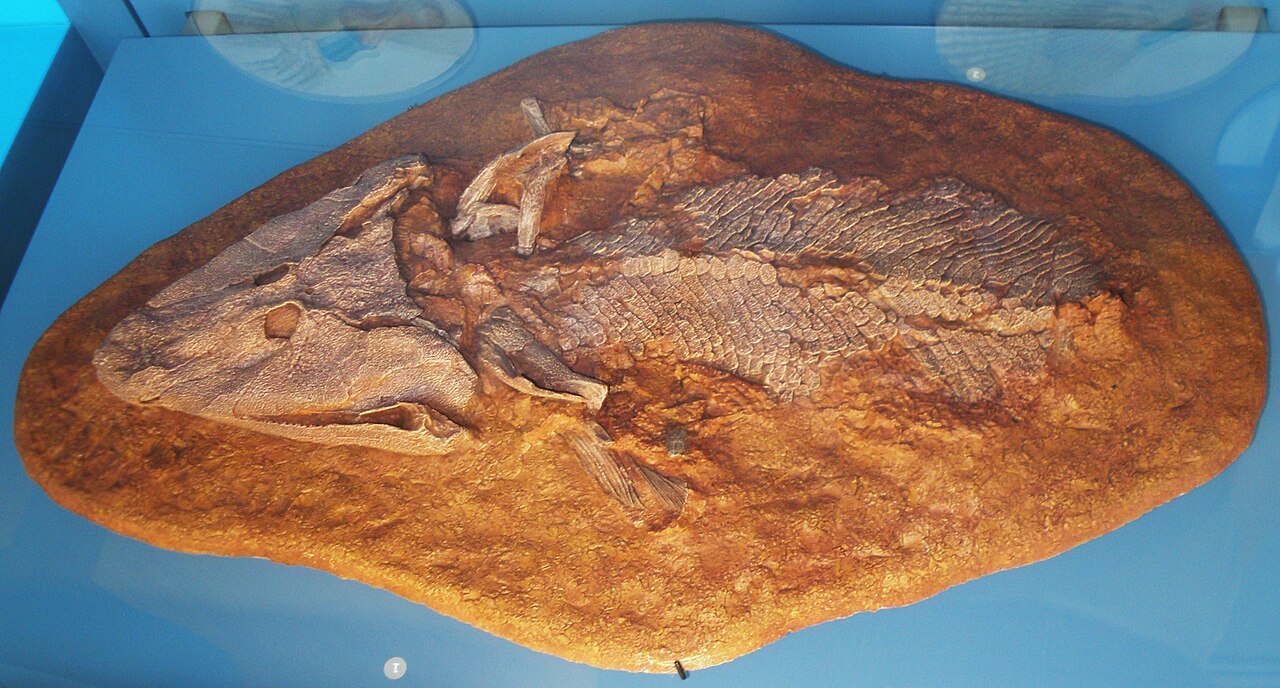
The Transition Became A Sequence Problem
The older public story about the origin of tetrapods often sounded too binary: fish first, land vertebrates later, with one dramatic crossing point in between. Tiktaalik complicated that narrative in a productive way. The Nature paper did not present a creature with full limbs already in place. It presented a finned animal that combined primitive fish traits with features that foreshadowed later tetrapod conditions, including a mobile neck and a wrist-like forefin joint.[1]
That combination changed the question from "Which fossil is the first walker?" to "In what order did the relevant parts of the body change?" Once framed that way, Tiktaalik became valuable because it preserves a body organized for a habitat at the water's edge. A neck matters when the shoulder girdle no longer fuses the head to the trunk as tightly. Wrist-like joints matter when the front appendage has to press, prop, or pivot against a substrate. Enlarged ribs matter when the trunk has to resist sagging and share load differently from a fully buoyant swimmer.[1][2]
The point is not that Tiktaalik had already solved life on land. The point is that several of the structural demands associated with that move had already begun to reorganize the skeleton while the animal still carried fins, fin rays, and an unmistakably aquatic life history.[1][2]
Support Came Before Steps
The 2014 pelvic material made that lesson sharper. New fossils showed well-preserved pelves and a partial pelvic fin, and the University of Chicago summary of the study emphasized how expanded size, mobility, and robusticity in the pelvic girdle, hip joint, and fin opened a wider range of motor behaviors than older "front-wheel drive" models had assumed.[2] In plain terms, Tiktaalik no longer looked like a creature whose important mechanical story sat only in the front half of the body.
That mattered because the standard evolutionary picture had often placed strong hind appendages later in the transition, after vertebrates were already closer to full tetrapod locomotion. Tiktaalik pushed some of that change backward into fish-grade anatomy. The hind fin and pelvis were still fish-like, yet the proportions suggested that pelvic-driven motion had become more important than expected.[2]
The 2024 axial-skeleton paper extends the same argument into the trunk. Its abstract describes specialized sacral-domain ribs, expanded and ventrally curved, with likely ligamentous attachment to the enlarged iliac blade of the pelvis.[3] That is a technical way of saying the body was starting to connect trunk support and pelvic propulsion before the origin of limbs themselves. Head mobility, body support, and pelvic-fin buttressing were being reorganized together inside a finned vertebrate.[3]
This is the most illuminating way to place Tiktaalik in lineage context. The key innovation is not a theatrical first footstep. The key innovation is an increasingly load-aware body: head freed for independent movement, ribs helping manage support, forefins capable of bracing, pelvis enlarged, axial column beginning to acknowledge the hind appendage. The shoreline body plan was being assembled before digits finished the job.[1][2][3]
The Head Changed In Water
Tiktaalik also helps because it prevents a second oversimplification: the idea that feeding on land required an abrupt clean break from fish feeding in water. The 2021 PNAS study argues for something more interesting. CT analysis of the skull found a rigid cranial architecture suitable for biting and snapping, yet also joint morphologies consistent with limited cranial kinesis and suction generation.[4]
That mixed condition matters for the same reason the pelvis matters. Evolution was not waiting for a complete environmental handoff before reworking the anatomy. A creature living at the water margin could carry both older and newer solutions at once. The article's significance statement describes Tiktaalik as a key intermediate with a skull capable of biting while preserving structures that would still allow suction-related expansion, a combination compared with living gars and polypterids.[4]
That result fits the rest of the skeleton. Tiktaalik was not organized as a perfectly terrestrial animal trapped in a fish body, nor as a conventional fish with a few decorative tetrapod hints. It sat in a zone where functions overlapped. The front end could become better at substrate-based prey capture while still working inside an aquatic medium. The transition, in other words, was modular. Support changed in one register, steering in another, feeding in another, and the environment rewarded combinations before it rewarded clean replacements.[3][4]
Why Tiktaalik Still Holds The Middle
Many fossils now fill the broad fish-to-tetrapod interval, and that is exactly why Tiktaalik remains useful. It is not important because it stands alone. It is important because it occupies the middle with unusual clarity. The available fossil descriptions point in the same direction: Tiktaalik makes most sense as a shallow-water, bottom-engaged animal whose anatomy was reorganizing for shoreline demands without yet becoming a fully terrestrial redesign.[1][2][3]
That is a stronger and more precise claim than the old "missing link" label. Tiktaalik shows that the decisive changes were distributed. Neck before full terrestrial head carriage. Wrist-like support before hands. Enlarged pelvis before hind limbs become true legs. Axial-pelvic linkage before the full tetrapod trunk. Mixed feeding mechanics before a clean land-feeding system.[1][2][3][4]
Once you see that order, Tiktaalik stops being a mascot for a single crossing. It becomes evidence for a deep-time principle: major evolutionary transitions are often assembled in habitats where old and new demands overlap. In that overlap zone, the body experiments with combinations first. Tiktaalik is memorable because it preserves one of those combinations unusually well.
Sources
- Edward B. Daeschler, Neil H. Shubin, and Farish A. Jenkins Jr., "A Devonian tetrapod-like fish and the evolution of the tetrapod body plan." Nature 440, 757-763 (2006).
- University of Chicago News, "Discovery of new fossils reveals key link in evolution of hind limbs" (2014).
- Thomas A. Stewart et al., "The axial skeleton of Tiktaalik roseae." Knowledge UChicago / PNAS record and abstract (2024).
- Justin B. Lemberg, Edward B. Daeschler, and Neil H. Shubin, "The feeding system of Tiktaalik roseae: an intermediate between suction feeding and biting." PNAS via PMC (2021).
- Wikimedia Commons file page for the specimen photograph used as the article image, "File:Tiktaalik roseae.jpg".