Protoceratops is often introduced from the wrong end. Sometimes it arrives as a miniature prelude to Triceratops; sometimes it appears through the famous Gobi egg story; sometimes it is reduced to a cute hornless ceratopsian that never quite became impressive.[1][3][4] The better reading is stricter. Protoceratops matters because it lets early ceratopsian biology come into focus before giant horns dominate the scene. In a small-bodied animal from the Campanian Djadokhta Formation of Mongolia, the beak, the oversized skull, the neck frill, and a deep growth series are already doing most of the evolutionary work.[1][2][3]
That makes the taxon more revealing than its popular shorthand. Maiorino, Farke, Kotsakis, and Piras describe Protoceratops andrewsi as a small, quadrupedal neoceratopsian, under two meters long, with a thin bony frill over the neck and without the prominent horns that later ceratopsids made famous.[1] The same paper also stresses why the genus became such a useful laboratory taxon: more than one hundred well-preserved skulls and skeletons, including juveniles and adults, have been collected since the American Museum of Natural History's Central Asiatic Expeditions.[1] Once that sample size exists, Protoceratops stops being a placeholder for "early horned dinosaur" and becomes a taxon in which growth, variation, and display can be tested.
Image context: the cover uses a real museum photograph of a mounted Protoceratops skeleton from Wikimedia Commons. It belongs here because the species is all about proportion. Even in skeletal form, the beak and broad frill already make the head the commanding structure of the body, while the missing giant horns remind the viewer that ceratopsian display did not begin at its later maximum.[5]
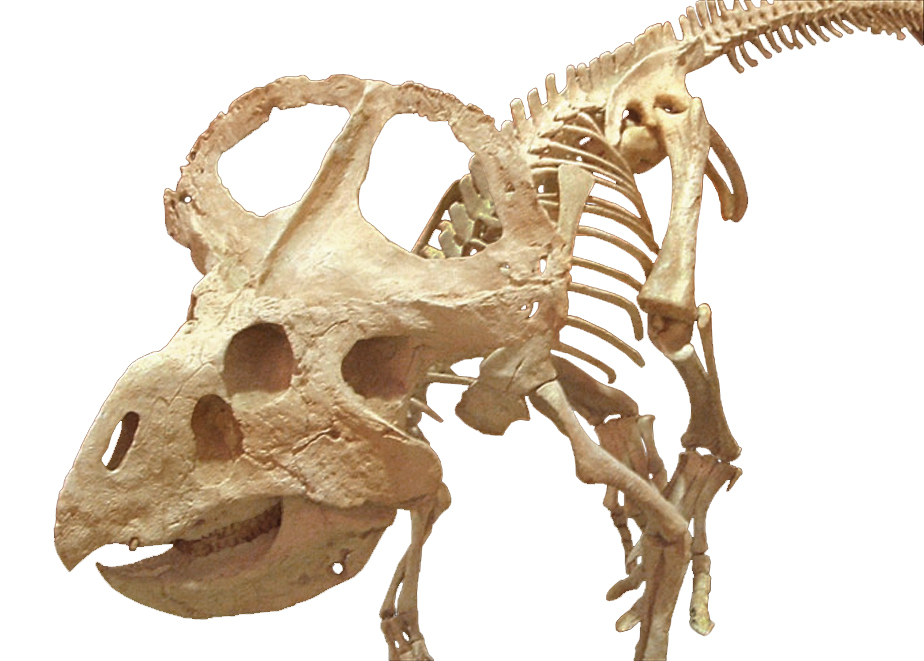
Before giant horns, the skull was already the center of the animal
The first thing Protoceratops clarifies is sequence. Ceratopsian history did not wait for the late, massive horned faces before turning the skull into the center of the animal's biology.[1][3] On the AMNH exhibition page, the museum explains that ceratopsian heads were enormous partly because the skull carried a bony collar, the frill, and that species differences across the clade are strongly tied to the shapes of frills and horns.[3] Read beside the morphometric work, that point becomes more precise for Protoceratops. This is a small-bodied herbivore whose head is already oversized and architecturally differentiated even though the later giant horns are absent.[1][3]
That matters because it blocks a lazy evolutionary story. Protoceratops is not important as an unfinished Triceratops. It is important because the core ceratopsian bargain is already visible in another form: a parrot-like beak for cropping plants, a large skull with a broad frill, and enough intraspecific variation to make display and recognition biologically plausible.[1][3] The frill does not need to wait for giant brow horns to become meaningful. The skull was already becoming a social and functional surface.
The frill makes the strongest sense as a growth-heavy display structure, not as simple armor
The frill is the taxon's best-known feature, but the evidence points away from the simplest old readings. AMNH's public explanation says the frill was thin, made the animal look larger, and was likely important in competition and attraction rather than acting as straightforward heavy protection.[3] The newer quantitative studies tighten that interpretation. The 2021 three-dimensional morphometric analysis found that the frill behaved as a distinct module within the skull, changed faster in size and shape during growth than other regions, and showed especially high morphological variance.[2] Those are exactly the kinds of patterns researchers expect from a structure under socio-sexual or broader social signalling pressure.[2]
At the same time, the same study did not recover clear sexual shape dimorphism.[2] That is where the species becomes more interesting. The signal need not be a simple male-versus-female badge. The frill can still be a visually important structure if it is involved in mutual assessment, dominance, or social signalling more generally.[2] Maiorino and colleagues reinforce the same caution from another direction. Their 2015 reassessment found that the classic claims of strong sexual dimorphism in frill height, frill width, and skull size are not well supported; most of the variation is better explained by ontogeny and ordinary intraspecific variation, with nasal horn height the only feature left as a limited candidate for dimorphism.[1]
That combination is the real scientific payoff. Protoceratops shows a ceratopsian display structure becoming large and biologically important without letting paleontologists sort every specimen into neat sex bins.[1][2] The frill grew fast, varied widely, and likely mattered in social life, but the signal was not organized in the cartoonishly binary way older museum lore often implied.
The egg story made Protoceratops famous, but it is also a warning about abundance
The Gobi reproductive story is where Protoceratops became culturally famous, and it is also where the taxon teaches methodological discipline. AMNH's dinosaur-egg page recounts that the first famous Flaming Cliffs eggs were initially attributed to Protoceratops because it was the most common dinosaur at the locality.[4] That was a reasonable inference from abundance, but later discoveries of identical eggs with an oviraptor embryo forced a correction: the eggs that made headlines were not Protoceratops eggs after all.[4]
That correction is not a side anecdote. It explains why Protoceratops still matters. The species is so common in the Gobi record that it can pull early interpretation toward itself before direct evidence arrives.[1][4] In other words, Protoceratops is useful not only because it is abundant, but also because its abundance shows where paleontologists can get ahead of the evidence. The same fossil richness that makes ontogeny legible can also tempt overconfident attribution.
Yet abundance remains scientifically productive when kept under control. The AMNH exhibition page notes that fossils range from infants to adults, giving the species an unusually strong growth series.[3] The egg page also shows Protoceratops skeletons associated with a nest, which keeps the taxon inside a real reproductive setting even after the famous misattribution is removed.[4] The result is a better, narrower conclusion. Protoceratops is not the owner of every famous Gobi egg, but it is one of the clearest ceratopsians for thinking about growth, social display, and life history together.
Why the species still holds
The best species profile for Protoceratops therefore starts small and stays specific. Confidence is high that this was a small-bodied Campanian neoceratopsian from Mongolia with a beak, a broad frill, a large sample of skulls across ontogeny, and a fossil history tightly linked to the Flaming Cliffs record.[1][3][4] The stronger interpretation built on that foundation is that ceratopsian display began as a frill-led system before giant horns took over the visual economy of the clade.[1][2][3]
That is why Protoceratops still deserves attention in 2026. It keeps ceratopsian evolution from collapsing into a story told only by later giants. Long before Triceratops turned the face into a full armature of horns and shield, Protoceratops was already showing how a beak, an oversized skull, and a fast-growing frill could reorganize the animal around feeding, signalling, and recognition. In that sense, the species is not a minor ancestor figure. It is where the head starts taking over.
Sources
- Leonardo Maiorino, Andrew A. Farke, Tassos Kotsakis, and Paolo Piras, "Males Resemble Females: Re-Evaluating Sexual Dimorphism in Protoceratops andrewsi (Neoceratopsia, Protoceratopsidae)," PLOS ONE (2015).
- A. Knapp, R. J. Knell, and D. W. E. Hone, "Three-dimensional geometric morphometric analysis of the skull of Protoceratops andrewsi supports a socio-sexual signalling role for the ceratopsian frill," Proceedings of the Royal Society B via PMC (2021).
- American Museum of Natural History, "My, What A Big Skull You Have" - exhibition page on Protoceratops frill growth, display, and juvenile-to-adult series.
- American Museum of Natural History, "Dinosaur Eggs" - Flaming Cliffs discovery history, the early Protoceratops egg attribution, and the later Oviraptor correction.
- Wikimedia Commons, "File:Protoceratops-skeleton.jpg" - museum photograph used as the lead image.