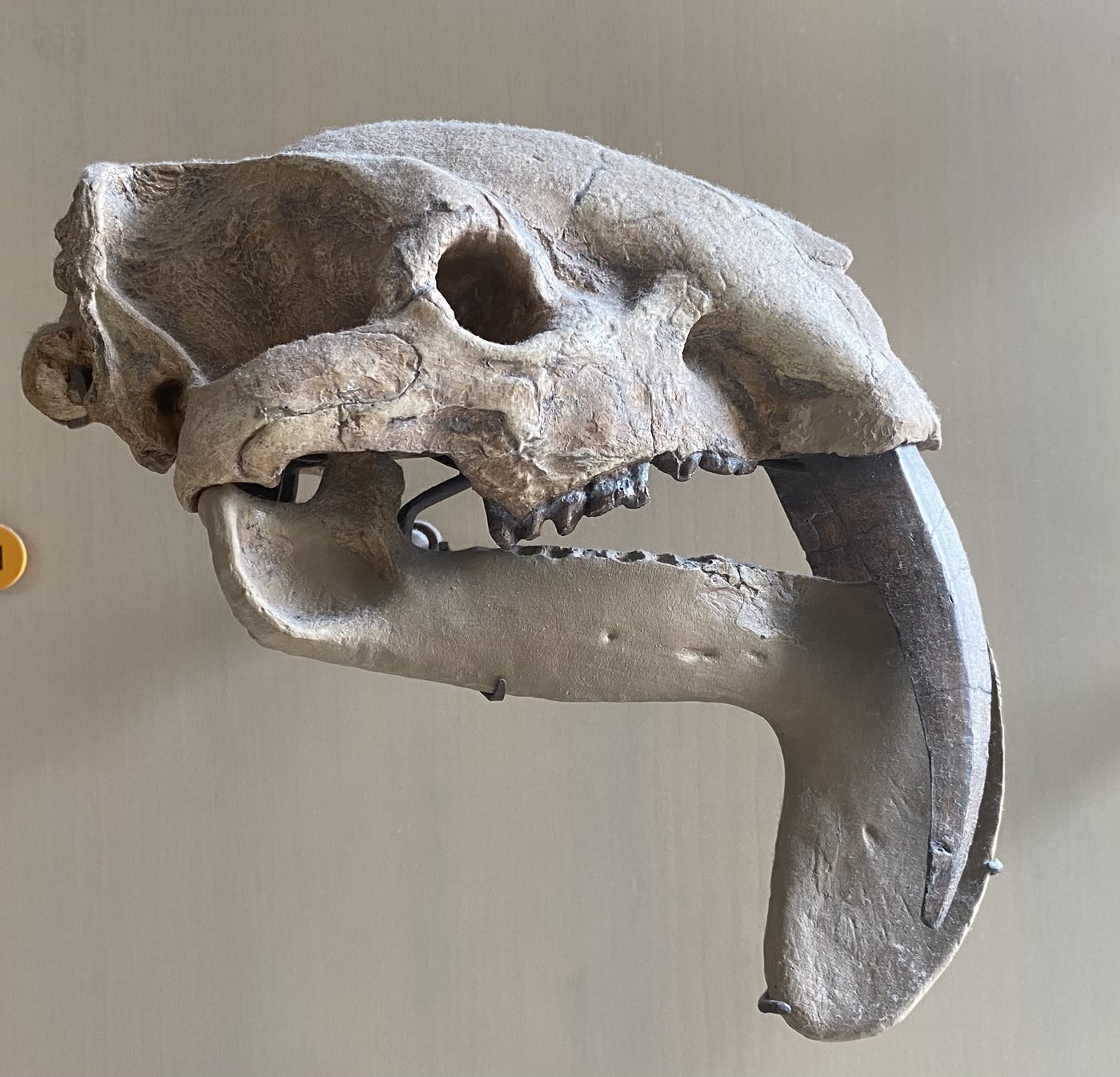
Thylacosmilus atrox is one of those extinct mammals that arrives in popular writing already mislabeled. The stock phrase calls it a "marsupial sabertooth tiger," which is catchy and anatomically clumsy. Thylacosmilus was not a tiger, not a cat, and on current evidence not even a straightforward ecological copy of Smilodon.[1][2][3] What makes the species worth profiling is exactly that mismatch between silhouette and function. It evolved enormous saber canines in South America, but the rest of the skull, the eyes, the bite system, and even the extinction story keep resisting the lazy cat analogue.
Once the profile is read on its own terms, the animal becomes stranger and better. It lived in South America from the late Miocene into the Pliocene, carried ever-growing upper canines, lacked the neat placental sabertooth toolkit many readers expect, and appears to have occupied a more specialized feeding niche than the old super-predator legend allowed.[1][2][4][5] The strongest profile is therefore not "South American Smilodon before Smilodon." It is an extreme sparassodont whose whole face and feeding apparatus were reorganized around a dental structure that changed almost everything else.
Image context: the lead image uses a real photograph of a Thylacosmilus skull at the American Museum of Natural History from Wikimedia Commons. It belongs here because this species is best understood from the skull itself. A life reconstruction can make the animal look like a familiar cat analogue too quickly; the museum specimen keeps the reader anchored in the actual osteology, where the oversized canines, the ventral flanges, and the unusual orbit placement immediately signal a more difficult anatomy.[6]
1) The best starting point is not the sabers alone, but the failed cat analogy
The resemblance to placental sabertooths is real at the level of outline. Thylacosmilus carried huge upper canines and a deep lower jaw that helped house them, so older accounts often treated it as one more iteration of the same predatory formula that later produced machairodont cats.[1][2] The problem is that closer comparison keeps breaking that formula apart.
The 2020 multi-proxy study by Janis, Figueirido, DeSantis, and Lautenschlager is the cleanest reset.[2] Their combined trait analysis, biomechanical modeling, and dental microwear work argued that Thylacosmilus diverged from placental sabertooths in important ways rather than simply converging on them. In their reading, the craniodental complex is not just a marsupial version of the same weapon system. The animal had a stronger pull-back capacity with the canines than placental sabertooths, but it lacked several features associated with the classic saber-tooth killing strike, and its postcanine wear did not read like a neat meat-shearing machine.[2]
That is why the profile sharpens once the word "copy" is removed. Convergence happened at the level of oversized sabers. It did not deliver a full duplicate of cat-like predation.[1][2]
2) Rootless canines changed the entire face, including the eyes
The 2023 Communications Biology paper by Gaillard, MacPhee, and Forasiepi added one of the most useful constraints on how to picture the animal's head.[3] Thylacosmilus has often looked visually wrong to paleontologists because its orbits are markedly divergent, more laterally set than those of familiar mammalian predators. That seems at first glance to undercut the expectation of stereoscopic hunting vision. But the paper showed that convergence of the orbits is not the whole story. Orbital frontation and verticality could compensate to preserve some stereoscopic function even as the eyes were displaced.
The deeper point is architectural. The paper argued that the extraordinary growth of the rootless canines forced skull-wide tradeoffs, including relative orbital displacement.[3] In other words, the species did not merely "add big teeth" to an otherwise standard predator head. The canines were such dominant structures that they reorganized the face around themselves. The eyes were not sitting in the wrong place because the animal was poorly designed. They were sitting in a compromised place because the sabers had become developmentally and functionally unavoidable.
This is one of the best reasons Thylacosmilus remains memorable. Many extinct animals are famous for a single exaggerated trait. Here the exaggerated trait rammed through the rest of the skull and forced a cascade of compensations. The orbits are part of the saber story, not a side note to it.[3]
3) The bite was powerful in one sense and weak in another
The older 2013 biomechanical paper by Wroe and colleagues remains valuable because it separates jaw power from the whole killing apparatus.[1] Their finite-element modeling found that jaw-adductor-driven bite forces in both Smilodon fatalis and Thylacosmilus atrox were low compared with a conical-toothed cat, but that neck-muscle-driven loading mattered enormously. For Thylacosmilus especially, the study suggested a skull well adapted to resist stress generated by head depressors, while the jaw adductors themselves contributed little to the kill.[1]
That result once helped make Thylacosmilus look like an even more specialized version of the saber-tooth lifestyle. The 2020 paper kept part of that picture and complicated the rest.[2] Janis and colleagues agreed that the animal's canines and skull were not behaving like a generic cat bite. But when they added dental microwear and broader trait comparison, they argued that the diet looked soft and that the overall feeding system did not support the usual image of a predator dispatching prey with the same sort of head strike inferred for placental sabertooths.[2]
The safest reading is therefore asymmetric. Thylacosmilus was not weak because it lacked dramatic anatomy. It was weak in the narrow sense that jaw-closing bite force does not seem to have been the center of its feeding system. The animal looks strongest when reconstructed as a specialist built around wide gape, neck-assisted action, and soft-tissue processing rather than as a straight analogue for a feline throat-biter.[1][2]
4) Detailed skull work made the species stranger, not simpler
The 2019 caudal cranium monograph by Forasiepi, MacPhee, and del Pino matters because it keeps the animal from collapsing into a profile-view icon.[4] Once the back of the skull, middle-ear walls, vasculature, and nerve pathways were described in detail, Thylacosmilus looked less like a simplified sabertooth caricature and more like a heavily specialized metatherian with its own cranial history. That kind of paper rarely becomes popular shorthand, but it does important profile work. It tells us the species was not just "teeth plus flange." The deeper skull was also carrying unusual structure and evolutionary information.[4]
This matters methodologically. Iconic extinct predators often get reduced to the feature visible on a poster or mount. In Thylacosmilus, that would be a mistake. The skull keeps rewarding full-anatomy reading because the weirdness is distributed. The canines are spectacular, but they are not the only thing that changed.[3][4]
5) Even the extinction story resists the old invasion myth
A familiar ending casts Thylacosmilus as the South American sabertooth that simply lost when northern cats arrived during the Great American Biotic Interchange. The newer evidence is less theatrical. The 2024 niche paper comparing Thylacosmilus atrox with Smilodon fatalis and Smilodon populator found no evidence for competition with S. populator and judged direct co-occurrence with S. fatalis unlikely despite some similarity in climatic niche space.[5] The paper instead pointed toward Thylacosmilus having a narrower climatic niche and lower tolerance for environmental change.[5]
That does not solve the extinction in one move. The authors themselves are cautious about record limits.[5] But it improves the boundary. The disappearance of Thylacosmilus does not need a neat duel narrative in which the "real" sabertooth arrives and wins. The better profile is consistent from head to end: this was a highly specialized South American predator whose narrow ecological positioning may have become a liability as environments shifted.[2][5]
6) What the species profile supports
High-confidence claims first. Thylacosmilus was a sparassodont metatherian, not a cat; it evolved enormous rootless upper canines; those canines forced broad cranial tradeoffs including orbital displacement; and the feeding system is poorly described by a simple cat-like killing bite.[1][2][3][4] It also appears safer to treat its extinction separately from a blunt Smilodon replacement story.[5]
The limits matter too. No current paper turns Thylacosmilus into a solved ecological equation. There is still argument over how exactly the canines interacted with prey or carcasses, and the fossil record does not let us observe behavior directly.[1][2] But the boundaries themselves are productive. They leave us with a species more interesting than the old label. Instead of a South American fake cat, the evidence supports an evolutionary outlier: a predator whose facial architecture, eye placement, and bite system were all bent around one extraordinary dental experiment.
Sources
- Stephen Wroe, Uphar Chamoli, William C. H. Parr, Philip Clausen, Ryan Ridgely, and Lawrence Witmer, "Comparative Biomechanical Modeling of Metatherian and Placental Saber-Tooths: A Different Kind of Bite for an Extreme Pouched Predator." PLOS ONE 8, no. 6 (2013).
- Christine M. Janis, Borja Figueirido, Larisa DeSantis, and Stephan Lautenschlager, "An eye for a tooth: Thylacosmilus was not a marsupial 'saber-tooth predator'." PeerJ 8 (2020).
- Charlène Gaillard, Ross D. E. MacPhee, and Analía M. Forasiepi, "Seeing through the eyes of the sabertooth Thylacosmilus atrox (Metatheria, Sparassodonta)." Communications Biology 6, article 257 (2023).
- Analía M. Forasiepi, Ross D. E. MacPhee, and Santiago del Pino, Caudal cranium of Thylacosmilus atrox (Mammalia, Metatheria, Sparassodonta), a South American predaceous sabertooth. Bulletin of the American Museum of Natural History no. 433 (2019).
- Fábio H. Ghilardi, Francisco J. Prevosti, and colleagues, "No evidence for niche competition in the extinction of the South American saber-tooth species." npj Biodiversity 3, article 7 (2024).
- Wikimedia Commons file page for the lead image, "File:Thylacosmilus skull at AMNH.jpg".