Stupendemys is usually introduced with one fact and then abandoned inside it: this was one of the largest turtles ever known, a freshwater giant from Miocene South America with a shell on nearly absurd scale.[1][3][4] That headline is accurate and still too small for the animal. The stronger species profile begins once size stops doing all the interpretive work. Stupendemys matters because several different kinds of evidence lock together in the same body: a shell large enough to reset the upper limit for nonmarine turtles, horned and hornless carapace morphotypes that likely record sex, jaws and skull material that sharpen the feeding picture, and a geographic spread broad enough to tie the species to the wetland world of northern South America rather than to one exceptional outcrop.[1][2][3]
That combination is why the genus still feels alive in 2026. The 2020 Science Advances paper described exceptional new material from Venezuela and Colombia and argued for a single giant turtle species distributed across the northern Neotropics during the middle to late Miocene.[1] The 2021 Heliyon follow-up then added the first associated skull-and-shell individual for Stupendemys geographica and used it to clarify both anatomy and growth.[2] Read together, those studies shift the animal away from poster status. This was not simply a giant river turtle that happened to overshoot modern size. It was a whole-body design shaped inside a very large wetland system.
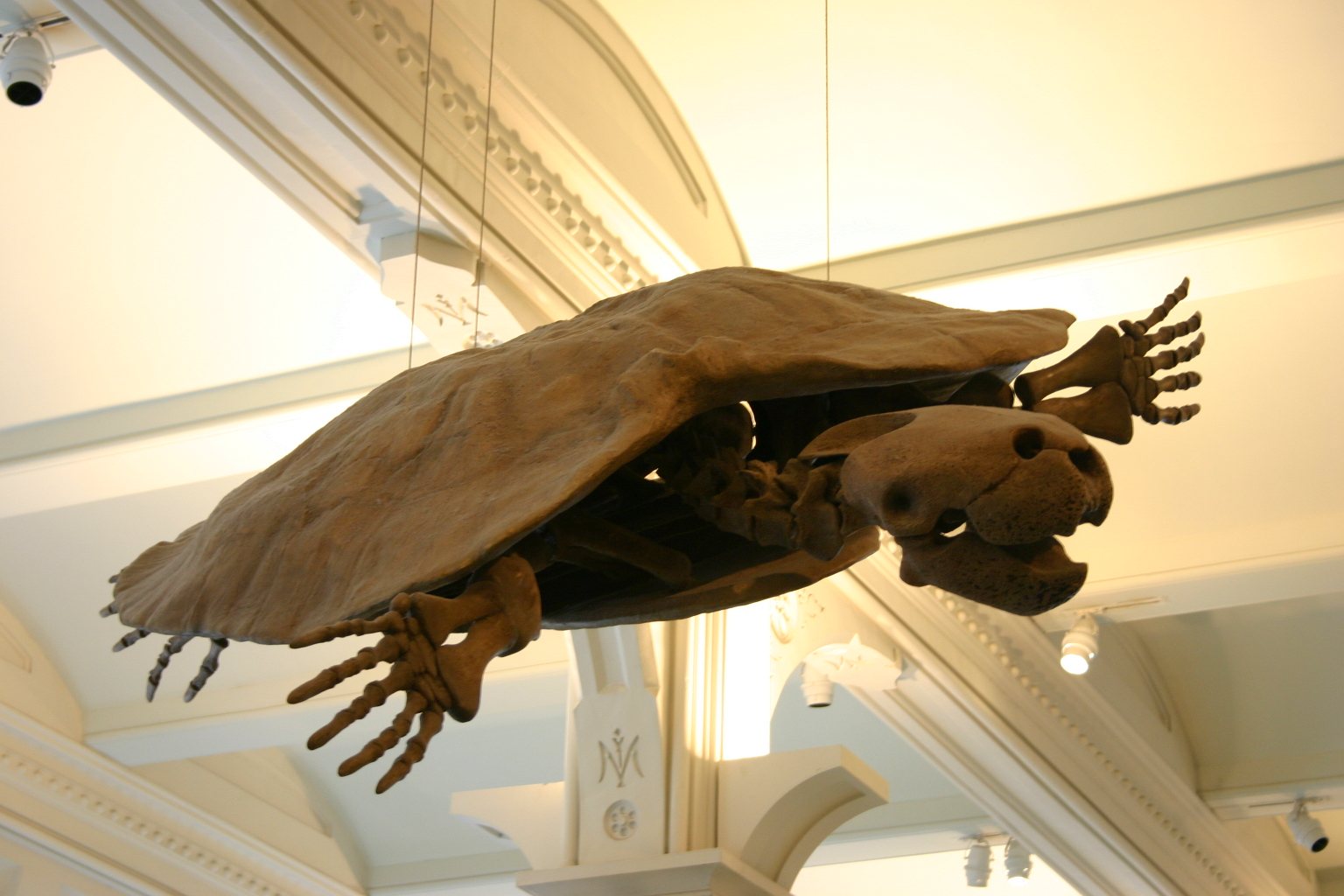
Image context: the cover uses a real photographed Stupendemys specimen from the 2021 Heliyon material, showing the carapace and associated skull together in dorsal view.[2][5] It belongs here because the article's argument depends on keeping scale and anatomy tied to one another. The shell tells you the animal was enormous. The skull reminds you that size alone is not the species.
1) The shell is not just big; it changes the profile into a structural argument
The size evidence is still the correct starting point because it resets what kind of turtle this is. Cadena and colleagues reported a complete carapace about 2.40 meters long and an estimated body mass of roughly 1,145 kilograms, making Stupendemys the largest complete shell known for any extant or extinct turtle in that study's sample and the largest nonmarine turtle securely known from a complete shell.[1] The University of Zurich release, written from the same research program, frames some individuals as reaching almost three meters across the carapace.[3] However the number is phrased, the point is the same: this is not a merely enlarged version of a modern river turtle.
But the shell matters for more than scale. The 2020 paper argued that two shell morphotypes likely reflect sexual dimorphism, with horned males and hornless females.[1][3] That claim is important because it prevents the horns from being treated as a generic species ornament or an isolated pathology. If correct, the shell was doing social work as well as defensive work. A giant body already changes what a turtle can survive. A horned carapace suggests that in at least some individuals, the front of the shell also entered display or combat space.
That is where the species profile becomes more specific. A giant shell can be turned into myth very quickly. Horns force the reader back toward biology. They imply variation within the species, not just magnitude beyond it.[1][3] Stupendemys stops being a giant dome and starts looking like a giant freshwater turtle whose body was structured by sex, interaction, and basin-scale ecology.
2) The skull and jaw material make the animal less one-note
The other reason Stupendemys deserves more than a size headline is that the head changed the story. The 2020 Science Advances paper added lower-jaw material and argued that the species may have had a broader diet than a narrow specialist reading would allow.[1] The very acute symphysial region and widened triturating surfaces fit an animal capable of handling a wider feeding range than the giant-carnivore caricature implied by comparisons with Caninemys.[1]
The 2021 Heliyon paper tightened this further by describing the first associated skull and shell for Stupendemys geographica from Colombia.[2] That matters because associated material reduces one of the old problems in giant Miocene turtle work: impressive shells and impressive skulls do not automatically belong to the same taxon. Cadena and colleagues explicitly reestablished Caninemys tridentata as distinct rather than collapsing every large turtle skull into Stupendemys.[2] That makes Stupendemys scientifically stronger, not weaker. A species is clearer once it stops absorbing every oversized neighbor.
The feeding picture becomes better at the same time. Stupendemys no longer needs to stand in for all giant turtle ecologies in the Miocene Pebas and Acre systems. It can be read more narrowly as a broad-diet giant side-necked turtle whose jaws and skull do not force a single prey style, and whose ecosystem evidently had room for more than one large-bodied turtle lineage at once.[1][2]
3) Growth and geography are part of the body plan
The associated Colombian material also matters because it adds an ontogenetic dimension. The 2021 paper describes changes through growth that include carapace flattening, constriction of the vertebral scutes, and an increase in the height and thickness of the nuchal upturn wall.[2] That may sound like background detail, but it changes how the shell should be read. Giant size was not only an endpoint. The shell itself changed shape through development in ways that help explain how the species arrived at its adult proportions.
Geography matters in the same way. The 2020 study placed Stupendemys across what were once the Pebas and Acre systems of northern South America, with material from Venezuela, Colombia, Brazil, and Peru folded into a wider wetland distribution.[1] That scale is essential to the profile. It suggests that the animal's size was not a freak result of one odd pond or one isolated river channel. Stupendemys belonged to a broad tropical wetland world full of giant vertebrates, including massive caimans such as Purussaurus.[1][3]
That ecological backdrop enters the shell directly. The 2020 paper reported bite marks and punctured carapace bones consistent with interactions with large caimans.[1] The safe reading is not a dramatized predator-prey screenplay. It is simpler and better: giant size did not remove the species from danger, and the Miocene wetland system that could sustain a turtle this large also sustained animals able to damage it. The shell was part of an arms-bearing environment, not a guarantee of immunity.
4) The right boundaries make the turtle more interesting
The evidence now supports a strong but disciplined profile. Stupendemys was a giant freshwater side-necked turtle whose shell set extreme size records, whose horned and hornless carapaces likely recorded sex, whose skull and jaw evidence point to a broad diet, and whose distribution tied it to a huge northern South American wetland system.[1][2][3][4] What the evidence does not give us is a full behavioral script. We do not know exactly how frequently the horns were used, how aggressive males were, or every food item taken across every locality.
Those limits improve the species rather than shrinking it. The best paleontology profiles are not built from maximum spectacle. They are built from the points where anatomy, growth, range, and ecological context reinforce one another. Stupendemys is memorable because the shell says scale, the horns say intraspecific structure, the skull says feeding breadth, and the map says this body only really works inside a giant wetland world.
That is the better way to hold the species in mind now. Stupendemys was not just a turtle with a bigger shell than modern readers expect. It was a Miocene river giant whose whole biology was distributed across sex, growth, feeding anatomy, and geography. Once those elements are kept together, the animal stops looking like a freshwater exaggeration and starts looking like one of the clearest basin-scale body plans in the fossil record.
Sources
- Edwin-Alberto Cadena, Torsten M. Scheyer, Jorge D. Carrillo-Briceño, Rodolfo Sánchez, Oswaldo A. Aguilera-Socorro, Andrés Vanegas, Mauricio Pardo, Dennis M. Hansen, and Marcelo R. Sánchez-Villagra, "The anatomy, paleobiology, and evolutionary relationships of the largest extinct side-necked turtle," Science Advances 6, eaay4593 (2020).
- Edwin-Alberto Cadena, Andrés Link, Siobhán B. Cooke, Laura K. Stroik, Andrés F. Vanegas, and Melissa Tallman, "New insights on the anatomy and ontogeny of the largest extinct freshwater turtles," Heliyon 7, no. 12 (2021).
- University of Zurich, "Extinct Giant Turtle Had Horned Shell of up to Three Meters" (February 12, 2020).
- Roger C. Wood, "Stupendemys geographicus, the world's largest turtle," Breviora 436 (1976).
- Wikimedia Commons file page for the photographed specimen used as the article image, "File:Stupendemys young adult.jpg."