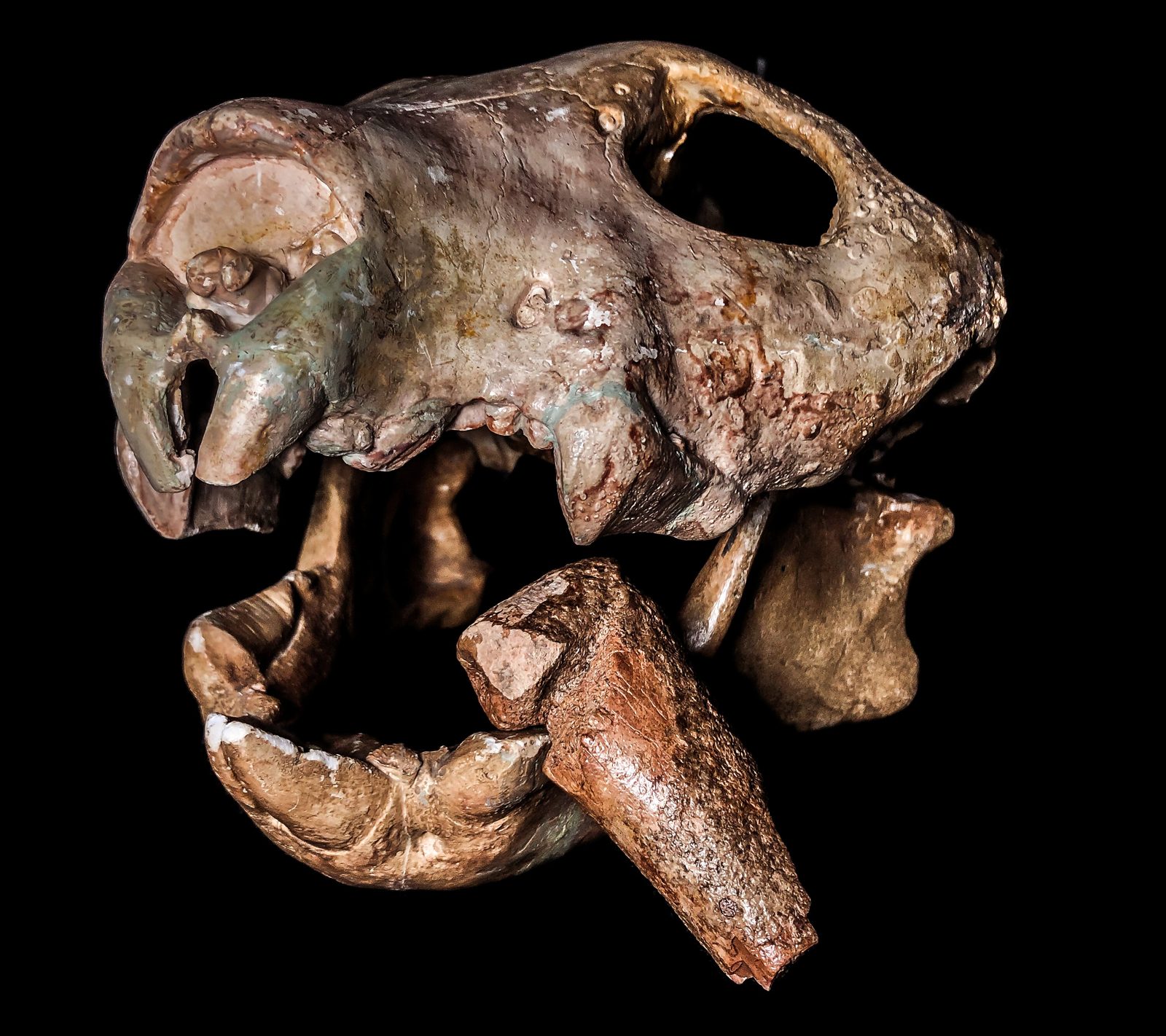
Thylacoleo carnifex is almost always introduced through the nickname first. "Marsupial lion" is efficient, memorable, and slightly misleading.[1][2] It makes readers expect a cat analogue with big canines, chase-oriented limbs, and a familiar mammalian carnivore script. The fossil evidence points to a stranger and better animal. Thylacoleo mattered because its third premolars turned into long shearing blades, its incisors took over the stabbing role that canines play in many placental predators, and its forelimb anatomy suggests a predator that did a great deal of gripping, holding, and manipulating at close range.[1][2][3][4]
That combination is why the species still reads as a serious paleontological problem instead of a museum mascot. The largest known mammalian carnivore from Pleistocene Australia was not simply "a lion, but marsupial."[1][4] It was a distinct predatory experiment built from a herbivore-derived lineage, with dental specialization and forelimb behavior that do not line up neatly with any living large carnivore.[1][2][3]
Image context: the cover uses a real Museums Victoria skull photograph from Wikimedia Commons. It belongs here because the species profile is really about the front end. The prey metatarsal sitting in the jaws clarifies the article's core claim in one glance: this animal should be read through bite geometry and prey handling, not through a cat nickname.[5]
1) The cheek teeth are the center of the profile
The Australian Museum page still provides the cleanest public summary of what made Thylacoleo anatomically distinctive: the third premolars became enlarged shearing blades, posterior molars were reduced, the canines were vestigial, and the upper incisors became large stabbing structures.[1] That arrangement is the first reason the "lion" label needs correction. In a placental big cat, the canines dominate the popular image and much of the killing story. In Thylacoleo, the most dramatic predatory specialization sat farther back in the tooth row.[1]
The 2008 Zoology paper by Wroe, Lowry, and Anton pushes the same point into comparative form.[2] Their multivariate study placed Thylacoleo with Smilodon as part of a robust large-prey ecomorph, but the route there was not identical. The paper stresses a combination of bear-like postcranial robustness and more felid-like carnassialization of the cheek-tooth row.[2] That is exactly the kind of sentence that improves a species profile. It does not flatten Thylacoleo into a marsupial copy of a placental cat. It tells you which parts of the body converged on what kind of predatory work.
This is why the skull deserves to carry the whole article. Once the blade premolar becomes the main event, Thylacoleo stops looking like a curiosity with the wrong nickname and starts looking like a specialized flesh-processing machine with an unusual dental plan.[1][2] The animal's predatory identity sits in the shearing geometry of the mouth before it sits in any cinematic reconstruction.
2) The forelimb makes the species harder, not easier, to compare with lions
If the teeth explain how Thylacoleo cut, the elbow and shoulder explain how it may have controlled prey. The 2016 Paleobiology study on elbow-joint morphology reaches a sharp conclusion: Thylacoleo is the only carnivorous mammal in the dataset to cluster with living animals that have an extreme degree of forearm maneuverability, and it appears to have used its forelimbs for grasping or manipulating prey to a much higher degree than an African lion does.[3]
That result is more valuable than another generic "powerful forelimb" statement because it narrows the kind of power involved. The paper does not simply say the forelimb was strong. It says the elbow morphology supports unusual maneuverability, that the animal was primarily terrestrial but retained some climbing ability, and that the semi-opposable thumb with its large retractable claw belongs inside that behavioral picture.[3] This is a profile built around handling as much as impact.
The 2018 PLOS ONE redescription strengthens the same read from a broader postcranial angle.[4] With more complete skeletal material, including the first full tail and newly recognized clavicles, Wells and colleagues argue for a relatively stiff tail, rigid lumbar spine, and shoulder girdle braced by strong clavicles.[4] Their comparisons point not toward a clean pursuit-predator model but toward a terrestrial hunter-scavenger with climbing capacity, closer overall to a scaled-up, more specialized version of a powerful grasping marsupial than to a long-distance runner.[4]
That matters because it changes the drama of the animal. Thylacoleo no longer reads as "Australian lion" in the Serengeti sense. It reads as a close-range predator whose body became dangerous when the jaws, forelimbs, thumb claw, and trunk all worked together.[2][3][4]
3) The lion nickname survives only if it stays narrow
There is still a useful reason the nickname persists. Thylacoleo really was a large predator capable of tackling big prey, and the 2008 paper is explicit that its body plan can be read as a robust ecomorph adapted to predation on large animals.[2] The mistake comes when the nickname starts doing taxonomic and functional work it cannot support.
First, the lineage is wrong if read lazily. The Australian Museum notes that most palaeontologists think thylacoleonid ancestors were herbivores, which is part of what makes the clade so interesting.[1] This was not just another branch of mammalian carnivores becoming sharper teeth and larger bodies. It was a carnivorous result built from a different evolutionary starting point.[1]
Second, the functional picture is wrong if the reader imagines a cat's face and a cat's kill sequence. The canines are not the star structures, the cheek teeth are unusually important, and the forelimb seems to have been central to prey control.[1][2][3] Even the 2018 paper, which entertains climbing and scavenging alongside active hunting, resists a simple placental-cat analogy.[4]
That narrower use of the nickname is the right one. Thylacoleo can remain a marsupial lion only in the loose ecological sense that it occupied a top-predator role. Anatomically, it is much more particular than that phrase implies.
4) The boundaries are part of what makes the species valuable
A good profile should stop where the evidence stops. The sources support hypercarnivory, specialized shearing teeth, powerful prey-oriented forelimb use, and a postcranial system built for robust close-range behavior rather than high-speed pursuit.[1][2][3][4] They do not give a full cinematic storyboard of every hunt. They do not prove a single exclusive prey-killing method. They do not turn climbing ability into proof that the animal lived like a leopard in trees.[3][4]
Those limits improve the species rather than shrinking it. Thylacoleo is scientifically durable because several parts of the body point in the same direction without collapsing into one overconfident behavior myth. The mouth says flesh-shearing specialization.[1][2] The elbow says manipulation.[3] The more complete skeleton says trunk stiffness, strong clavicles, and a predator-scavenger with some climbing ability rather than a sprint specialist.[4]
That is enough to make the species memorable on better terms. The nickname may bring readers in, but the real animal stays in the mind for a different reason: it shows how far mammalian predation can diverge from familiar placental templates while still becoming brutally effective.
Sources
- Australian Museum, "Thylacoleo carnifex" — identification, tooth specialization, incisors, thumb claw, size range, and lineage overview.
- Stephen Wroe, Michael B. Lowry, and Mauricio Anton, "How to build a mammalian super-predator." Zoology 111, no. 3 (2008).
- Borja Figueirido, Alberto Martin-Serra, and Christine M. Janis, "Ecomorphological determinations in the absence of living analogues: the predatory behavior of the marsupial lion (Thylacoleo carnifex) as revealed by elbow joint morphology." Paleobiology 42, no. 3 (2016).
- Robert T. Wells, Stephen Wroe, and colleagues, "New skeletal material sheds light on the palaeobiology of the Pleistocene marsupial carnivore, Thylacoleo carnifex." PLOS ONE 13, no. 12 (2018).
- Wikimedia Commons file page for the Museums Victoria skull photograph used as the lead image, "File:Thylacoleo carnifex skull.jpg".