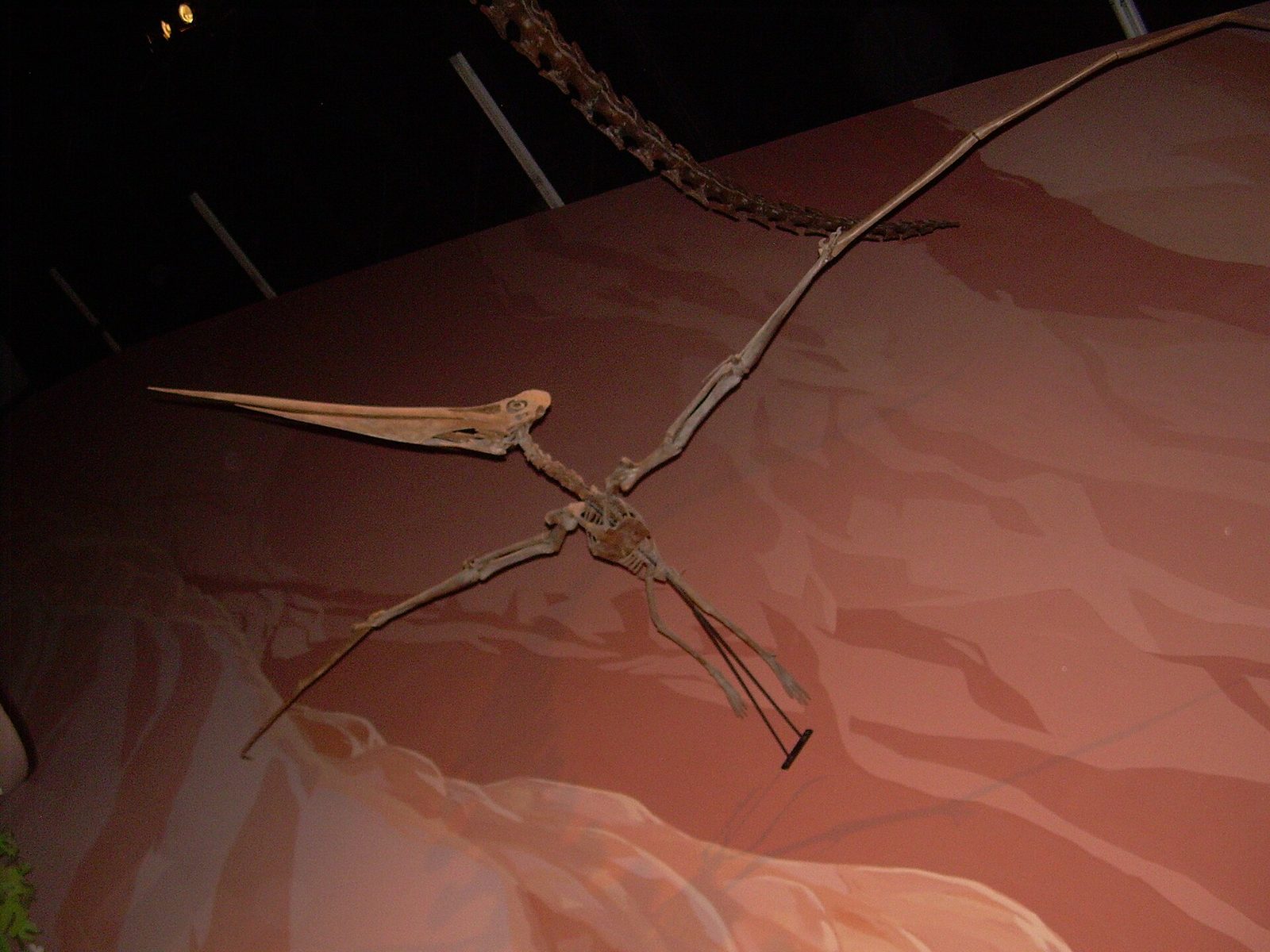
Pteranodon is still one of the easiest fossil flyers to flatten into a logo. A long toothless beak points forward, a long crest points back, and the whole head begins to look like a clean aerodynamic device, as if Late Cretaceous evolution had simply bolted a steering fin onto the rear of the skull.[3][5] That reading lasts because the silhouette invites it. The stronger interpretation is narrower and more interesting. The crest belonged to a flying animal and could not have been aerodynamically irrelevant in every circumstance, but the best evidence does not make it a dedicated rudder. It makes it a display structure living inside a flight problem.[1][2][4][5][6]
That distinction matters because Pteranodon has exactly the kind of anatomy that invites single-purpose storytelling. The first fossils came from the Niobrara strata of western Kansas, deposited in the shallow Western Interior Seaway, and later museum work had to reconstruct a giant pterosaur from compressed, often incomplete material.[2][6] Once the crest becomes the whole animal, the temptation is to ask one direct question: what did it do for flight? Paleontology works better here when it asks two questions together. How did the crest sit inside a flying head and body? And what kind of variation would we expect if display and identity were part of the answer as well?
Image context: the cover uses a real Wikimedia Commons photograph of a mounted Pteranodon skeleton rather than a reconstruction, diagram, or aerodynamic sketch. That choice matters because this article needs the head and crest inside the animal's whole flight body. The photograph keeps attention on the fossil geometry that made aerodynamic readings plausible in the first place.[7]
1) Why the rudder idea lasted
The aerodynamic reading has a respectable history. In 1971, Douglas Brower published an explicit aerodynamic treatment of Pteranodon, trying to understand how this large pterosaur might have functioned in flight.[3] That older line of reasoning is easy to caricature, but it was not irrational. A long rostrum projects far in front of the neck, and a large crest projects behind the skull. On paper, that arrangement almost begs to be treated as a balance-and-control system.[3]
The problem is not that early researchers were foolish to ask the aerodynamic question. The problem is that silhouette can outrun sample quality. If the crest is treated in isolation, it starts to look as though it must explain itself chiefly through airflow. But Pteranodon was not built from one ideal skull. It was a taxon known from many specimens, uneven preservation, and more than one crest shape.[1][2] Once those variations are kept in view, the search for one optimized steering surface becomes harder to sustain.
That is also why the article should resist the lazy opposite move. The crest was attached to a flying skull, so it almost certainly affected airflow in some way.[3][4] The real question is one of priority. Did natural selection mainly shape the crest as a flight-control tool, with display as an afterthought? Or did display, sex, and species recognition drive the gross shape while aerodynamic costs and side effects had to remain tolerable? The current evidence points more strongly to the second path.[1][4][5]
2) Large samples changed the question from pure aerodynamics to dimorphism and identity
Christopher Bennett's 1992 study remains the key pivot because it pushed Pteranodon out of the world of one-off iconic skulls and into population-level variation.[1] The paper argued for sexual dimorphism, with crest size and body size tied together rather than scattered randomly across specimens.[1] In broad public language, the pattern survives well: larger individuals carried larger, more elongate crests, while smaller individuals had smaller, rounder ones.[1][6]
Yale's 2024 Peabody Museum piece makes the same pattern legible for a general audience when it describes its Pteranodon sternbergi display family.[6] The male is more than twice the size of the female, and the female's crest is shorter and rounder than the male's.[6] This does not solve every taxonomic argument in pterosaur research, but it does one crucial thing for anatomy and method. It shows that crest form scales with sex-linked body patterning strongly enough that display can no longer be treated as decorative speculation bolted on after the aerodynamic story is finished.
Bennett's 1994 systematic treatment reinforces the point from a different angle.[2] Pteranodon was not a single unvarying head design repeated forever through the Niobrara sky. The taxonomy had to sort crest form, stratigraphic distribution, and specimen assignment across valid species and dubious names.[2] Once species-level difference enters the frame, the crest begins to look less like one universal control surface and more like a structure that was visible, variable, and evolutionarily available for signaling.[2][5]
The American Museum of Natural History's crest overview fits that wider reading neatly.[5] It places Pteranodon sternbergi and Pteranodon longiceps beside other crested pterosaurs and notes just how extreme the diversity of pterosaur head ornaments became.[5] Species identification and sexual selection stay on the table precisely because the variation is so conspicuous.[5] A crest can still sit in the airstream while being shaped first by who needs to notice it.
3) Later aerodynamic testing shrank the flight-only claim rather than erasing airflow altogether
The most useful modern correction is not "the crest had nothing to do with flight." It is that the aerodynamic case appears limited. Elgin and colleagues' 2008 study tested the cranial crest in aerodynamic terms and found an effect, but not one strong enough to support the old idea that crest evolution in Pteranodon was primarily about aerodynamic function.[4] The result matters because it narrows the claim without pretending the skull lived outside physics.
That limited-effect result is exactly what a display-first reading would predict. A large visible structure on the head of a flyer cannot ignore airflow, weight, and head posture.[3][4] But it does not have to be optimized like an airplane control surface to persist. It only has to avoid becoming too costly while still delivering whatever social or species-level advantage selection was actually favoring.[1][4][5]
This is the most productive way to keep the evidence in one sentence. The crest had aerodynamic consequences because everything on a flying head does. It was not, however, forced by the available evidence into the role of a dedicated rudder.[3][4] Once dimorphism, species variation, and testing stay together, the stronger interpretation becomes a signaling structure constrained by flight rather than a flight device that happened to become flashy.
4) The boundaries matter as much as the reset
That reset should still stay inside its limits. The fossils do not give us exact crest colors for Pteranodon.[5] They do not provide a full behavioral film of mate choice above the Western Interior Seaway.[1][5] And because pterosaur material is often crushed flat, even excellent specimens come with reconstructive difficulty built in.[6] A careful anatomy article should not turn display into a new total explanation after criticizing aerodynamics for being one.
But the evidentiary hierarchy is now much clearer than the old popular image suggests. Large-sample work made crest form part of sexual dimorphism.[1][6] Systematics showed that crest variation also belonged to taxonomic sorting rather than to one immutable head plan.[2] Aerodynamic testing kept airflow relevant while lowering its explanatory rank.[4] Public-facing museum interpretation now reflects that balance by treating the crest as conspicuous biological information, not just as a prehistoric tailplane mounted in the wrong place.[5][6]
That is why Pteranodon still rewards close reading. The famous crest remains dramatic. It simply becomes more scientific once it stops carrying the whole story alone.
Sources
- S. Christopher Bennett, "Sexual dimorphism of Pteranodon and other pterosaurs, with comments on cranial crests" (1992), Journal of Vertebrate Paleontology.
- S. Christopher Bennett, "Taxonomy and systematics of the Late Cretaceous pterosaur Pteranodon (Pterosauria, Pterodactyloidea)" (1994), Occasional Papers of the Natural History Museum, University of Kansas.
- Douglas Brower, "Aerodynamics of Pteranodon" (1971), Biological Journal of the Linnean Society.
- R. A. Elgin, C. A. Grau, C. Palmer, D. W. E. Hone, D. Greenwell, and M. J. Benton, "Aerodynamic characters of the cranial crest of Pteranodon" (2008), Zitteliana; University of Bristol research record.
- American Museum of Natural History, "Flying Colors: Pterosaurs' Crests."
- Yale News, "Winged reptile family nests in renewed Peabody Museum's main lobby" (2024).
- Wikimedia Commons file page for the mounted Pteranodon skeleton photograph used as the article image.