Maiasaura peeblesorum became famous so quickly that its nickname almost swallowed the fossil. "Good mother lizard" is memorable, and John Horner and Robert Makela chose it in 1979 for a reason.[1] The Montana material from Egg Mountain really did change what paleontologists could say about dinosaur reproduction. But the most durable value of Maiasaura is harder and better than the slogan. This was a roughly 9-meter Late Cretaceous hadrosaur from what is now the western United States, and it matters because nests, hatchlings, juveniles, larger bonebeds, and adult anatomy can all be tied into one unusually dense life-history record.[1][2][3][4][5][6]
That distinction is worth keeping because the sentimental version is too neat. Maiasaura is not important simply because it lets modern readers imagine affectionate family scenes in the Cretaceous. It is important because several different kinds of evidence line up in sequence. The nests suggest repeated colony use. The juveniles suggest young that stayed in the nest long enough to matter behaviorally. Perinatal anatomy helps show what the earliest growth stages actually looked like. Histology then turns the species into population biology, with a mortality curve and a growth schedule instead of a single feel-good tableau.[1][2][3][4][5]
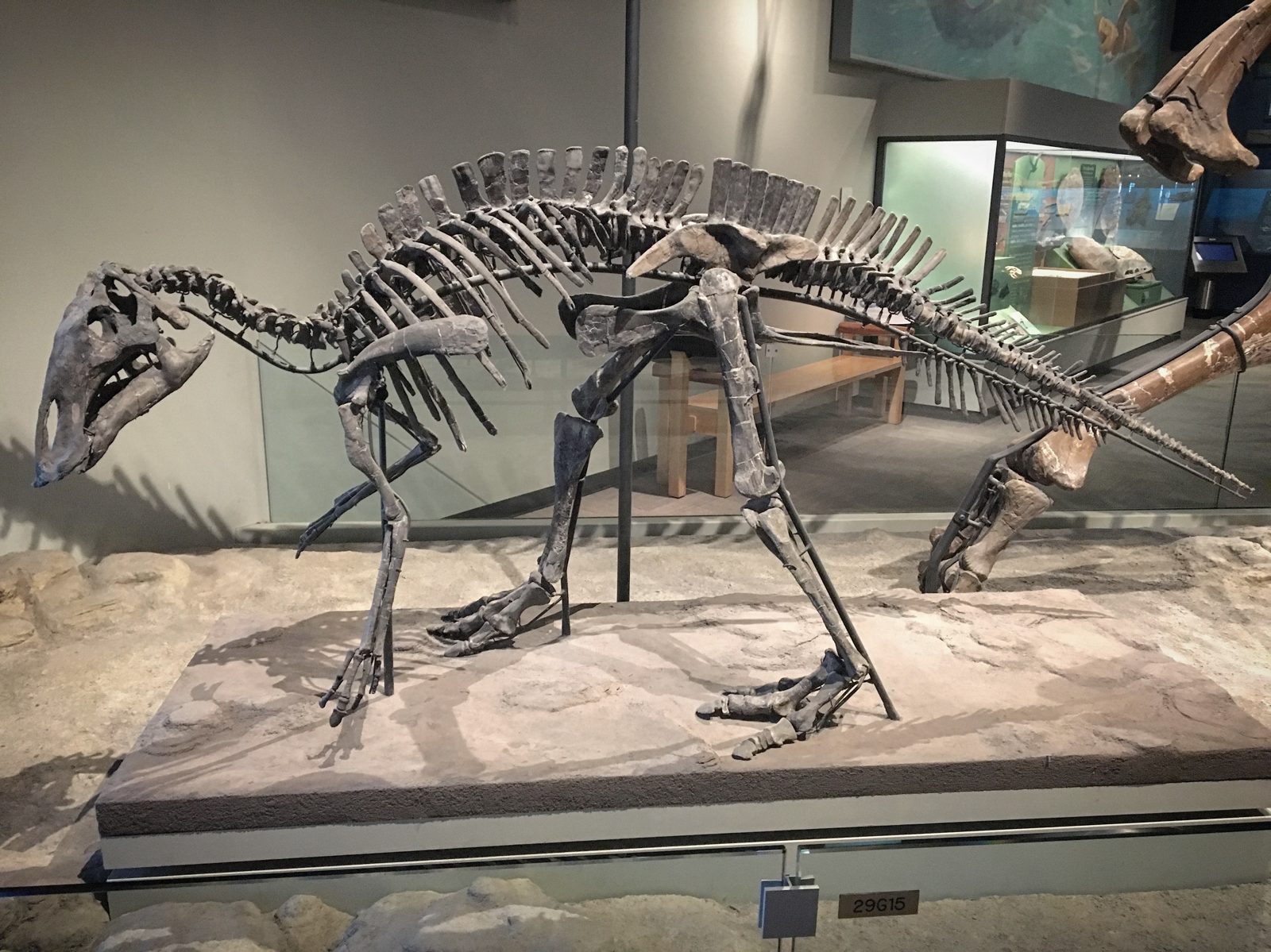
Image context: the cover uses a real museum photograph of a mounted Maiasaura skeleton at the Field Museum of Natural History, sourced via Wikimedia Commons. It belongs here because the article's point is that Egg Mountain did not reveal a special "parenting dinosaur" detached from the rest of hadrosaur biology. It revealed that one large herbivore could be followed through unusually many life stages, from nest to adult body.[7]
1) The original nests mattered because they tied juveniles to behavior
The 1979 Nature paper did not merely announce a new duck-billed dinosaur from Montana. Its force came from association. Horner and Makela reported a nest of juveniles and used that material to argue for family structure among dinosaurs.[1] The claim was not built from sentiment. It was built from the mismatch between the juveniles' developmental stage and the idea of immediately self-sufficient hatchlings. They had emerged from the egg, they had already been feeding, and yet their limb development still suggested young animals that were not ranging widely on their own.[1][4]
That is the first reason Maiasaura deserves a species profile rather than a parenting anecdote. The evidence is behavioral only because it is anatomical first. If the hatchlings had looked like tiny independent runners, the "good mother" name would have had much less scientific traction. What gave the interpretation force was the link between nest context, worn teeth, and immature locomotor apparatus.[1][4]
The modern boundary matters just as much. The fossil does not record emotion, pair bonding, or a modern bird-style household in any cinematic sense. What it supports much more securely is prolonged nest use by young animals after hatching, which in turn makes some level of parental provisioning or attendance a serious inference rather than a fantasy.[1][4]
2) The colony mattered because it turned one nest into a breeding ground
The 1982 follow-up pushed the argument from one nest to a nesting ground. Horner described colonial nesting and site fidelity among ornithischian dinosaurs in the Two Medicine Formation, meaning adults were not using the area randomly but returning to a breeding site often enough to leave a repeated pattern in the rock.[2] That shift matters because it turned Maiasaura from an exceptional anecdote into a population-level behavior problem.
Once the colony enters the picture, the species stops reading like a sentimental one-off. The question becomes logistical. How many adults used the site? How often was it reused? What did dense nesting imply about spacing, incubation, and the hazards of crowding? The evidence does not answer every one of those questions completely, but it changes the scale of inference. Maiasaura is no longer one touching nest. It is a hadrosaur whose breeding behavior left a recurring landscape signature.[2]
That landscape signal also helps explain why the species still holds its place in dinosaur culture. Many famous taxa are known from dramatic skeletons. Maiasaura became famous because it made a place legible: Egg Mountain could be read as a nesting colony rather than as a random fossil patch. In paleontology, that kind of context is often more valuable than one spectacular skeleton, because it lets anatomy and behavior enter the same argument.[1][2]
3) Perinatal anatomy made the hatchlings less mythical and more real
Later work tightened the early-life picture. Prieto-Márquez and Guenther described perinatal specimens in 2018 and used them to refine the earliest ontogeny of this saurolophine hadrosaurid.[4] That matters because the original "good mother" story can otherwise drift into a blur: cute babies in nests, adults nearby, parental care assumed. Perinatal material resists that blur by making the newborn body itself more specific.
What comes through is not a miniature adult but a body still under construction.[4] The skull, jaws, and postcranial skeleton do not simply scale down from the mature animal. They preserve a stage in which the young were biologically committed to rapid growth and still limited in what they could do independently.[4] That sharper developmental picture does not cancel the original nesting interpretation. It strengthens it by giving the vulnerable life stage a firmer anatomical basis.
This is one of the reasons Maiasaura remains such a powerful species profile. It does not rest on one kind of evidence. Nest context, juvenile dental wear, immature limb function, and perinatal anatomy all point in the same direction without becoming identical arguments. Each line narrows the behavioral possibilities a little further.[1][4]
4) Histology turned Maiasaura from a nest story into population biology
What Egg Mountain began as behavior, histology later converted into demography. Woodward and colleagues' 2015 Paleobiology study treated Maiasaura as a model organism for extinct vertebrate population biology and analyzed a large tibia sample to estimate growth dynamics and survivorship.[3] The result is one of the clearest dinosaur age-structure pictures in the literature. Over half the tibiae in the sample came from individuals less than one year old, and the broader growth curve indicated fast growth with skeletal maturity reached in roughly six to eight years.[3]
Those numbers matter because they pull Maiasaura out of the realm of mascot species. The animal now has a population shape. The first year was dangerous. Growth was rapid. Adult size was reached on a schedule closer to high-performance archosaur growth than to the slow, vague reptilian stereotype that used to dominate dinosaur popularization.[3] In other words, Maiasaura no longer just tells us that some dinosaurs nested. It tells us something about how one dinosaur population was distributed across age classes and how fast those bodies moved through life.
Woodward and colleagues sharpened the first-year story again in 2019 by examining young-of-the-year tibiae and showing nonannual cortical vascular rings during a period of extremely rapid early growth.[5] That is a technical point with a real payoff. It means the first year should not be reduced to a simple one-line growth mark story. Even in this famous taxon, bone tissue has to be read carefully or growth rhythms get oversimplified.[5]
5) What the species really teaches
The strongest way to summarize Maiasaura is not "dinosaurs were loving parents." That sentence is too broad for the evidence and too soft on the details that make the fossil record useful.[1][2][3][4][5] The stronger summary is that Maiasaura links breeding-site context, vulnerable young, early ontogeny, and growth histology tightly enough to make parental care a testable behavioral sequence rather than a decorative story.
That is why the species still matters. One paper gave it a name and a nest. Another gave it a colony. Later work gave it perinatal anatomy and a demography curve.[1][2][3][4][5] Together those layers make Maiasaura one of the rare dinosaurs that can be read from hatchling dependency to population structure without leaving the fossil record behind.
The result is better than the nickname. "Good mother lizard" made the public remember Maiasaura. The deeper science is what keeps the animal alive in paleontology: not a sentimental certainty, but a rare case where behavior, development, and population biology can all be argued from the same taxon with unusual precision.[1][2][3][4][5]
Sources
- John R. Horner and Robert Makela, "Nest of juveniles provides evidence of family structure among dinosaurs," Nature 282 (1979).
- John R. Horner, "Evidence of colonial nesting and 'site fidelity' among ornithischian dinosaurs," Nature 297 (1982).
- Holly N. Woodward, Denver W. Fowler, and John R. Horner, "Maiasaura, a model organism for extinct vertebrate population biology: a large sample statistical assessment of growth dynamics and survivorship," Paleobiology 41, no. 4 (2015).
- Albert Prieto-Márquez and Mathew F. Guenther, "Perinatal specimens of Maiasaura peeblesorum from the Upper Cretaceous of Montana (USA): insights into the early ontogeny of saurolophine hadrosaurid dinosaurs," PeerJ 6 (2018).
- Holly N. Woodward, John R. Horner, and Frankie D. Jackson, "The growth of Maiasaura peeblesorum revisited: young-of-the-year histology reveals nonannual cortical vascular rings in a rapidly growing hadrosaurid," Frontiers in Earth Science 7 (2019).
- Natural History Museum, "Maiasaura" dinosaur directory entry (length, weight, age, and discovery overview).
- Wikimedia Commons file page for the mounted Maiasaura photograph used as the lead image.