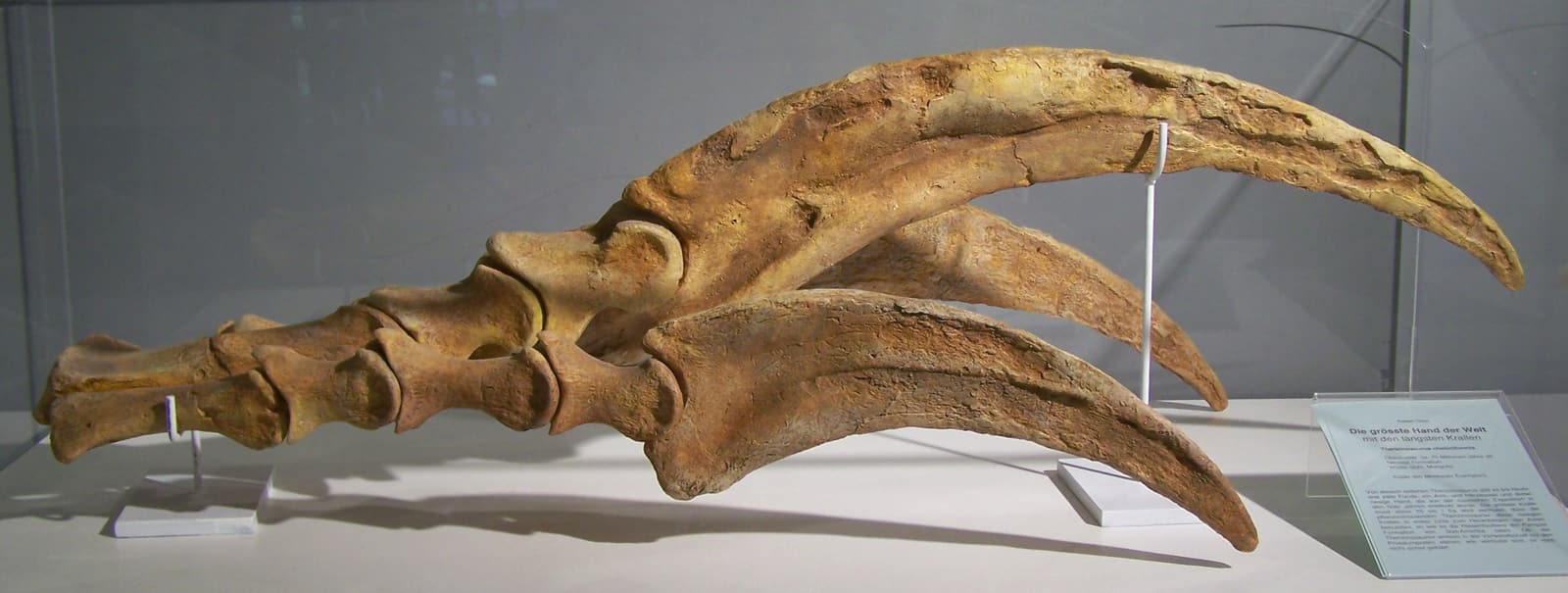
Therizinosaurus is one of those dinosaurs public memory keeps trying to force into the wrong sentence. The claws are so large that readers instinctively reach for a predator story: a giant theropod with knives where the hands should be. The better sentence starts elsewhere. Therizinosaurs were not ordinary meat-eating theropods with one bizarre accessory. They were a derived maniraptoran lineage that accumulated some of the clearest skeletal evidence for herbivory anywhere inside Theropoda.[1][3][4] Once that frame is restored, the famous claws stop looking like simple stabbing weapons and start looking like one part of a plant-oriented body plan that later became extreme enough to strain simple mechanical explanations.[2][4][5]
That distinction matters because Therizinosaurus is usually flattened from the hand outward. The claw becomes the whole animal. In the literature, the more useful direction runs the other way. Clade-level studies first establish dietary change toward herbivory or omnivory, then biomechanical work tests what different claw shapes could actually do, and only after that does the adult Therizinosaurus hand appear as an outlying late branch inside the larger experiment.[1][2][4] The result is less cinematic but more interesting: a browsing lineage in which the forelimbs were increasingly recruited for reach-and-pull foraging, and in which Therizinosaurus may have pushed that trend so far that display or size-driven exaggeration entered the picture.[2][4]
Image context: the cover uses a real Wikimedia Commons photograph of the mounted Therizinosaurus claws in the Sauriermuseum Aathal. It belongs here because the article's claim depends on scale and curvature staying visible at the same time. One glance is enough to see why the hand triggered decades of overreading, but also why the structure needs biomechanical restraint before it can be turned into a weapon story.[7]
The lineage turned toward plants before Therizinosaurus pushed the hand to its limit
The first correction is evolutionary, not mechanical. Zanno and colleagues' 2009 reassessment of therizinosaur relationships argued that this clade carries the strongest anatomical evidence for herbivory among theropod dinosaurs, and that its history likely involved dietary plasticity and facultative herbivory before later specializations accumulated.[1] That matters because it blocks the lazy interpretation that the Therizinosaurus hand belongs in a straightforward predator template. The claws were inherited inside a lineage already moving away from obligate flesh-eating.
The jaw literature sharpens that shift. Zanno, Tsogtbaatar, Chinzorig, and Gates described the lower jaws and dentition of Segnosaurus galbinensis as unusually specialized for a therizinosaur, with a strongly downturned front dentary, edentulous rear dentary region, and tooth features consistent with a higher degree of oral processing than in earlier members of the group.[3] Lautenschlager's 2017 mandibular modelling then showed that several supposedly herbivorous therizinosaur features, including a downturned jaw tip and expanded postdentary region, were not decorative oddities. They had stress-mitigating effects and corresponded to different dietary strategies within a plant-eating clade.[4]
That wider context is the key to Therizinosaurus. The hand cannot be interpreted in isolation, because the rest of the clade had already been reorganizing around plant acquisition and processing.[1][3][4] Long necks, small heads, broad pelvises, and modified jaws belong in the same sentence as the claws. A giant manual ungual in such a lineage does not need to be a predator blade by default. It can be part of a foraging system.
Earlier functional work moved the claws away from digging and toward hook-and-pull browsing
That is exactly where the 2014 claw study changed the conversation.[2] Lautenschlager compared therizinosaur manual unguals through shape analysis and finite-element modelling, testing scratch-digging, hook-and-pull, and piercing scenarios. The result was not one uniform therizinosaur function. Some taxa clustered toward a more generalist use, while others were better interpreted as grasping hooks during foraging.[2] Just as important, the long and curved claws of later therizinosaurs recorded high stress in scratch-digging scenarios, making digging the least persuasive of the tested functions for those extreme forms.[2]
This is the article's first real boundary. A claw that looks spectacular is not automatically a good fighting or digging tool. In therizinosaurs, elongation and curvature changed function as much as they changed appearance.[2] Lautenschlager explicitly treated Therizinosaurus as the most hypertrophied case in the clade, a taxon where the general trend toward larger, longer unguals reached its most dramatic endpoint.[2] The most defensible use that survived the modelling was hook-and-pull behavior: catching or looping the claw around vegetation, then drawing it inward.[2][5]
That foraging interpretation also makes ecological sense within a lineage already pushed toward herbivory.[1][3][4] A tall-bodied, long-necked dinosaur does not need the hand to kill in order for the hand to matter. It can use forelimb reach to enlarge its feeding envelope. Once that possibility is admitted, the old "predator knives" story starts to look like a shortcut built from silhouette rather than anatomy.
Newer analyses make adult Therizinosaurus look less like a perfect tool than like an outlier
The second boundary comes from the 2023 Communications Biology study by Qin, Liao, Benton, and Rayfield.[5] Their broader functional-space analysis compared bizarre theropod manual unguals and again found that efficient digging belongs to late-branching alvarezsauroids rather than to therizinosaurs.[5] For therizinosaurs, the paper reaffirmed the herbivore frame and the earlier hook-and-pull interpretation. But it also made the adult Therizinosaurus claw stranger, not simpler. In the authors' summary, the giant sickle-like ungual had such extreme proportions that no single mechanical function could be identified with confidence; they suggested the claw may have become decorative and lengthened through peramorphic growth linked to increased body size.[5]
That does not erase foraging from the story. It changes the scale at which the story is told. Earlier therizinosaurs can still be read as functional forelimb browsers, and the late-branching Therizinosaurus hand still inherits that lineage context.[2][4][5] What changes is that the adult animal may have pushed the structure beyond neat utility. The claw remains part of a browsing lineage, yet the latest modelling warns that the largest version may no longer be optimally explained as a cleanly efficient feeding implement.[5]
This is a common pattern in evolutionary anatomy: a structure can begin inside one adaptive channel and later overshoot into signaling, exaggeration, or multi-use ambiguity. The 2023 paper does not prove that Therizinosaurus waved its claws as pure ornaments, but it does make the old one-line weapon story weaker than ever.[5]
The 2025 keratin-claw paper shows why bone alone is still not the whole hand
A final correction comes from Mongolia again. Kobayashi and colleagues' 2025 description of Duonychus tsogtbaatari reported a didactyl therizinosaur with a preserved keratinous claw sheath, offering rare direct evidence for the external claw shape in this lineage.[6] The paper is not about Therizinosaurus itself, but it matters here because it reminds us that the bony ungual is not the entire living structure. In Duonychus, the preserved sheath and strong curvature supported an amplectorial, grasping interpretation useful for handling vegetation.[6]
That evidence does not automatically rescue every extreme Therizinosaurus functional claim. Qin and colleagues explicitly note that keratin does not magically solve the structural-performance issues seen in the giant ungual models.[5] Even so, the 2025 fossil is valuable because it keeps the argument honest. When paleontologists say a therizinosaur claw was used for grasping or pulling, they are talking about a living hand that extended beyond the bare bone preserved in most specimens. The external claw mattered, and in at least one Mongolian therizinosaur it materially strengthened the case for vegetation handling.[6]
Placed beside the older modelling, the lesson is clear. The clade-level function is easier to defend than the most extreme species-level script. Therizinosaurs broadly developed hands compatible with plant-oriented grasping and pulling.[2][6] Adult Therizinosaurus may then have pushed that inherited system into a body-size and display regime where clean mechanical optimization became harder to recover.[5]
The strongest reading keeps herbivory first and spectacle second
That is the version worth keeping. Therizinosaurus did not stop being bizarre once paleontologists put it back into a herbivorous theropod lineage. It became legible. The jaws and skulls of close relatives show a clade already committed to plant acquisition and processing.[1][3][4] Earlier functional work moved the hand away from digging and toward grasping-hook behavior during foraging.[2] Newer modelling then made the most gigantic Therizinosaurus claw look less like an idealized weapon and more like an extreme outlier whose size may have exceeded any single tidy mechanical role.[5]
So the claws do fit a plant-eating lineage better than a predator script. They just do not fit a simplistic browsing script either. The best current reading is more layered: a theropod herbivore lineage turned the forelimb into a reaching and pulling system, and Therizinosaurus carried that system far enough that function, exaggeration, and display may all have started to overlap in the same hand.
Sources
- Lindsay E. Zanno, David D. Gillette, L. Barry Albright, and Alan L. Titus, "A new North American therizinosaurid and the role of herbivory in 'predatory' dinosaur evolution," Proceedings of the Royal Society B / PubMed record and abstract page (2009).
- Stephan Lautenschlager, "Morphological and functional diversity in therizinosaur claws and the implications for theropod claw evolution," Proceedings of the Royal Society B (2014), PMC article page.
- Lindsay E. Zanno, Khishigjav Tsogtbaatar, Tsogtbaatar Chinzorig, and Terry A. Gates, "Specializations of the mandibular anatomy and dentition of Segnosaurus galbinensis (Theropoda: Therizinosauria)," PeerJ (2016).
- Stephan Lautenschlager, "Functional niche partitioning in Therizinosauria provides new insights into the evolution of theropod herbivory," Palaeontology 60, no. 3 (2017).
- Zichuan Qin, Chun-Chi Liao, Michael J. Benton, and Emily J. Rayfield, "Functional space analyses reveal the function and evolution of the most bizarre theropod manual unguals," Communications Biology (2023).
- Yoshitsugu Kobayashi, Darla K. Zelenitsky, Anthony R. Fiorillo, and Tsogtbaatar Chinzorig, "Didactyl therizinosaur with a preserved keratinous claw from the Late Cretaceous of Mongolia," iScience (2025).
- Wikimedia Commons file page for the photographed Therizinosaurus claw specimen used as the article image, "File:Therizinosaurus claw.jpg".