Placodonts are easy to flatten into one postcard image: squat Triassic marine reptiles with armor on the back and pebble-like teeth for smashing shellfish. The lineage was less tidy than that. The best fossil evidence now suggests that the first decisive innovation was dental, not dorsal. The mouth reorganized first. The later armor came unevenly, and by the time heavily shielded forms appeared, the diet had already become more varied than the old one-line "shell-crusher" label implies.[1][2][3][4]
That order matters because placodonts are often described from their endpoint outward. Readers start with Henodus or turtle-like cyamodontoids, then work backward and assume the whole clade was built that way from the beginning. The lineage context points in another direction. A stem placodont from the Netherlands helps bridge pointed ancestral teeth and later crushing batteries.[1] Placodus shows the classic skull-first solution before the body reaches its most armored form.[2][4] Later placodonts keep the crushing heritage but push it into new shapes, including reduced tooth counts and wear patterns consistent with a broader feeding envelope.[3][4]
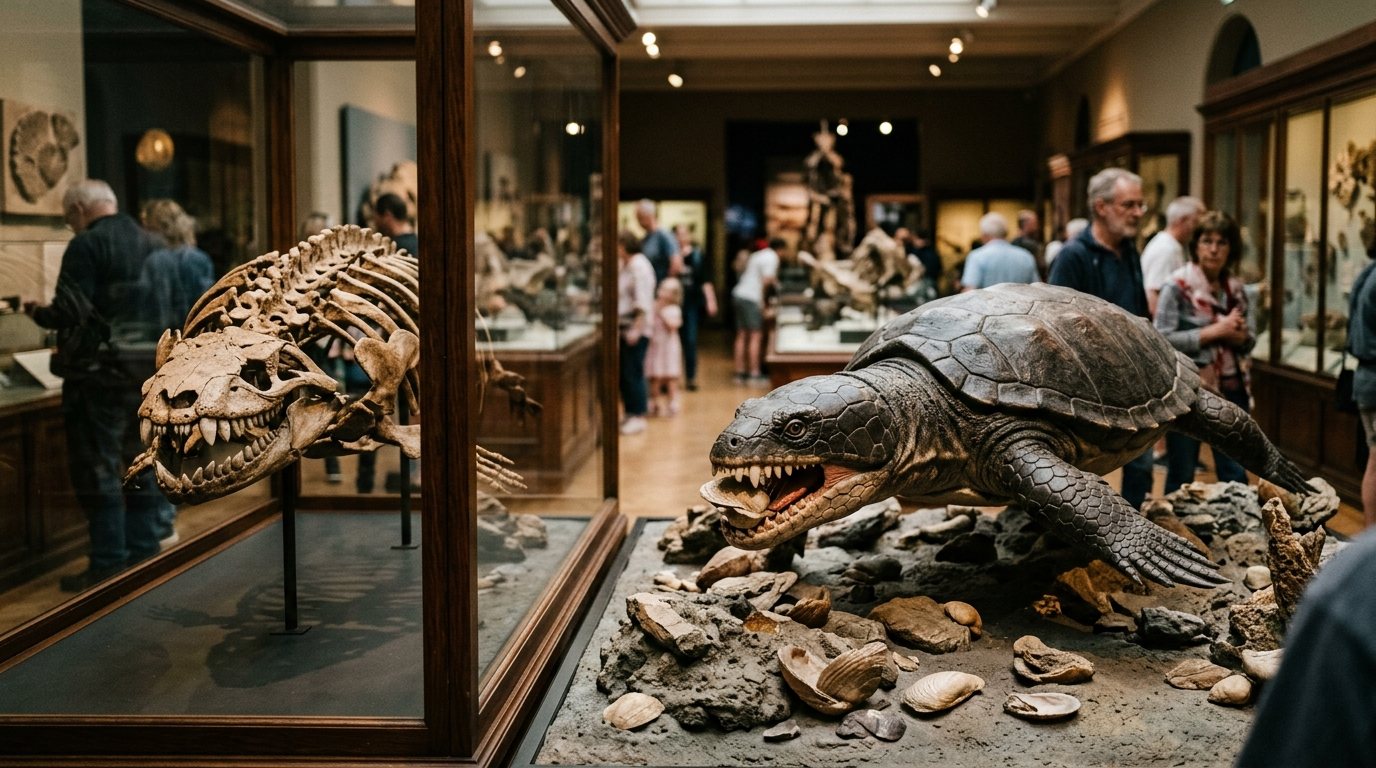
Image context: the cover uses a real Senckenberg Museum photograph of a Placodus gigas fossil from Wikimedia Commons. It belongs here because the article's argument starts with visible asymmetry. The skull is already massively committed to processing hard food, but the whole animal does not yet look like the plated, turtle-like placodont stereotype. The mouth has outrun the body.[5]
The lineage did not begin with a ready-made shell-crusher face
The clearest starting correction comes from the 2013 Nature Communications paper on a juvenile stem placodont from the Netherlands.[1] Neenan, Klein, and Scheyer argued that this fossil clarified the European origin of Placodontia and, more importantly for body-plan reading, exposed a transitional stage in dentition. The key shift was from a more generalized piercing arrangement with pointed teeth toward the flattened crushing dentition that later placodonts made famous.[1]
That finding matters because it relocates the clade's central innovation. Placodont identity does not begin with a complete defensive silhouette. It begins with the palate and jaw. The lineage first had to turn an ordinary reptile mouth into a machine capable of processing hard benthic food.[1][2] Only once that feeding system was underway does the rest of the body start to look like the placodont image that museums and textbooks prefer to print in one frame.
In other words, "placodont" should not be read first as an armor word. It is a feeding word. The broad palatal and dentary teeth, and the developmental route by which they emerged from more pointed ancestral conditions, tell us more about the clade's origin than the later shielded outline alone.[1][2]
Placodus is the classic proof that the skull solved the problem early
This is where Placodus becomes more valuable than its reputation as a generic shell-crusher. It is the form that makes the mouth-first story easiest to see. The occlusal-morphology study published in Paleobiology emphasized that placodont teeth were not all the same kind of blunt pavement, and that species-level differences in tooth surfaces mattered for how food was processed.[2] Even so, placodontoid forms such as Placodus sit squarely inside the high-force crushing side of the lineage, with hemispherical or rounded teeth suited to loading hard items in a different way from the flatter teeth of more nested cyamodontoids.[2]
That distinction is important because it breaks a second simplification. Placodont evolution was not a straight line from "no crushing" to "more crushing." Different tooth forms imply different handling strategies, and the feeding apparatus remained anatomically informative long after the broad durophagous identity of the clade was established.[2][4] Placodus is therefore not just a representative placodont. It is the stage where the dental solution is already conspicuous and the rest of the body has not yet collapsed into one standard armored template.
The photographed fossil fits that reading. What the eye meets first is not a turtle-like carapace. It is a deep head, a compact torso, and a row of rounded crushing teeth preserved along the jaws and palate.[5] The lineage had already put its priority in the mouth.
Armor came later, and later placodonts did not all eat the same way
Once the later placodonts enter the story, the familiar armor becomes more obvious, but the diet becomes less simple. That is the lesson of Henodus chelyops. The 2021 study on tooth replacement and feeding in Henodus describes an animal with an extreme reduction in crushing teeth to a single pair of palatine and dentary teeth, together with unusual occlusal morphology and a highly specialized feeding system.[3] This is not merely "more of the same" shell-crushing design. It is a reorganization of the placodont mouth at the far end of the lineage.
The 2024 dental-wear study makes the broader point explicit.[4] Looking across nine European Middle and Late Triassic placodont species, Gere and colleagues found wear differences consistent with dietary grouping and shift within the clade.[4] The paper still places placodonts firmly inside a durophagous tradition, but it does not leave them there as one ecological blur. In particular, it argues that Henodus may have included plant food in its diet, drawing the comparison toward modern herbivorous marine mammals and lizards rather than toward a single-minded mollusk-cracking machine.[4]
That matters because later armor can mislead the reader. A broad shielded outline encourages the assumption that all heavily built placodonts occupied the same niche in the same way. The wear evidence and the Henodus dentition show otherwise.[3][4] By the time placodont bodies become more turtle-like to the eye, the lineage is branching functionally rather than merely repeating one successful feeding trick.
The best lineage read is tooth-first, body-second, diet-diversifying
Put together, the sequence is much sharper than the stereotype. Stem placodonts show the transition from pointed to crushing dentition as a real evolutionary process, not a sudden appearance of ready-made shell-busting jaws.[1] Placodus demonstrates that a heavily specialized crushing skull could exist before the lineage's most turtle-like armor dominated the body plan.[2][5] Later placodonts, including Henodus, show that shielded bodies did not freeze the clade into one ecological role. Tooth reduction, altered wear, and probable dietary divergence kept the lineage moving.[3][4]
That is the version worth keeping. Placodonts changed the mouth first. The armor followed later and unevenly. Once the body becomes more familiar to modern eyes, the feeding story is already more experimental than the old label suggests.
Sources
- James M. Neenan, Nicole Klein, and Torsten M. Scheyer, "European origin of placodont marine reptiles and the evolution of crushing dentition in Placodontia." Nature Communications 4, Article 1621 (2013).
- "Tooth occlusal morphology in the durophagous marine reptiles, Placodontia (Reptilia: Sauropterygia)." Paleobiology 43(1) (2017), Cambridge Core article page.
- Yann Pommery, Nicole Klein, Torsten M. Scheyer, and colleagues, "Dentition and feeding in Placodontia: tooth replacement in Henodus chelyops." BMC Ecology and Evolution 21, Article 96 (2021).
- Krisztina Gere, Anita L. Nagy, Torsten M. Scheyer, and colleagues, "Complex dental wear analysis reveals dietary shift in Triassic placodonts (Sauropsida, Sauropterygia)." Swiss Journal of Palaeontology 143, 4 (2024).
- Wikimedia Commons file page for the photographed Placodus gigas fossil used as the lead image, "File:Placodus gigas 4.jpg".