
Polished stones beside a dinosaur skeleton are one of those paleontological details that seem to explain themselves. The story feels immediate: a giant herbivore swallowed rocks, the rocks ground down tough plants, and the dinosaur's stomach worked like an oversized bird gizzard. The Science Museum of Minnesota's short specimen spotlight is worth curating because it starts from that familiar intuition and then quietly opens a harder question.[1] What exactly do stomach stones prove, and what do they fail to prove, when the animal in question is a sauropod?
That distinction matters because "gastrolith" is a broader term than public dinosaur culture usually admits. Oliver Wings' review is useful here: a gastrolith is, at base, a hard object in the digestive tract, but its origin and function can vary widely.[3] Some stones are swallowed. Some concretions form inside the animal. Some may aid trituration, some may overlap with ballast or other functions, and some may be accidental. For sauropods, then, the real evidentiary problem is not whether stones can occur in the stomach. It is whether a given cluster of stones is abundant enough, well associated enough, and functionally persuasive enough to justify the popular image of a giant avian-style gastric mill.[3][4]
The Minnesota video is valuable because it keeps that problem at specimen scale. Nicole Desnoski does not present a cartoon stomach full of anonymous gravel. She points at actual stones, defines the term, and then moves quickly from naming to inference.[1] That is the right sequence. In paleontology, the stones come first; the digestive theory has to earn its place afterward.
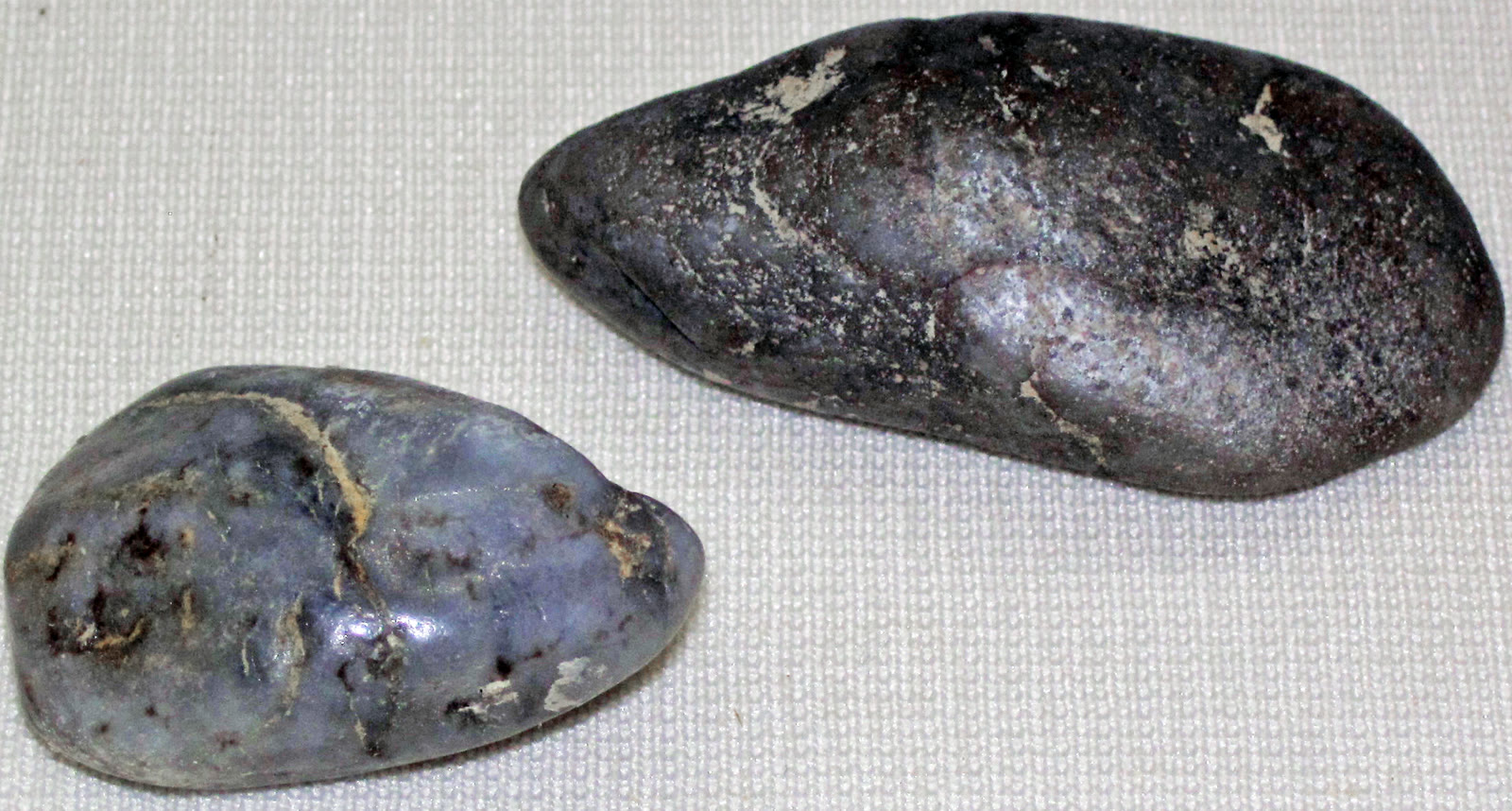
Image context: the cover uses a real Wikimedia Commons photograph of sauropod gastroliths from the Jurassic of Montana. It belongs here because the article's whole claim depends on resisting easy symbolism. These stones are not just props for "how dinosaurs ate." They are objects whose polish, sorting, and provenience have to be interpreted carefully before they can support a digestive model.[5]
Around 0:15, the broad definition helps, but it also creates the real problem
Early in the clip, Desnoski explains gastroliths literally as "stomach stones" and notes that they can include stones created in the animal or stones swallowed from outside.[1] That opening is more useful than it first sounds because it prevents a common mistake: treating every polished pebble near a fossil as if it already came labeled with a single function. Wings' 2007 review makes the same point more formally by arguing that paleontology needs to separate origin from interpretation.[3] A stone in the digestive tract is not automatically evidence for one narrow behavior.
That broader framing matters especially for extinct animals, because the fossil record does not preserve soft tissue mechanics directly. We do not get to watch the stomach work. We infer from association, quantity, wear, and comparison. So when the video starts broad, it is doing something methodologically correct. It tells the viewer that the first task is classification, not romance.[1][3]
Around 0:45, the video's cross-animal tour is a reminder that one stone function does not fit every lineage
The next useful move comes when the video ranges across crocodilians, marine reptiles, dinosaurs, and birds.[1] Public discussions often compress this diversity into a single sentence about "animals swallowing stones to digest food." The written sources make that compression harder to sustain. Wings' review notes that trituration is common and well supported in many vertebrates, especially birds, but ballast has also been proposed in aquatic taxa and accidental ingestion remains a live possibility in some cases.[3] The Western Australian Museum page expresses the same caution in more public language: plesiosaurs and crocodiles can carry stones too, but the function is not simply identical across groups.[2]
This is why the sauropod case has to be handled on its own terms. The moment a viewer hears that birds, seals, sea lions, plesiosaurs, theropods, and sauropods all appear in the same conversation, the temptation is to flatten them into one behavior.[1][3] But paleontology gets interesting exactly where the flattening fails. Similar objects can sit in very different digestive systems and do very different amounts of work.
Around 1:10, polish is real evidence, but polish alone is not enough
The video's most intuitive claim is the oldest one: animals swallow stones to help break up food they otherwise take in largely whole.[1] That logic is not wrong. Birds really do use gizzards and gastroliths this way, and the Western Australian Museum page makes the contrast vividly by pointing to rough gastroliths in bird-like theropods such as Oviraptor and then to the smoother, rarer stones associated with sauropods.[2] The problem is that polish by itself does not settle the question.
Wings' review is useful because it insists on evidentiary discipline.[3] To identify authentic fossil gastroliths, researchers need more than a pleasingly rounded pebble. They need anatomical association with a skeleton, a plausible position in the body cavity, and a context that rules out simple sedimentary coincidence.[3] That point gets even stronger in the later rarity study, which warns against turning isolated "exoliths" or polished surface stones into free-floating digestive proof.[4]
So the correct reading of a polished sauropod stone is narrower and better. It may well be a genuine stomach stone. It does not automatically follow that the animal used a large, efficient, bird-style grinding system. Evidence of ingestion is not the same as evidence of heavy-duty trituration.[3][4]
Around 1:40, the mass threshold changes the whole digestive picture
The sharpest moment in the video comes when Desnoski turns to ballast and relative weight, saying that buoyancy control would require stones approaching about 6 percent of body weight, whereas many animals are found with much less.[1] The key move there is proportional thinking. Once the stones are measured against body mass, vague storytelling gets harder. Wings and Sander push that logic much further for sauropods in their Royal Society paper: relative gastrolith mass in sauropods is far below 0.1 percent of body mass, while ostriches and other herbivorous birds cluster closer to 1 percent.[4] That gap is not a detail. It is the argument.
The same paper also reports that bird gastroliths in real gizzards abrade quickly and do not acquire the glossy polish people often imagine as the signature of powerful grinding.[4] That makes the popular sauropod picture wobble from both directions at once. The stones are too few, relative to body mass, to support a convincing avian-style gastric mill, and their polish does not map neatly onto a simple grinding analogy either.[4] In other words, the video's little tray of stones is more important for setting limits than for preserving an old certainty.
What the stones still tell us
That does not make sauropod gastroliths trivial. Quite the opposite. Their value is that they keep the question open while narrowing the acceptable answers. The 2015 Morrison Formation study is especially useful on this point because it compares famous sauropod localities and finds very few unambiguous stomach-stone associations across a record otherwise rich in dinosaur bone.[4] If avian-style gastric mills had been standard equipment in sauropods, the pattern should look less exceptional.
The better conclusion is therefore stricter than the children's-museum version but more interesting scientifically. Sauropods probably could ingest stones, and some polished clusters associated with skeletons are authentic enough to matter.[2][4][5] What those stones do not justify is the universal mental picture of every long-necked herbivore carrying a giant grinding barrel in its belly. The stones remain evidence, but they are evidence for digestive limits, behavioral variation, and unresolved function before they are evidence for a single clean mechanism.[1][3][4]
That is why this short video deserves annotation. It is not memorable because it confirms a dinosaur fact everybody already knows. It is memorable because, once placed beside the written literature, it shows how paleontology often advances: by turning a familiar object into a stricter standard of proof.[1][3][4]
Sources
- Science Museum of Minnesota, "Gastroliths, stomach bones from a sauropod | Specimen Spotlight," YouTube video.
- Western Australian Museum, "Stomach Stones" (public explainer on dinosaur and marine-reptile gastroliths).
- Oliver Wings, "A review of gastrolith function with implications for fossil vertebrates and a revised classification," Acta Palaeontologica Polonica 52(1) (2007).
- Oliver Wings, "The rarity of gastroliths in sauropod dinosaurs - a case study in the Late Jurassic Morrison Formation, western USA," Fossil Record 18 (2015).
- Wikimedia Commons file page for the lead image, "File:Sauropod gastroliths.jpg".