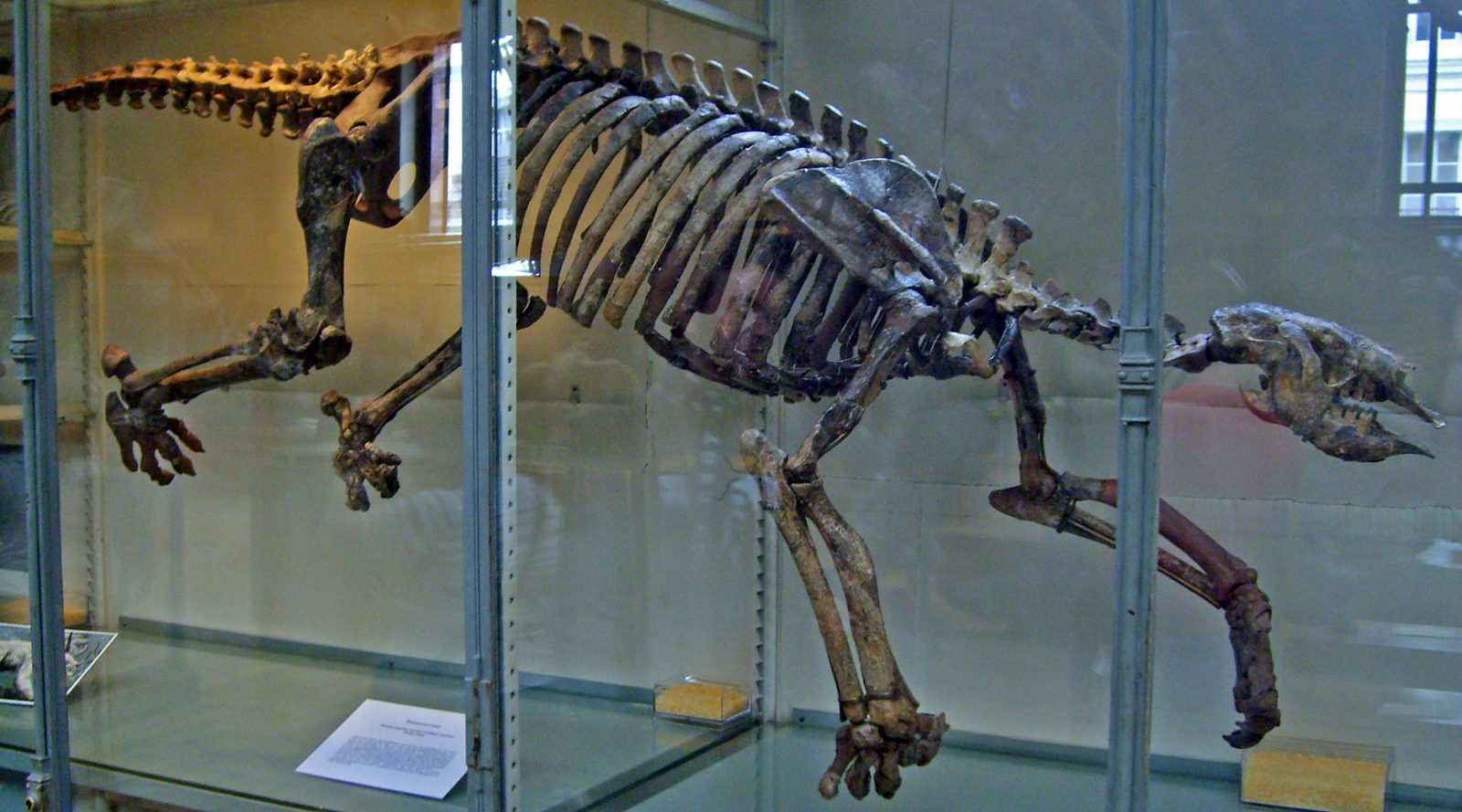
Thalassocnus is one of those fossil genera that sounds invented after the argument has already been won. A sloth in the sea sounds like a headline first and a lineage second. The better reading runs the other way. What makes Thalassocnus scientifically valuable is not the novelty of one odd animal, but the fact that several species preserve a graded return to the water along the Pacific coast of South America from the late Miocene into the Pliocene.[1][2][3][4]
That longer sequence changes the question. Instead of asking whether a ground sloth could enter shallow marine settings, paleontology can ask how feeding, buoyancy, skull shape, and stratigraphic range changed as the lineage spent more time there.[2][3][4] On that scale, Thalassocnus stops looking like a gimmick taxon. It starts looking like a rare evolutionary series in which shoreline browsing, underwater grazing, and heavier-bodied seafloor life can be watched tightening step by step.
Image context: the cover uses a real photograph of the mounted Thalassocnus natans skeleton in Paris. It belongs here because the article's main claim is about whole-body transition. Before any paper parses mandibles or limb bones, the mount already shows a sloth body being pulled toward a different medium and a different feeding level.[6]
The earliest species still keep one foot near the shore
The original 1995 Nature description already set the ecological problem clearly.[1] Christian de Muizon and H. Gregory McDonald argued that abundant, well-preserved remains from marine Pliocene deposits of Peru were best explained if the animal was living on the shore and entering the water to feed on sea-grasses or seaweeds.[1] That was a stronger claim than simple drift into the sea after death, especially because the Peruvian coast was already desert and other land mammals were scarce in the same marine assemblages.[1][3]
The feeding paper from 2004 sharpened that first picture by refusing to flatten all species into one ecological package.[2] The three older species, according to that study, were probably partial grazers or mixed feeders, and the abundant dental striae on their molariform teeth suggested sand ingestion consistent with feeding in very shallow water or on stranded vegetation.[2] That matters because it places the beginning of the marine experiment at the edge, not at full commitment. The early Thalassocnus species do not yet read like clean analogues of sirenians. They read like sloths learning how much of the day can be spent in the surf line.
That boundary is easy to miss because the word "aquatic" sounds categorical. In this lineage it was cumulative.[1][2] The earliest members are already unusual, but they are unusual in a way that preserves ambiguity: shoreline foraging, shallow-water grazing, and a body plan still close enough to terrestrial sloths that the transition remains visible rather than hidden.[2]
Later species turn grazing into a more underwater affair
The same 2004 feeding-adaptation study argued that the younger species, T. carolomartini and T. yaucensis, were more specialized grazers than the older forms.[2] Their teeth almost lack the earlier sand-scoring pattern, and the authors interpreted the jaws as carrying a more distinct transverse component during chewing.[2] That is the kind of change that matters more than the usual museum superlatives. It suggests that the lineage did not merely become "more aquatic" in a vague sense. It became better at processing marine vegetation in the water itself.[2]
The companion 2004 paper on T. yaucensis pushes the same point through skull shape and chronology.[3] It describes the younger species as more derived than T. natans and emphasizes a more elongated rostrum and more robust, squarer molariform teeth shared by the later forms.[3] Those are not decorative differences. They fit a lineage whose feeding target and feeding posture were both shifting. The paper even treats the shared features of T. carolomartini and T. yaucensis as signs that these species were better adapted to grazing on marine vegetation than the earlier species.[3]
This is the moment where Thalassocnus becomes especially useful as lineage evidence. Many fossil marine transitions are reconstructed from one dramatic species and a cloud of inference around it. Here the changes are distributed. Teeth, rostrum, and chewing mechanics move in the same direction across multiple named species.[2][3] The result is not a single "sea sloth" icon, but a series in which diet and head use become steadily more underwater.
Dense bones make the water problem physical, not metaphorical
Feeding alone does not solve a marine transition. A large herbivore also has to solve buoyancy. The 2014 Royal Society paper on bone structure made that point explicit by arguing for a gradual adaptation of the skeleton to aquatic life in extinct sloths from Peru.[5] Its conclusion, as reflected in the study summary, is especially valuable because it treats Thalassocnus as a sequence rather than a one-off. The dense-bone condition intensified through the lineage, and the authors suggested that the osteosclerosis of Thalassocnus may have begun as an exaptation from already compact pilosan bones before being pushed much further by aquatic demands.[5]
That is a better story than simply saying the sloth "went back to the sea." Water loads the body with new mechanical constraints. If an herbivore is feeding below the surface, staying down becomes part of the anatomy.[5] In Thalassocnus, the heavy skeleton is therefore not just a curiosity. It is one of the clearest signs that the marine phase stopped being occasional. Later species were not merely paddling between shoreline patches. Their bodies were being reorganized around life in which submergence had become routine enough to matter at the level of bone.
This is also where the lineage acquires its strongest deep-time tension. Sloths are usually remembered for suspension, digging, or slow browsing on land. Thalassocnus redirects that inheritance into a very different physical problem.[5] The unusual result is not speed or streamlining, but ballast. That is why the lineage feels so alien and so plausible at once. It solves marine herbivory without pretending to be a sirenian.
The newest Chile material breaks the old tidy ladder
For years, Thalassocnus was often presented as an unusually neat four-million-year ladder of one species after another.[3] The 2025 Chile paper complicates that picture in exactly the right way.[4] Valenzuela-Toro and colleagues report T. natans material from Norte Bahía Caldera in the Bahía Inglesa Formation and describe it as the most complete Thalassocnus specimen yet reported from Chile.[4] More importantly for interpretation, their broader review argues that overlapping stratigraphic ranges for type material of T. antiquus with both T. natans and T. littoralis weaken the old case for a perfectly clean anagenetic succession.[4]
That revision does not make the lineage less interesting. It makes it more believable. Evolutionary transitions are often taught as ladders because ladders are easy to draw. Real fossil sequences are messier in time and geography.[3][4] The Chile evidence stretches Thalassocnus across several basins over more than 800 km, confirms a substantial record outside Peru, and preserves the useful distinction between directional adaptation and a perfectly single-file species parade.[4] In other words, the marine trend remains strong even after the tidy version softens.
That is probably the best final sentence about Thalassocnus. It matters because it preserves a directional marine experiment without collapsing into a cartoon of inevitability.[1][2][3][4] Early species still look close to the shore. Later ones look more committed to underwater grazing and to the heavy-boned logic required for it.[2][3][4] The newest material then reminds us that strong evolutionary direction does not require a perfectly clean ladder. The sea sloth becomes most legible at exactly that point, where anatomy, feeding, and stratigraphy all move together, but not too neatly.
Sources
- Christian de Muizon and H. Gregory McDonald, "An aquatic sloth from the Pliocene of Peru," Nature (1995) - original description of Thalassocnus natans and the argument for a shoreline mammal entering the water to feed on marine plants.
- Christian de Muizon, H. Gregory McDonald, Rodolfo Salas, and Mario Urbina, "The evolution of feeding adaptations of the aquatic sloth Thalassocnus," Journal of Vertebrate Paleontology 24(2) (2004) - older species as mixed or partial grazers, younger species as more specialized underwater grazers.
- Christian de Muizon, H. Gregory McDonald, Rodolfo Salas, and Mario Urbina, "The youngest species of the aquatic sloth Thalassocnus and a reassessment of the relationships of the nothrothere sloths" (2004 PDF) - elongated rostrum, more robust teeth, and the older anagenetic-ladder framing.
- Ana M. Valenzuela-Toro, Nicholas D. Pyenson, Jorge Velez-Juarbe, and Mario E. Suarez, "Aquatic sloths (Thalassocnus) from the Miocene of Chile and the evolution of marine mammal herbivory in the Pacific Ocean," PeerJ 13 (2025) - new Chile material, the most complete Chilean specimen, and the argument that the old clean species succession is too tidy.
- Eli Amson et al., "Gradual adaptation of bone structure to aquatic lifestyle in extinct sloths from Peru," Proceedings of the Royal Society B (2014) - bone-density evidence for a staged shift toward aquatic life in the lineage.
- Wikimedia Commons file page for the Thalassocnus skeleton photograph used as the article image.