Walcott Quarry is one of those fossil sites that arrives pre-packaged as wonder. The official hike page still sells the essential paradox honestly: you climb high into Yoho National Park and handle traces of a world more than 500 million years old, now exposed near the top of a mountain.[2] The original quarry also carries the weight of familiarity. It is where Charles D. Walcott built the classic Burgess Shale collection, where the Great Marrella layer became famous, and where enough soft-bodied fossils accumulated that the site now anchors almost every public account of the Cambrian Explosion.[1][5]
That reputation is deserved, but the quarry becomes sharper when its evidence is read in the right order. Walcott Quarry is not best understood as a perfect census of one afternoon on the Cambrian seafloor. It is better understood as a repeated burial stack at the foot of the Cathedral Escarpment, where mud-rich flows, chemical boundaries, and unusually favorable burial conditions kept turning vulnerable carcasses into a dense fossil archive.[1][3][4] The ecology is real. The trap is real too.
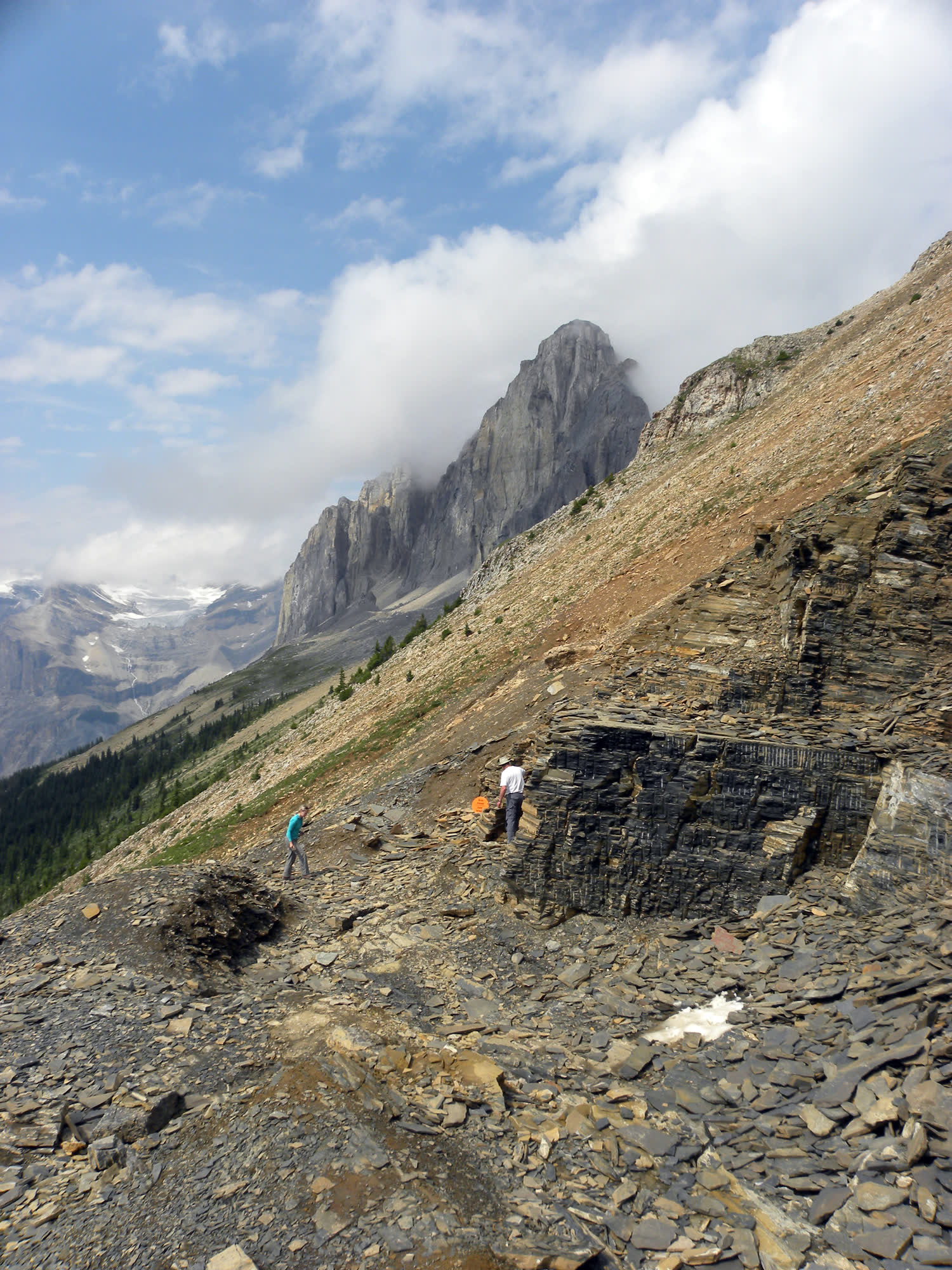
Image context: the cover uses a real Wikimedia Commons photograph of Walcott Quarry on Fossil Ridge. It belongs here because the article's central claim is geographic and sedimentary before it is taxonomic. The steep alpine setting reminds the reader that the famous fossils now sit in a quarry face that has to be reached, protected, and interpreted as layered rock rather than as a flat museum legend.[6]
The quarry is a bedded archive, not one magical slab
Walcott's own 1911 monograph is still the cleanest reminder that the quarry was always a layered object.[5] He described the phyllopod bed as about 7 feet 7 inches thick and broke it into multiple subdivisions rather than treating it as one homogeneous fossil blanket.[5] Within that package he identified particular productive layers, including the famous Great Marrella layer, and he noted that different horizons yielded different concentrations and combinations of forms.[5] That level of stratigraphic attention matters because it prevents a lazy reading. The Burgess Shale was never just "the place where strange animals appeared." It was a stack of beds with changing fossil densities and changing taxonomic emphases.
That layered view also explains why the site stayed scientifically alive for so long. The Royal Ontario Museum's Walcott Quarry community page notes that about 150 species have been described from this one locality and that the collections are enormous: roughly 65,000 specimens at the Smithsonian, 10,000 at the Geological Survey of Canada, and 150,000 at the ROM.[1] A site with that many specimens is not scientifically powerful because one slab is beautiful. It is powerful because repeated beds and repeated collecting created a sample large enough to test ecology, abundance, and anatomy at scale.[1]
The strongest model starts at the foot of the escarpment
The older popular image imagined Burgess animals living in shallower waters on top of the Cathedral Escarpment and then being swept downslope.[1] The ROM's current synthesis is more specific: most Walcott Quarry fossils probably represent organisms that lived in comparatively deep waters at the foot of the escarpment, and recent work suggests many of them lived and died near where they were ultimately buried.[1] That is already a more disciplined ecological picture. It moves the quarry away from a cartoon of total long-distance chaos without pretending the beds are untouched life positions.
The taphonomic review by Gaines makes the geometry even clearer.[3] In that model, the steep slope at the front of the Cathedral Escarpment lay near the angle of repose, so periodic slope failure, likely influenced by storms, generated dense mud-rich slurries.[3] The quarry sat in the rare zone where transport distance to the preservational trap was short, the chemocline was close enough to matter, and rapid burial in fine-grained sediment could repeatedly outpace ordinary decay.[3] That combination is the real engine of the site. Exceptional preservation was not a generic property of Cambrian mud. It was the result of a specific slope-plus-chemistry arrangement that kept delivering bodies into conditions favorable for conservation.[3]
Flow transport changes the reading, but it does not erase the ecology
The most useful recent correction comes from the 2021 flume-experiment paper.[4] Minter and colleagues argue that at least some Walcott Quarry beds were produced by sediment-gravity flows capable of entraining recently dead animals, carrying them substantial distances, and depositing them as mixed assemblages within a single bed.[4] Their paper says this directly: the traditional interpretation of Greater Phyllopod Bed assemblages as in-life communities may not be a faithful depiction in every case.[4] That is not a minor technical tweak. It changes how a reader should imagine the quarry.
The right adjustment, though, is not to swing from "perfect snapshot" to "meaningless jumble." That would be too simple in the other direction. The same paper is dealing with particular beds and particular flow behavior, not denying the broader ecological reality of the Burgess habitat.[4] The ROM synthesis still points to a community living at the escarpment's base, and the massive collections still support quantitative ecological study at the quarry scale.[1] The better sentence is narrower: bed by bed, Walcott Quarry is often an assembled evidence stack rather than a literal instant photograph. Quarry by quarry and horizon by horizon, it still samples a coherent Cambrian slope-foot world.[1][3][4]
That distinction is why the site remains so instructive. Paleontology often has to choose between preserving anatomy and preserving ecology. Walcott Quarry gets unusually far on both fronts, but only if the reader keeps transport and burial inside the story instead of editing them away.[3][4] Soft-bodied animals did not become legible by magic. They became legible because flows, oxygen boundaries, and mud worked together in a narrow window that preserved bodies while also slightly reorganizing them.[3][4]
Why the mountain still matters
The Parks Canada page helps recover one last fact that museum culture can blur: the quarry is still a place with access limits, distance, and protection rules.[2] Guided hikes run only in season, the site is restricted, and the trail remains difficult.[2] That present-day discipline mirrors the deeper scientific one. Walcott Quarry should not be treated as a flat symbol for "Cambrian weirdness." It is a particular protected outcrop on Fossil Ridge, containing a particular fossil package whose meaning depends on bed thickness, slope, transport, and where the preservational trap sat relative to the living habitat.[2][3][5]
That is why the best field-report sentence is stricter than the standard legend. Walcott Quarry is valuable because it kept returning bodies from a Cambrian slope-foot ecosystem to a burial setting that could save them.[1][3][4] The site is not diminished when the one-afternoon fantasy drops away. It becomes better. The quarry stops being a miracle postcard and becomes what it really is: a layered community record assembled by repeated events, read through stratigraphy, and protected precisely because the details still matter.
Sources
- Royal Ontario Museum, "The Walcott Quarry Community" on The Burgess Shale site - overview of species count, collection sizes, and the current ecological interpretation of the quarry community.
- Parks Canada, "Walcott Quarry: Classic expedition" - official page on the protected site, guided access, and the mountain setting of the quarry in Yoho National Park.
- Robert R. Gaines, "Burgess Shale-type Preservation and Its Distribution in Space and Time" (2014) - review of the escarpment, chemocline, transport, and rapid-burial model for Burgess Shale-type preservation.
- Nicholas J. Minter et al., "Flume experiments reveal flows in the Burgess Shale can sample and transport organisms across substantial distances," Communications Earth & Environment (2021).
- Charles D. Walcott, "Middle Cambrian Branchiopoda, Malacostraca, Trilobita, and Merostomata" (1911), Smithsonian Miscellaneous Collections - original quarry-layer description including the phyllopod bed thickness and Great Marrella layer.
- Wikimedia Commons file page for the Walcott Quarry photograph used as the article image.