Ankylosaurus magniventris is one of the few dinosaurs that arrives overexplained before the evidence has even been named. Most readers think they already know the animal: a low armored tank, a massive tail club, and a perfectly settled silhouette lumbering beside Tyrannosaurus at the end of the Cretaceous. The stronger species profile starts by removing that false familiarity. Ankylosaurus is famous beyond the completeness of its fossils. Its best evidence comes from a handful of latest Cretaceous specimens, especially the skull, and the animal becomes clearer only when the missing skeleton stays visible in the story.[1][2][3][6]
That narrower starting point does not weaken the dinosaur. It improves it. Barnum Brown's 1908 naming paper established Ankylosaurus from partial material and used it to define an entire new family of armored dinosaurs.[1] A century later, Arbour and Mallon could still write that the genus was represented by only a handful of specimens, far fewer than some of its earlier relatives, even though those remains already showed a very unusual skull, narial region, and body size.[3] The Natural History Museum's public summary puts the boundary in the plainest form: Ankylosaurus is the most famous ankylosaur, but not the best understood, because no complete skeleton has yet been found.[6]
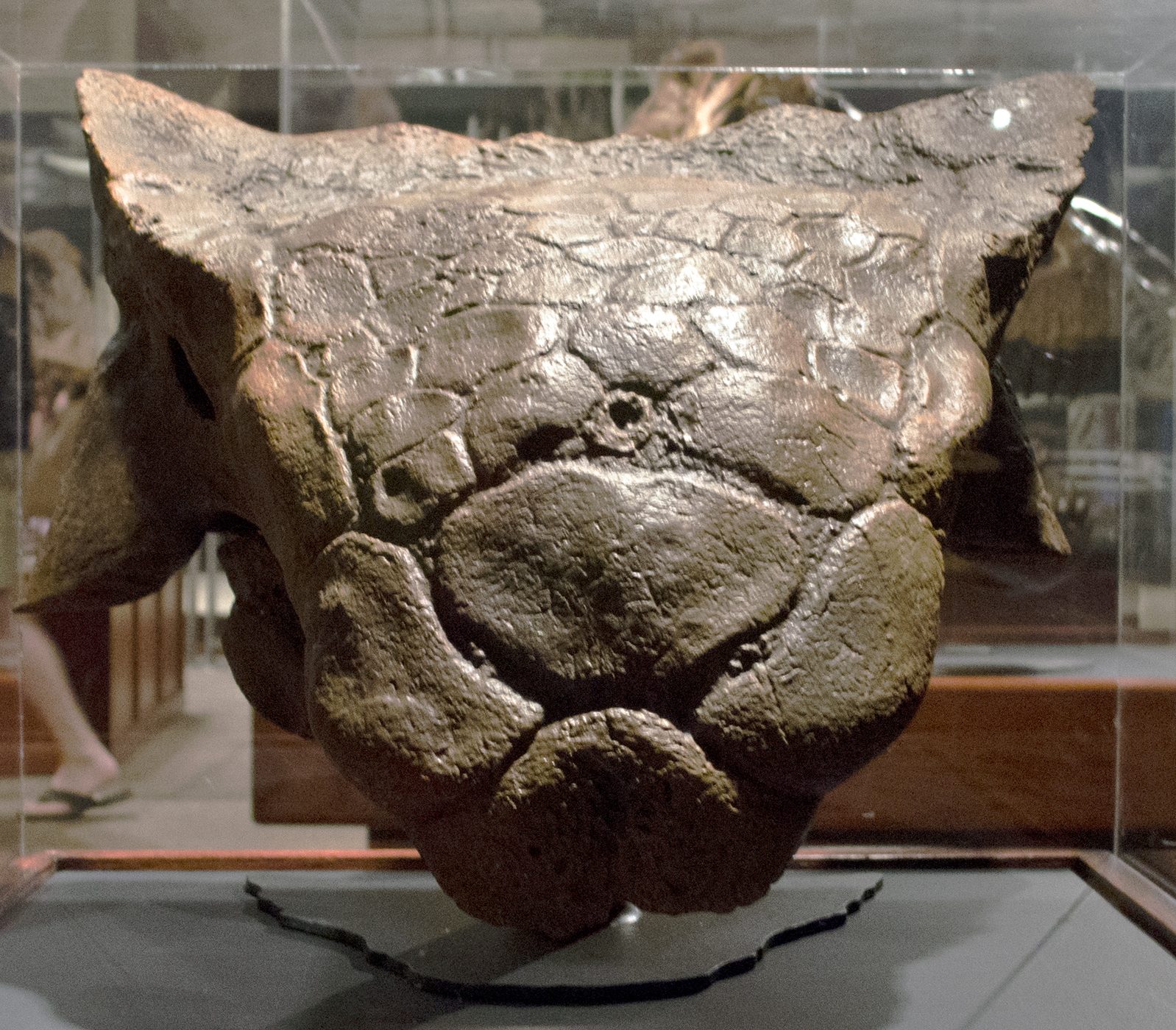
Image context: the cover uses a real museum photograph of an Ankylosaurus skull cast from the Museum of the Rockies via Wikimedia Commons.[7] It fits this article because the skull is the most secure place to begin. Rather than pretending that the full-body reconstruction is equally direct everywhere, the image keeps the reader anchored to a physical fossil-room object and to the cranial evidence that made this animal historically legible.
1) The first fact about Ankylosaurus is not the club. It is the fragmentary record.
Brown's original description was based on a partial skull, teeth, vertebrae, ribs, a scapula, and many osteoderms from the Hell Creek Formation of Montana.[1] That was enough to show that this was not just another plated dinosaur. The skull roof was tightly armored, the body was broad, and the ribs suggested a very wide torso.[1] But the animal entered science as pieces, not as a complete mounted certainty.
Carpenter's 2004 redescription and the later 2017 review both make the same point in a more disciplined way.[2][3] Material attributable to Ankylosaurus comes from the Hell Creek, Lance, Scollard, and Frenchman formations, but it remains sparse and uneven. Different specimens preserve different strengths: the holotype offers historically important cranial material and some postcranium, AMNH 5214 preserves the best tail club knob, and CMN 8880 preserves the largest skull.[2][3] That is enough to support a real taxon profile, but not enough to erase uncertainty by sheer specimen count.
This matters because public paleoart often works backward from the idea that Ankylosaurus is the archetypal ankylosaur. Scientifically, the situation is nearly the reverse. The genus gave its name to the family, yet it is less completely known than several relatives.[3][6] The profile therefore has to stay evidence-first. A broad, low-bodied latest Maastrichtian ankylosaurid is secure. A perfectly mapped arrangement of every osteoderm across the living body is not equally secure.[2][3]
2) The skull is where Ankylosaurus diverges from the generic armored-dinosaur template
The skull is the reason Ankylosaurus does not reduce cleanly to "largest ankylosaur with a club." Carpenter emphasized the broad muzzle, the small teeth, and the unusually modified nasal region.[2] Arbour and Mallon sharpened the same point by arguing that Ankylosaurus had diverged substantially from other late ankylosaurines in the dentition, narial anatomy, tail club, and overall body size.[3] Their conclusion is worth dwelling on because it changes the animal's center of gravity. The most distinctive part of the taxon is not simple armor thickness. It is the head.
That head is peculiar in a specific way. The external nostrils are displaced laterally rather than facing neatly forward in the simplified toy version.[2][3] The snout is broad and low, the skull roof is heavily caputegulated, and the teeth are small enough that Arbour and Mallon treated diet as an open problem rather than a solved herbivore stereotype.[3] They even suggest that the altered narial region may reflect changed functions in the nasal passage, olfaction, or feeding ecology, while stopping short of pretending the adaptive story is already settled.[3]
This is where comparison becomes useful but must stay labeled as comparison. Bourke, Porter, and Witmer's 2018 CFD study did not model Ankylosaurus itself; it modeled Euoplocephalus and Panoplosaurus.[5] But the study matters here because it showed that the convoluted nasal passages of ankylosaurs could function as efficient heat exchangers, with the larger ankylosaurid model outperforming the nodosaurid one in heat recovery.[5] That does not prove the exact airflow dynamics of Ankylosaurus. It does tighten the interpretive boundary: when Ankylosaurus evolves an unusually modified narial region, the best comparative frame is a clade in which elaborate airways were doing real thermophysiological work.[3][5]
3) The tail club is real, but the record is narrower than the legend
The club remains central, but it is central in the way a specimen-based structure is central, not in the way a mascot weapon is central. Arbour and Mallon note that AMNH 5214 preserves a portion of the tail club handle and a complete, well-preserved knob, while the tail of Ankylosaurus as a whole is still poorly known.[3] Their reconstruction suggests a handle with vertebrae much wider than those of some other ankylosaurines, and a large knob consistent with a very substantial distal weapon.[3] That is strong evidence for a formidable club. It is not the same thing as having a perfectly known full tail in articulation.
The physics work on ankylosaurid tail clubs helps here, again with a boundary attached. Arbour, Sissons, and Burns modeled impact forces in ankylosaurids using better preserved clubs from related taxa and showed that the handle was a structural compromise, stiff enough to support the knob and absorb shock, but at a cost to maximum acceleration.[4] The broader lesson is that clubs are not fantasy maces hung on a generic tail. They are engineering problems. In Ankylosaurus, where the knob is large but the total tail remains incomplete, the safest claim is that the animal possessed a serious striking structure whose exact performance envelope still has to be inferred comparatively.[3][4]
That narrower reading is better than the old all-purpose tank myth. It keeps the club important while refusing to let it consume the rest of the anatomy. The skull remains just as diagnostic, and the fragmentary record remains part of the scientific meaning of the animal.
4) The strongest 2026 profile is large, late, bizarre, and still usefully bounded
Put the current evidence together and a stable picture emerges. Ankylosaurus was a latest Cretaceous North American ankylosaurine, among the largest members of its lineage, with a broad low skull, laterally displaced nostrils, small teeth, extensive cranial armor, and a large tail club.[1][2][3] It lived in the same end-Cretaceous worlds as the familiar Hell Creek giants, but it was not simply a standard ankylosaur scaled up. The head was remodeled, the body was immense, and the public image outran the fossil completeness very early.[2][3][6]
The useful limit is just as clear. We do not have one complete skeleton that turns every reconstruction choice into direct observation.[3][6] We do not know the exact arrangement of every osteoderm with the certainty readers often assume. We do not know the exact function of its altered nasal region, only that the region is unusual and belongs inside a clade where elaborate airways had real physiological potential.[3][5] And we do not know the exact striking performance of the tail club from Ankylosaurus material alone, even though the club itself is unquestionably real.[3][4]
That is the version of Ankylosaurus worth keeping. It is not impressive because it confirms every childhood image. It is impressive because the fossils support a stranger and more disciplined animal: a giant late ankylosaur whose skull was more specialized than the generic tank model allows, whose club was formidable but incompletely preserved, and whose fame has to be kept slightly behind the evidence in order to stay accurate.
Sources
- Barnum Brown, "The Ankylosauridae, a new family of armored dinosaurs from the Upper Cretaceous" (1908), Bulletin of the American Museum of Natural History 24.
- Kenneth Carpenter, "Redescription of Ankylosaurus magniventris Brown 1908 (Ankylosauridae) from the Upper Cretaceous of the Western Interior of North America" (2004), Canadian Journal of Earth Sciences 41.
- Victoria M. Arbour and Jordan C. Mallon, "Unusual cranial and postcranial anatomy in the archetypal ankylosaur Ankylosaurus magniventris" (2017), FACETS 2.
- Victoria M. Arbour, Robin L. Sissons, and Michael E. Burns, "Estimating Impact Forces of Tail Club Strikes by Ankylosaurid Dinosaurs" (2009), PLOS ONE 4(8).
- Jason M. Bourke, Wm. Ruger Porter, and Lawrence M. Witmer, "Convoluted nasal passages function as efficient heat exchangers in ankylosaurs (Dinosauria: Ornithischia: Thyreophora)" (2018), PLOS ONE 13(12).
- Natural History Museum, "Ankylosaurus" - overview noting that the dinosaur is famous but still lacks a complete skeleton.
- Wikimedia Commons file page for the Museum of the Rockies Ankylosaurus skull-cast photograph used as the article image.