
PBS Eons' terror-bird episode is useful because it starts with the hook that made phorusrhacids famous, then gives enough evidence to move beyond it.[1] A giant, flightless, carnivorous bird with a hooked beak is almost impossible to introduce without theatrical language. The phrase "terror bird" does that work before the fossil has even been described. But the strongest way to watch the video is to let the drama become a question: what, exactly, did those skulls, necks, and legs allow these animals to do?
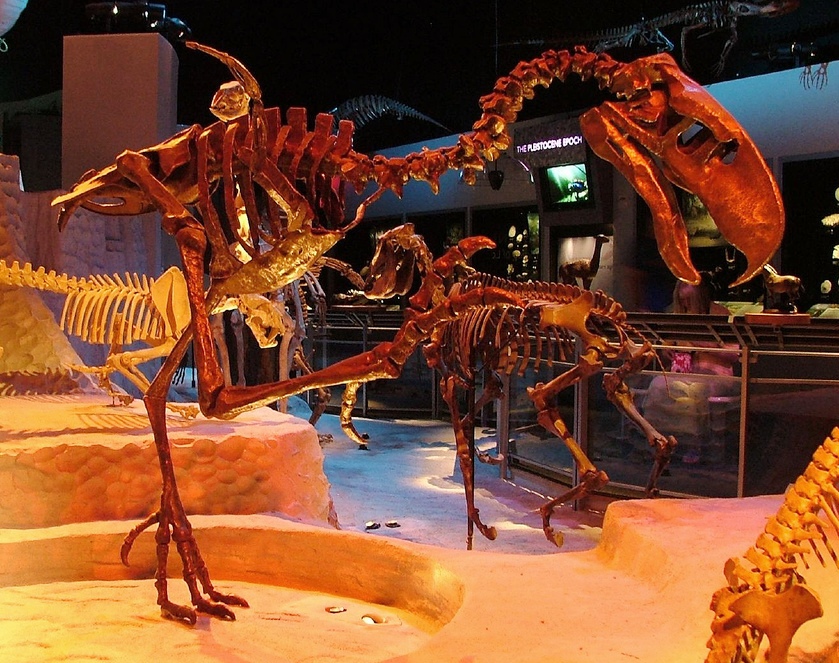
That matters because phorusrhacids were not a single creature. They were a long-running radiation of mostly South American ground predators, with species ranging from smaller forms to giants and with one especially famous northern representative, Titanis walleri.[2][3] The Florida Museum places Titanis from about 5 to 1.8 million years ago and notes that real fossils of the animal are displayed alongside a full-sized metal interpretation of the skeleton.[2] That image of a museum mount is a good corrective. Terror birds are not only paleoart silhouettes. They are fragmentary bones, comparative anatomy, CT models, and biomechanical arguments.
Image context: the cover photograph shows the Florida Museum's Titanis walleri display, not a generated scene. It fits this piece because the essay asks viewers to keep returning from the video image of a formidable predator to the material constraints of fossil evidence: known bones, reconstructed posture, and museum interpretation.[2][7]
The title promises invasion, but the better story is anatomy under constraint
The video frames terror birds through movement: a successful southern radiation, an eventual appearance in North America, and predators that look ready to sprint out of the Cenozoic.[1][2] That is the right popular entry point. Titanis is compelling partly because it makes the Great American Biotic Interchange feel less mammal-centered. Here is a bird lineage, not a cat or canid, crossing the map of late Neogene faunas.[2]
But the fossil record becomes sharper when "invasion" is treated as background rather than as the whole argument. The most interesting question is not whether terror birds looked frightening. It is what kinds of forces their bodies could tolerate. Degrange and colleagues' 2010 analysis of Andalgalornis is especially important here because it turns the beak from a prop into a mechanical system.[3] Their CT and finite-element work interpreted the skull as unusually rigid, strong in vertical and front-back loading, but more vulnerable to lateral stresses.[3] That is a very different predator than the vague monster in the name. It suggests a beak suited to targeted, sagittal strikes and pullback forces, not to casually wrestling large, struggling prey side to side.[3]
Around the beak, the video should be read against the finite-element model
When the episode dwells on the head, the temptation is to read size as self-explanatory.[1] Large hooked beak equals dominant killer. The biomechanics complicate that. In Andalgalornis, the estimated bite at the bill tip was not the only important number; the direction of stress mattered more.[3] The skull performed well under dorsoventral loading, yet lateral shaking produced much higher stress.[3] In plain terms, a terror bird's head could be dangerous without being invulnerable.
That distinction makes the animal more interesting. A predator constrained by lateral weakness has to behave differently from one that can clamp, shake, and hold any target. The paper's proposed attack-and-retreat model is not a small downgrade from the monster image. It is a better scientific claim because it links behavior to anatomy.[3] The beak becomes a tool with a preferred operating direction. The video gives the viewer the animal; the paper gives the viewer the tolerances.
The neck adds a second moving part to the strike
A beak does not act alone. Tambussi and colleagues' 2012 neck study on Andalgalornis matters because it asks how the head could be positioned and driven during feeding.[4] The authors described regional patterns in the cervical column and treated the neck as a performance system rather than as a simple support pole.[4] That is exactly the kind of evidence the video can only gesture toward in a short runtime.[1]
The neck point also helps avoid a common mistake: imagining terror-bird predation as one static pose. A rigid skull, a long neck, and a running body have to be coordinated. If the skull is best used in the vertical plane, then the neck and body posture become part of the strike strategy. The predator is not simply "big bird plus sharp beak." It is a set of linked constraints: approach, aim, strike, recover, and avoid dangerous side loads.[3][4]
The legs keep the animal terrestrial, not merely oversized
The episode's moving reconstructions are most persuasive when they remind viewers that these were ground birds first.[1] Cambridge work on phorusrhacid hind-limb morphometry makes that point quantitatively, using pelvis and limb form to infer locomotor styles and substrate preferences.[5] The details vary across taxa, but the larger lesson is stable: terror birds are a locomotor problem as much as a skull problem.[5]
That is why the best version of the video is not a creature feature. It is a compact tour through the problem of being a large terrestrial bird predator after the non-avian dinosaurs were gone. The legs have to move the animal through open or mixed habitats; the neck has to manage head position; the skull has to deliver force in directions it can tolerate; and the prey has to be selected or attacked in ways that do not exceed those limits.[3][4][5] Nothing about that is less dramatic than the nickname. It is simply more accountable.
New finds keep the category from freezing into one icon
The 2024 report on a giant phorusrhacid fossil from Colombia is a good reminder that the group is still changing under our feet.[6] Smithsonian Magazine's summary emphasizes a roughly 12-million-year-old tibiotarsus from La Venta and notes that the specimen may represent one of the largest terror birds yet recognized.[6] That kind of find does not merely add another big animal to the roster. It broadens the ecological and geographic frame for the whole group.
This is the strongest reason to revisit a popular video after watching it. The clip supplies a clear narrative spine, but the fossils keep resisting a single mascot version of the animal.[1][6] Titanis gives North America a late branch of the story.[2] Andalgalornis gives a biomechanical test case for skull and neck function.[3][4] Hind-limb work gives a way to discuss locomotion across the family rather than guessing from outline alone.[5] New material from northern South America asks how many large phorusrhacids remain underdescribed or unrecognized.[6]
The best closing thought, then, is not that terror birds were terrifying. That part is easy. The better thought is that phorusrhacids are a case study in how paleontology improves a dramatic image by narrowing it. Once the beak has loading limits, the neck has regions of motion, the legs have measurable proportions, and the range has dated fossils, the animal becomes less like a monster mask and more like a real Cenozoic predator whose power had a shape.
Sources
- PBS Eons, "The Time Terror Birds Invaded," YouTube video.
- Florida Museum, "Titanis walleri."
- Federico J. Degrange et al., "Mechanical Analysis of Feeding Behavior in the Extinct 'Terror Bird' Andalgalornis steulleti," PLOS ONE.
- Claudia P. Tambussi et al., "Flexibility along the Neck of the Neogene Terror Bird Andalgalornis steulleti," PLOS ONE.
- Hind limb morphometry of terror birds, Cambridge Core.
- Smithsonian Magazine, "Rare 'Terror Bird' Fossil Found in Colombia Reveals the Enormous Size of a Prehistoric Predator."
- Wikimedia Commons file page for the lead image, "Skeleton of Titanis at the Florida Museum of Natural History.jpg."