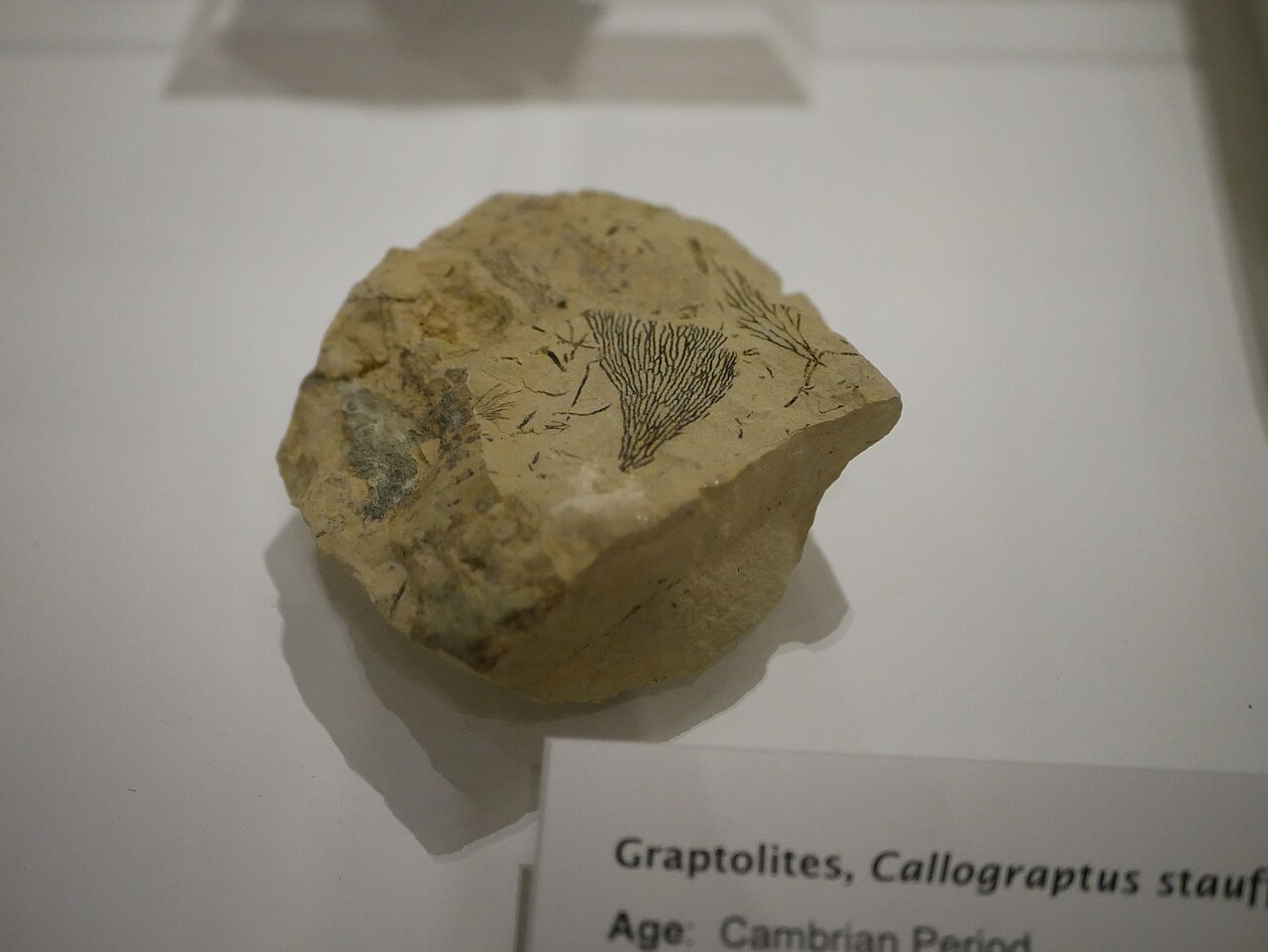
Graptolites are easy fossils to underestimate. They usually do not look like bones, shells, teeth, or tracks. On a slab of shale they can resemble pencil scratches, saw teeth, a comb pressed into mud, or a small twig flattened into carbon. That visual modesty is part of their scientific force. A fossil that looks like handwriting is, in practice, one of the best ways paleontologists learned to read large stretches of early Paleozoic time.[1][2]
The lineage is clearer if it is not treated as a strange fossil shape first. Graptolites were marine colonial pterobranch hemichordates: tiny animals living in shared tube systems, with individual zooids housed in thecae along branches called stipes.[1][2] Their record runs from the Cambrian into the Mississippian, and living pterobranchs now show that the old "extinct graptolite" story has a caveat: the spectacular planktonic Paleozoic forms are gone, but graptolite relatives survive in a quieter benthic mode.[1][3]
That long arc is why graptolites deserve a lineage-context reading. Their importance is not simply that they are useful index fossils, though they are. It is that their usefulness came from an evolutionary experiment: a colony-building seafloor animal line moved into the water column, diversified fast enough for its changing forms to mark time, and then left a fossil record concentrated in the dark mudstones where ordinary shelly faunas often tell a different story.[1][2][4][5]
Image context: the cover uses a real photograph of a Cambrian Callograptus staufferi specimen from the St. Lawrence Formation, displayed at the New Jersey State Museum.[6] It belongs here because the article turns on appearance versus evidence. The fossil looks delicate and almost botanical, but the branching colony is a record of animal housing, growth, and early graptolite architecture, not a plant impression or a decorative stain.[1][2][6]
1) The colony came before the clock
The first correction is structural. A graptolite fossil is not a single animal preserved whole. It is usually the remains of a colony's housing system. The British Geological Survey describes that system as beginning with an embryonic cone-like tube, the sicula, from which later tubes, the thecae, are arranged along stipes to make the larger colony, or rhabdosome.[2] The National Park Service gives the same practical field view: the "teeth" on the sawblade-like fossils are actually the cups or tubes where the individual animals lived.[1]
That matters because the fossil's visible pattern is not ornament. It is architecture. The colony's branching, spacing, and one-sided or two-sided arrangement record how a modular animal system added living chambers through growth. A graptolite is therefore a fossil of repeated construction. Even when preservation reduces it to a carbon film, the line still carries information about colony organization.[1][2]
This is the first step toward their later value as timekeepers. The fossil had to be morphologically legible before it could become biostratigraphically powerful. If a colony's shape changed in recognizable ways from interval to interval, those changes could become more than taxonomy. They could become a clock embedded in shale.
2) The big evolutionary turn was from bottom to water column
The second correction is ecological. The earliest graptolites were not the classic open-water forms that made the group famous. BGS describes the earliest graptolites as seafloor animals, attached to boulders or rooted into soft mud, while later forms became free floating.[2] That transition at the beginning of the Ordovician is the article's hinge. Graptolites did not merely diversify as colony shapes. They entered a new habitat.
The shift into planktonic life changed the problem the colony had to solve. A fixed seafloor colony can grow in place. A free-floating colony has to feed, stay suspended, resist sinking, and exploit food distributed through the water column. BGS notes a range of hydrodynamic strategies in later graptolites, including long nemas, hooked or spiny forms, net-like structures, and gently curved forms that may have rotated as they fed.[2] Those details are not side decoration. They show why colony architecture became ecology.
Zhang and Chen's diversity study makes the macroevolutionary version of the same point. Their global analysis identifies the beginning of the Ordovician as a major ecological innovation, when planktonic forms were derived from benthic ancestors, producing a large expansion of the graptolite guild.[4] In other words, the lineage's famous timekeeping power was built on a habitat shift. Graptolites became globally useful fossils because some of them became open-water animals.
3) Ordovician diversification made the signal global, but not uniform
Once graptolites entered the water column, they did not spread as a single simple wave. Zhang and Chen report that planktonic graptolites diversified from the beginning of the Ordovician, reached an acme in the early Middle Ordovician, and then declined steadily toward the end of the period.[4] Their South China comparison also matters because it resists a flat global story. The Upper Yangtze platform and Jiangnan slope both show increases, but with different magnitudes and patterns, leading the authors to propose a deep-water origin and shallow-water dispersal model for Ordovician graptolite faunas.[4]
That is a better picture than "graptolites spread everywhere." The open sea was not one uniform habitat. Continental slopes, shelves, upwelling zones, sea-level changes, and regional basins all mattered. BGS makes the ecological point in accessible terms: graptolites were common where food was abundant, especially where upwelling brought nutrient-rich deep water upward, and some forms were deep-water specialists while others exploited temporary food supplies.[2]
This is why the fossils work so well and still require care. Their rapid evolution and broad distribution make them excellent correlators, but local ecology still shapes what appears in a given rock package.[2][4] A graptolite zone is not magic ink. It is a biological signal filtered through ocean structure, preservation, and sampling.
4) Dark shale preserved the record, but did not define the lifestyle
The common setting also needs discipline. Graptolites are famously associated with black shales and mudstones, and that association helped make them central to stratigraphy. The National Research Council chapter on Late Ordovician change notes that graptolites occur abundantly in thinly laminated black shales and mudstones where shelly fossils may be absent or rare, which allowed graptolite zones to become divisions of Ordovician shale sequences.[5]
But a preservation setting should not be confused with the whole life habit. Maletz's 2023 review, listed by Freie Universitat Berlin, makes that boundary explicit in its abstract: the association of planktic graptolites with black shales encouraged a common link to anoxic or low-oxygen environments, but that is treated there as largely a preservational aspect rather than a full ecological definition.[3] Put simply, black shale is where many graptolites are easiest to find and preserve. It is not proof that all graptolites lived only in dark, oxygen-starved water.
That distinction is important because graptolites are often read at two scales at once. At the hand-sample scale, they are dark marks on dark rock. At the ocean scale, they were colonial animals living in a three-dimensional water column, subject to food supply, depth, buoyancy, and circulation.[2][3][4] Good paleontology keeps those scales separate before reconnecting them.
5) Extinction and survival make the lineage less tidy than the fossils
The end of the Ordovician puts graptolites under stress. The National Research Council chapter describes sea-level fall during Late Ordovician glaciation, surface-water cooling, mass mortalities among marine faunas, and graptolite mass mortality tied to changing ocean circulation and toxic or inhospitable waters entering the mixed layer.[5] It also notes that reradiation followed after sea level rose and environments stabilized, with new colony organization developing among graptolites before significant originations resumed.[5]
That sequence matters because it prevents the lineage from looking like a smooth textbook ascent. Graptolites became open-water success stories, then suffered through environmental bottlenecks, then reorganized. The fossil clock was not produced by an untouched lineage. It was produced by a group repeatedly pushed through changing Paleozoic oceans.[4][5]
Maletz's review extends the longer ending. It frames graptolites as small benthic Cambrian elements that later became a dominant planktic macrofaunal group in Ordovician and Silurian seas, then largely disappeared after the Devonian as faster-growing plankton and plankton-feeding animals reshaped marine food webs, leaving only cryptic benthic survivors into the modern world.[3] That is a striking afterlife. The famous fossils are mostly the record of a lost planktonic expansion, while the surviving relatives preserve a quieter version of the older colonial habit.[1][3]
So the best way to read a graptolite is not as a curiosity that happens to be useful. It is a lineage compressed into a mark. The mark records colony construction. The colony records a move from seafloor attachment into open water. The open-water forms diversified fast enough to date rocks, but not so simply that local ecology disappears. The black shale record preserved them with unusual clarity, but it did not fully define their lives. And their decline reminds us that even excellent geological clocks were once living systems exposed to food webs, sea level, oxygen, and extinction.
That is why graptolites still feel almost paradoxical. They are modest fossils with large consequences. A few dark strokes on shale can carry Cambrian ancestry, Ordovician ecological innovation, Silurian recovery, Devonian decline, and the practical reason a geologist can turn a piece of rock into a slice of time.[1][2][3][4][5]
Sources
- U.S. National Park Service, "Fossil Graptolites" - overview of graptolite anatomy, fossil appearance, age range, and U.S. park occurrences.
- British Geological Survey, "Graptolites" - explanation of colony structure, seafloor-to-planktonic transition, hydrodynamic forms, and biostratigraphic use.
- Freie Universitat Berlin publication page for Jorg Maletz, "Graptolites - survival in the palaeozoic seas" (2023), with DOI link and publication metadata.
- YuanDong Zhang and Xu Chen, "Diversity history of Ordovician graptolites and its relationship with environmental change," Science in China Series D: Earth Sciences 51 (2008).
- W. B. N. Berry, M. S. Quinby-Hunt, and P. Wilde, "Impact of Late Ordovician Glaciation-Deglaciation on Marine Life," in Effects of Past Global Change on Life, National Academies Press via NCBI Bookshelf (1995).
- Wikimedia Commons file page for the photographed Callograptus staufferi graptolite specimen used as the article image.