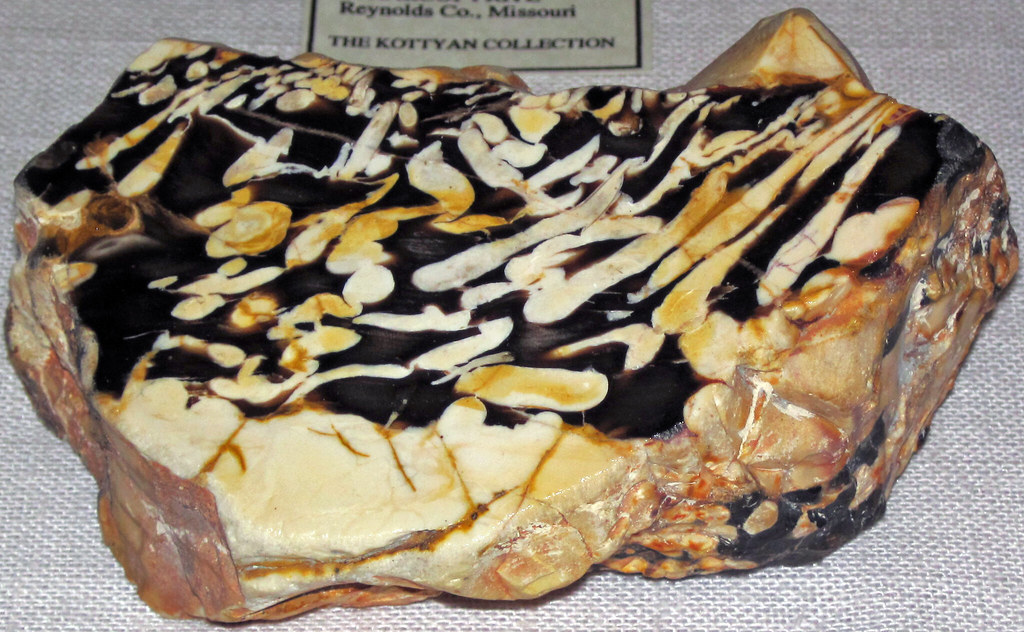
The pale patches look almost edible: cream-colored ovals scattered through dark stone, giving the fossil its collectors’ name, “peanut wood.” In James St. John’s photograph of a specimen from Western Australia’s Windalia Radiolarite, the contrast records two different materials. The dark wood has been mineralized with quartz. The lighter patches are sediment that entered tunnels excavated by bivalves during the Early Cretaceous.[1]
An animal removed part of a tree; sediment occupied the space; the resulting pattern survived. Reading that sequence requires a different kind of attention from identifying a shell. The fossil contains evidence of something an animal did, preserved inside something a plant grew. The name Teredolites belongs to the boring itself. It is a trace-fossil name, with its own classification, rather than the name of a particular clam.[2][3]
Follow the tunnel
A round opening is only one view of a three-dimensional structure. The useful questions concern its course through the wood: how long it runs, where it widens, whether it bends, and whether a mineral lining follows its wall. These features let researchers compare excavations even when their occupants have disappeared.[2]
Simon Kelly and Richard Bromley’s 1984 treatment separated flask-shaped borings in woody material, Teredolites, from comparable structures in rock and other hard mineral substrates, Gastrochaenolites. Their classification organized the traces by both form and the material penetrated. A hole’s address was part of its description.[2]
Within the wood-boring group, the contrast is striking. Teredolites clavatus is relatively short and club-shaped. The long form traditionally called T. longissimus can wind through the wood in narrow, twisting passages. A polished face cuts across those passages at different angles, so an oval on the surface is an invitation to reconstruct a tunnel, rather than a complete account of its shape.[3]
A tree acquires successive tenants
A fossil trunk from the Puez Formation in the Italian Dolomites preserves a particularly revealing sequence. In their 2013 study, Evelyn Kustatscher and colleagues assigned its wood to Agathoxylon, probably allied to araucarian conifers. Marine microfossils in the surrounding sediment place its burial in the Albian stage of the Early Cretaceous.[4]
Microscopic chambers contain fecal pellets attributed to oribatid mites. The authors interpreted these as traces made while the tree was alive or shortly after it died on land. Larger, gently curving borings widen inward to roughly a centimetre across. Some contain sediment with marine microfossils. The researchers assigned these to T. longissimus and inferred a later period of drifting at sea before the trunk sank and was buried.[4]
Here, the journey emerges from the combination. Wood anatomy identifies the plant; different excavations distinguish its inhabitants; the sediment supplies environmental context. The reconstruction gives an order of events without supplying a departure date or a measured voyage.[4]
The burial place needs its own evidence
The same discipline applies to a whole deposit. Andrew Oligmueller and Stephen Hasiotis’s 2024 study of Colorado’s Cretaceous Dakota Group described T. clavatus in the Plainview Formation. They interpreted the relevant settings as intertidal to subtidal using the rocks and their sedimentary structures alongside the traces.[5]
Other wood in their study contained shallow excavations attributed to mayfly nymphs. Some of that wood ended up in marine settings despite the freshwater origin inferred for the marks. The two kinds of boring were not found in the same pieces. The authors considered rapid burial one possible reason why the mayfly-bearing wood escaped later bivalve occupation.[5]
A log can therefore carry evidence from a habitat it has already left. Its surroundings at burial and its earlier life as an animal’s home must be reconstructed separately. An attractive specimen removed from its bed retains the marks, but loses some of the evidence needed to join those histories.
A river complicates the seawater reading
Shipworms—the elongated bivalves responsible for many familiar wood borings—have often been treated as evidence of marine influence. A 2019 study led by J. Reuben Shipway makes that shortcut harder to defend. In a freshwater reach of the Abatan River in the Philippines, the researchers documented Lithoredo abatanica boring into limestone. They also found the wood-boring shipworm Nausitora occupying submerged wood in the same freshwater setting.[6]
The second observation matters directly to fossil logs. It demonstrates that wood-boring shipworms need not be living in seawater. The researchers cautioned that the timing of such freshwater adaptations remains uncertain: the modern example does not establish when comparable behavior arose in the geological past.[6]
It does establish a boundary for interpretation. A fossil boring can support a marine reconstruction when other evidence agrees, as at Puez. On its own, it cannot guarantee salinity. That distinction keeps a useful environmental clue from becoming an automatic verdict.[6]
Why two names appear in the literature
The traces also expose a disagreement about classification. In a paper published online in 2017, Stephen Donovan separated the long, twisting form into Apectoichnus longissimus, emphasizing its difference from the shorter Teredolites clavatus. Oligmueller and Hasiotis rejected that separation in 2024, retaining both within Teredolites because they considered their shared features sufficient.[3][5]
Both names therefore remain in use. They classify excavations, without identifying the animal species that made them.[3][5]
Return to the Australian specimen and the pale ovals become easier to read. They preserve occupied space, emptied space, and space filled again. The tree supplied a habitat, animals excavated it, and burial preserved their alterations. Following those alterations restores a history that the outline of the log alone could never tell.[1]
Sources
- James St. John, “Teredolites bivalve borings in fossil conifer wood.” Flickr (2017); original photograph, locality and specimen description.
- Simon R. A. Kelly and Richard G. Bromley, “Ichnological nomenclature of clavate borings.” Palaeontology 27 (1984), 793–807; foundational classification.
- Stephen K. Donovan, “A new ichnogenus for Teredolites longissimus Kelly and Bromley.” Swiss Journal of Palaeontology 137 (2018), 95–98; published online December 2017.
- Evelyn Kustatscher, Howard Falcon-Lang and Alexander Lukeneder, “Early Cretaceous araucarian driftwood from hemipelagic sediments of the Puez area, South Tyrol, Italy.” Cretaceous Research 41 (2013), 270–276.
- Andrew R. Oligmueller and Stephen T. Hasiotis, “An ichnotaxonomic assessment of the Cretaceous Dakota Group, Front Range, Colorado, USA, and its comparison to other Western interior seaway deposits.” Paleontological Contributions 23 (2024); wood borings and classification.
- J. Reuben Shipway and colleagues, “Shipworm bioerosion of lithic substrates in a freshwater setting, Abatan River, Philippines: Ichnologic, paleoenvironmental and biogeomorphical implications.” PLOS ONE 14 (2019), e0224551.