A piece of fossil charcoal can look strikingly familiar. The specimen below came from a coal-mine spoil pile in Grundy County, Illinois; its finder identifies it as Carboniferous material, approximately 309 million years old.[1] An object that resembles the remains of a recent fire belongs to a world long before the first dinosaurs.
Its familiarity invites a deceptively simple question: how hot was the fire? Answering means separating several histories inside the same fragment—the plant that grew, the burning that changed it, and the geological events that followed.
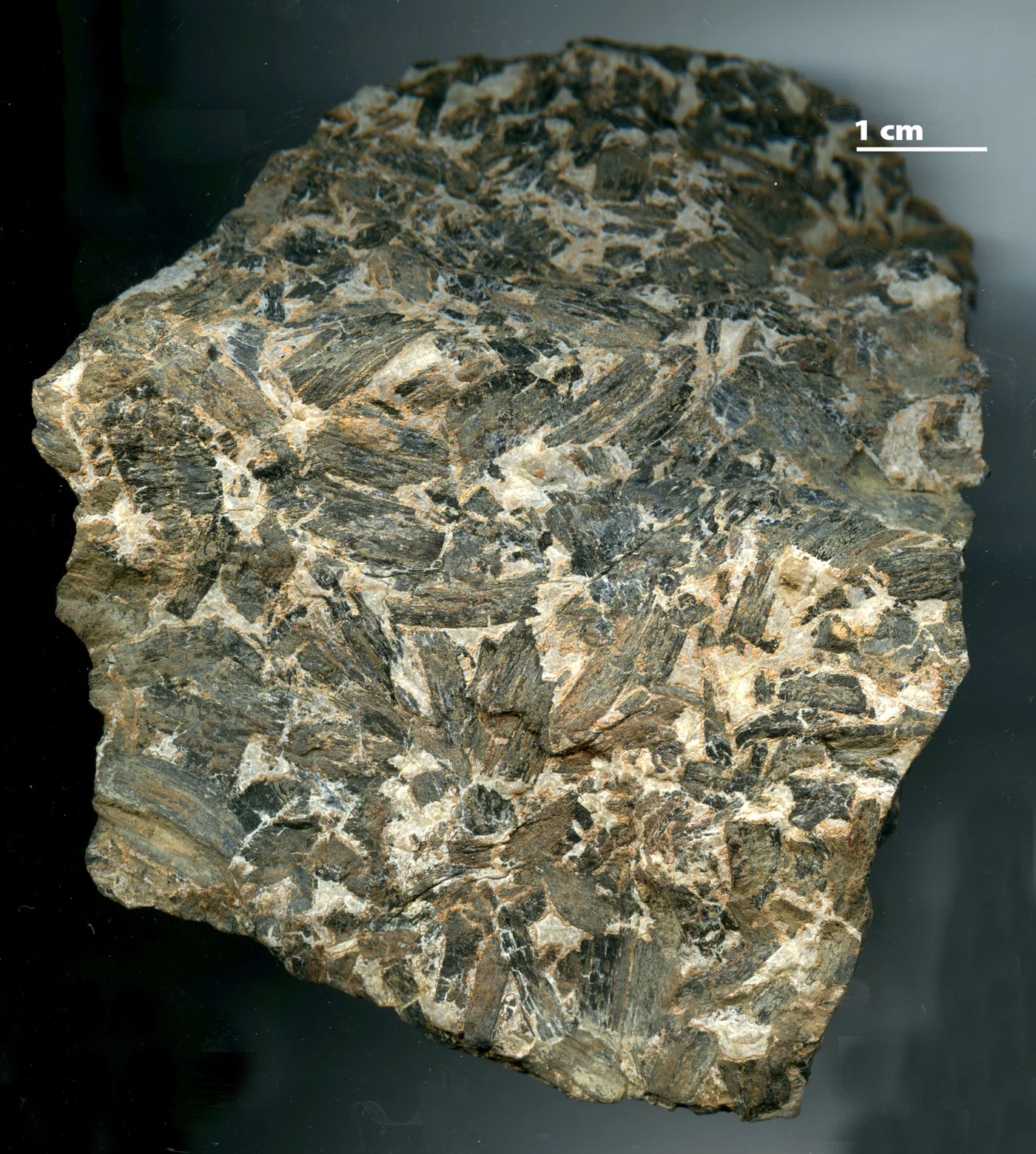
The plant survives the burning
Charcoal can preserve an unexpectedly legible plant. In their 1990 study of fossil-charcoal techniques, P. Martin Sander and Carole Gee emphasized the quality of anatomical detail available under a scanning electron microscope. Charred wood can support anatomical and taxonomic work, just as wood preserved through mineral impregnation can. It also carries evidence of burning.[2]
That combination gives an otherwise unassuming fragment two scientific jobs. Its structure helps identify the plant material; its preservation helps reconstruct what happened to that material. A fossil need not retain a leaf's outline or a tree's full trunk to contribute to the history of vegetation.
But a preserved structure and a recovered temperature are different kinds of result. The former can be examined directly. The latter requires a relationship established with material whose heating conditions are known.
Turning reflected light into a measurement
The laboratory procedure makes the distinction tangible. Charcoal fragments are embedded in resin, ground and polished, then examined under oil. Researchers measure the fraction of light reflected from exposed cell walls against calibrated standards. The resulting reflectance value describes an optical property of the prepared material.[3]
Laura McParland and colleagues used this approach in 2009 to compare natural-fire charcoal with material from experimental charcoal production and metalworking. They also reheated laboratory charcoal. In those controlled experiments, reflectance responded to the higher temperature experienced during the second heating; it was not permanently fixed by the first.[3]
That result establishes a useful warning before deep time enters the picture. Even a carefully measured value need not belong exclusively to the event that first made the charcoal. The optical reading is precise about what the instrument sees. Assigning it to a particular episode is another task.
One fire can leave different signals
A field study makes the problem less abstract. After a 2013 fire at All Saints Bog in County Offaly, Ireland, researchers collected charcoal from 17 sites. Victoria Hudspith and colleagues separated ground fuels from aboveground fuels and found substantially different reflectance values. Fuel type explained more of the variation than the field categories of burn severity or habitat condition.[4]
Their 2014 paper converted reflectance into estimated charring temperatures using an oven calibration. The measured differences and the temperature interpretation deserve separate attention. Different plant materials had left different optical records within the same fire; deciding exactly what those records meant thermally depended on the calibration.[4]
For a fossil assemblage, that distinction changes the first question. Before comparing two deposits as evidence of hotter and cooler fires, ask whether they contain comparable kinds of burned material. Anatomical identification becomes part of interpreting the fire, rather than a separate exercise in naming plants.
Replacing the oven with a burning experiment
An oven holds heating conditions relatively steady. A burning piece of wood participates in changing exchanges of energy. Belcher and colleagues' 2018 study tested charcoal from controlled laboratory burns and two experimental wildfires. Higher total heat release was associated with higher reflectance; their results favored interpreting reflectance through energy delivery rather than a simple oven-temperature conversion.[5]
They also found more residual lignin in charcoal formed under lower-energy conditions, suggesting greater vulnerability to subsequent degradation.[5] That creates a further question for paleontology: might the conditions of burning help determine which fragments survive to be collected?
A number measured in the laboratory therefore starts an investigation. Matching fuels, understanding combustion and evaluating preservation all matter before it can support a comparison between ancient fires.
The rock can add another heating episode
On Scotland's Isle of Mull, geological history complicates the reading further. Thomas Theurer and colleagues investigated fossil charcoal in a volcanic mudflow deposit penetrated by an igneous intrusion. Their 2025 study used Raman spectroscopy, which examines carbon structure through its interaction with laser light.[6]
They interpreted the measured features as the combined effects of oxidative weathering and later heating associated with the intrusion. Temperature estimates became problematic because the carbon had experienced changes after its initial formation.[6]
This was a Raman study, so it should not be presented as a direct test of every reflectance calibration. Its broader lesson concerns attribution: before turning a fossil's carbon structure into a fire history, establish whether subsequent geology could have modified that structure. A more sophisticated instrument still needs the outcrop.
The Illinois specimen remains compelling without an assigned fire temperature. Its value begins with the survival of plant material through burning and geological time. From there, each further claim has its own evidential burden: anatomy for the plant, experiments for the combustion signal, and geological context for the events that came afterward. Reading charcoal well means keeping all three histories in view.
Sources
- Paul Stocksdale, “Fusain Fossil Charcoal.jpg,” Wikimedia Commons—original photograph and finder-reported locality and approximate age.
- P. Martin Sander and Carole T. Gee, “Fossil charcoal: techniques and applications,” Review of Palaeobotany and Palynology 63 (1990), 269–279—anatomical preservation and microscopy.
- Laura C. McParland and colleagues, “The use of reflectance values for the interpretation of natural and anthropogenic charcoal assemblages,” Archaeological and Anthropological Sciences 1 (2009), 249–261—measurement and reheating experiments.
- Victoria A. Hudspith, Claire M. Belcher and Jonathan M. Yearsley, “Charring temperatures are driven by the fuel types burned in a peatland wildfire,” Frontiers in Plant Science 5 (2014), 714—field sampling, fuel differences and the original calibration-based interpretation.
- Claire M. Belcher and colleagues, “What Can Charcoal Reflectance Tell Us About Energy Release in Wildfires and the Properties of Pyrogenic Carbon?,” Frontiers in Earth Science 6 (2018), 169—laboratory and experimental-wildfire evidence.
- Thomas Theurer and colleagues, “Disentangling the multi-phase alteration of fossil charcoals: A cautionary tale from the Isle of Mull, Scotland,” Global and Planetary Change 254 (2025), 104990—University of Aberdeen record and open paper on later alteration.