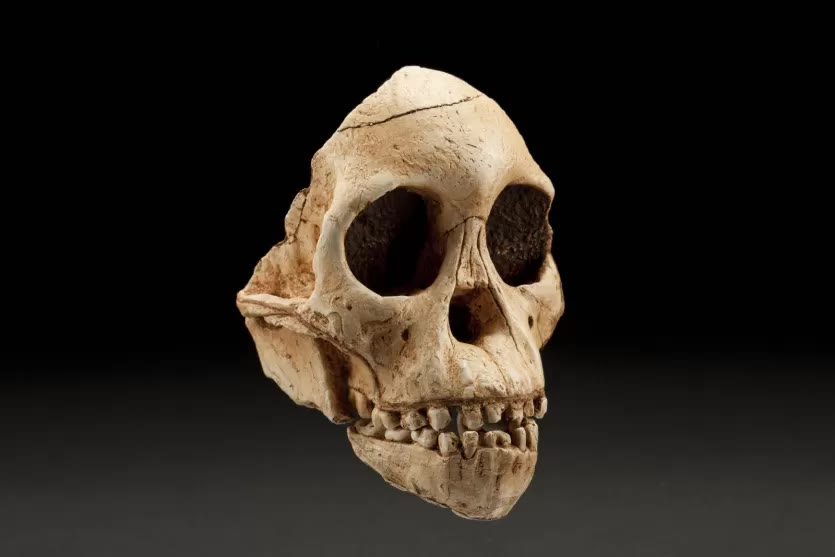
The Taung Child did not change human origins because it looked modern in one dramatic way.[1][2][3] It changed the field because several quieter signals arrived fused together in one juvenile skull from South Africa. Raymond Dart's 1925 description did not offer a big-brained ancestor waiting to flatter old expectations. It offered something harder to ignore on anatomical grounds: a small-brained child with human-leaning teeth and jaws, a forward-placed foramen magnum, and a natural endocranial cast preserved with the cranium.[1][2][3] In a period still distorted by big-brain-first assumptions and the lingering prestige of Piltdown, that package mattered more than any single trait could have.[1][3]
That is also why the fossil still rewards a close reading in 2026. Taung is not a simple victory object. The child died at about 3.3 years of age by dental development, which means every anatomical claim has to be filtered through immaturity.[2][5] Later work has also tightened, rather than inflated, the endocranial story: a 2007 virtual reconstruction estimated the endocast at 382 cm3, with a projected adult capacity of 406 cm3, smaller than some earlier numbers.[4] Those revisions do not weaken the fossil's place in the history of paleoanthropology. They clarify why Taung was so disruptive in the first place. It mattered even without an enlarged braincase or an adult skeleton.[3][4][5]
Image context: the lead image uses the Smithsonian's photograph of the Taung Child skull in three-quarter view. It belongs here because the article's claim depends on reading multiple anatomical surfaces at once. The eye sockets, jaw, dental arcade, and cranial base sit in one object rather than in a later composite reconstruction, which is exactly the evidentiary force Dart had in hand.[2]
The fossil arrived as a paired object, not as an isolated face
The strongest way to read Taung is to remember that it was never only a face.[1][3] Dart worked from a skull and a natural endocast that together let him move back and forth between external cranial form and the internal mold of the braincase.[1][3] The 2024 centenary review in Biology Letters makes clear why this mattered: Dart's original letter walked through cranial shape, dentition, mandibular form, dental arcade, and the location of the foramen magnum, while the endocranial cast preserved broad information about the major lobes and surface patterning of the brain.[3]
That combination gave the fossil unusual argumentative density. A single tooth can start a taxonomic suggestion. A single cranial base can suggest posture. A single endocast can start a debate about brain organization. Taung forced those lines to be read together.[1][3] The fossil did not need a large absolute brain volume to matter, because the crucial contradiction ran elsewhere: the brain was still ape-sized, but the skull was not behaving like the skull of a living African ape in every relevant way.[1][2][3]
This is the point at which Taung becomes more than a famous discovery story. It becomes a lesson in evidentiary conjunction. The fossil's power lay in how several moderate claims reinforced one another inside one specimen.
The decisive signal was posture before brain enlargement
Smithsonian's fossil page states the core point with useful bluntness: the position of the foramen magnum was the earliest clear sign, for Dart, that the head balanced atop the spine in a way associated with habitual bipedalism rather than quadrupedal ape posture.[2] That observation still matters because it explains why Taung cut against the ranking of traits many early twentieth-century scholars expected. If human ancestry had to begin with brain expansion, Taung looked wrong. If posture and dentition could change before large brains arrived, Taung suddenly looked dangerous to the old order.[1][2][3]
The dentition pushed in the same direction. Dart's original case leaned heavily on the relative form of the face, jaws, and teeth, and the centenary review notes that reduced anterior dentition was central to why he thought the specimen belonged on the human side of the ape-human divide despite its juvenile status and small cranial capacity.[1][3] Taung is therefore best read against the idea that human evolution had to proceed brain first, posture second. It preserved almost the opposite lesson: locomotor orientation and facial-dental change could announce themselves well before any modern-scale braincase appeared.[1][2][3]
This is also why the fossil remained controversial for so long. Taung did not fail to fit older expectations by a small margin. It inverted them.
Juvenility complicated the case without breaking it
Because the fossil is a child, every strong interpretation has to earn its keep.[2][4][5] Juvenile individuals can scramble taxonomic comparison, especially when most comparative samples are adults. That is one reason later workers kept returning to Taung rather than treating Dart's original announcement as settled history.[3][5]
Two later studies are especially useful here. McNulty, Frost, and Strait used developmental simulation to estimate Taung's adult form and found that the result was consistent with the hypothesis that Taung and the Sterkfontein Australopithecus africanus fossils were conspecific, while rejecting the idea that Taung was merely a juvenile robust australopith.[5] Falk and Clarke's new virtual reconstruction of the endocast then sharpened the brain story by lowering the likely cranial-capacity estimate while also describing shape features that sorted Taung more closely with gracile than robust australopiths.[4] In other words, later work did not rescue Taung by making it more modern than Dart thought. It made the fossil more constrained and still left it important.[4][5]
That is the right way to close-read the specimen. Not every detail of Dart's larger interpretive package survived. The Biology Letters review stresses that his broader "open veldt" ecological framing now reads as an oversimplification rather than a durable environmental model.[3] But the fossil's central conjunction survived repeated re-analysis: face, teeth, cranial base, and endocast continued to line up more closely with early hominin status than with any living ape model.[2][3][4][5]
The Taung Child therefore remains strongest when read as a combination fossil. It did not prove everything Dart hoped. It did something more lasting. It showed that a small-brained juvenile from Africa could carry enough coordinated anatomical evidence to shift the argument about human ancestry onto a new continent and a new sequence of trait change.[1][2][3][4][5]
Sources
- Raymond A. Dart, "Australopithecus africanus: The Man-Ape of South Africa," Nature 115 (1925).
- Smithsonian Institution Human Origins Program, "Taung Child."
- Roger Smith, "Dart and the Taung juvenile: making sense of a century-old record of hominin evolution in Africa," Biology Letters (2024), PMC version.
- Dean Falk and Ron Clarke, "Brief communication: New reconstruction of the Taung endocast," American Journal of Physical Anthropology 134 (2007), author-hosted PDF.
- Kieran P. McNulty, Stephen R. Frost, and David S. Strait, "Examining affinities of the Taung child by developmental simulation," Journal of Human Evolution 51 (2006).