
Isolated dinosaur teeth invite a bad habit. They are dramatic, portable, and easy to imagine as tiny identity cards for famous animals. Museum drawers, however, teach a stricter lesson. The Smithsonian video below is only a few minutes long, but it frames tooth identification in the right order: paleontologists begin with observation, then comparison, then a carefully limited claim about what the fossil can actually support.[1][2]
That hierarchy matters because teeth are among the most common dinosaur fossils in many formations, while articulated skeletons remain rare.[2][3][4] A tooth can therefore carry a lot of faunal information, but only if its shape is read with discipline. Enamel sheen, denticles, curvature, crown proportions, and the place a tooth once occupied in the jaw all help sort a specimen into narrower bins.[1][3][4][5] At the same time, the literature keeps warning against the leap from "diagnostic-looking tooth" to "secure species name." Theropods repeatedly evolved overlapping dental traits, and even teeth from different positions in one mouth can differ more than a casual viewer expects.[3][4][6][7]
Carrano's drawer of Cretaceous fossils from the Washington, D.C., area is therefore useful for more than local color.[1][2] It shows how paleontologists extract a regional census from incomplete material. As Smithsonian Magazine noted when the video appeared, the area has yielded too little beautifully articulated dinosaur material for skeleton-driven storytelling, yet isolated teeth still let researchers count what kinds of dinosaurs were present.[2] The scientific value comes from controlled comparison, not from pretending each tooth is a complete animal in miniature.
That is the lens worth carrying into the video. What makes the short demo strong is not only that it identifies a few teeth. It also shows where identification becomes stronger, where it becomes weaker, and why a careful paleontologist will often stop at a broader category instead of forcing a flashy species-level answer.[1][3][4][6]
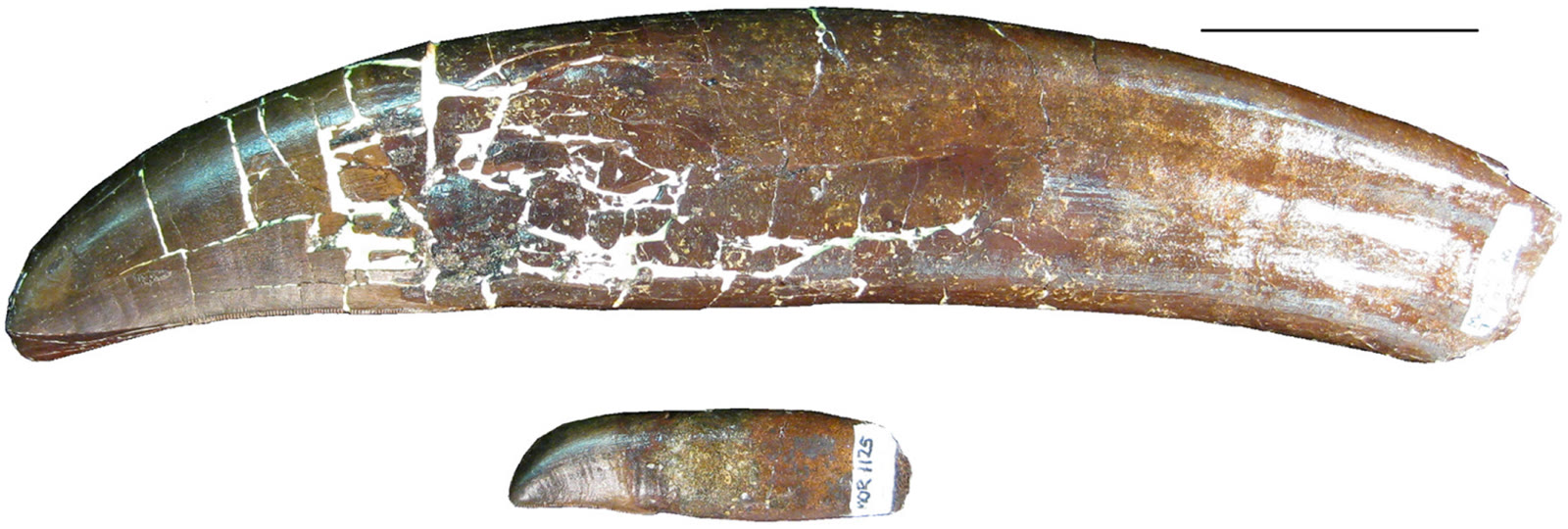
Image context: the cover uses the Wikimedia Commons photograph B-rex teeth.jpg, which shows two Tyrannosaurus teeth from different positions in the same lower jaw.[7] It belongs here because the article's main argument turns on internal variation. Tooth size and shape do not scale neatly from "small" to "young" or from "large" to "famous predator"; row position and function matter first.
Around 0:40, the first task is proving that the object is a tooth at all
The video gets the method right from the beginning.[1] Carrano does not start by naming a dinosaur. He starts by distinguishing a tooth from a claw. Both are curved and pointed, but the tooth carries enamel, sharper cutting edges, and serrations, while the claw has a more porous bony texture, grooves for the sheath, and a base shaped by articulation with the finger.[1] That sequencing is important because paleontology often works from fragments that can look broadly similar before closer inspection.
This is also where the broader literature helps. Theropod teeth are famous for ziphodonty, the serrated cutting edge that gives many predatory crowns their steak-knife analogy.[5] But even that apparently obvious feature is not just decorative roughness. The developmental study of theropod denticles argues that these structures helped shape and maintain the cutting edge through the life of the tooth, which means that serrations belong to tooth function and biology, not merely to visual style.[5] In practical museum work, that is why Carrano can move so quickly from surface texture to anatomical identification: he is reading tissue, wear, and edge structure before he ever approaches taxonomy.[1][5]
The deeper point is that fragmentary fossils demand layered questions. First: what element is this? Second: what general kind of animal or feeding toolkit does it imply? Only later, if the comparative base is strong enough, does the question tighten toward genus or species.[3][4] The video's opening minute is strong because it refuses to skip those early stages.
Around 1:30, comparison sorts broad ecological and taxonomic groups much better than it names exact species
Once the video lays out four teeth from different dinosaurs, the method becomes more recognizably taxonomic.[1] Carrano separates meat-eaters from plant-eaters through overall crown shape, edge sharpness, and serration pattern, then distinguishes pairs within those broad groups by differences in curvature, proportions, and denticle form.[1] That is exactly the scale at which isolated teeth often perform best. They are excellent at telling you that two fossils do not belong to the same morphotype, and often good at placing a tooth within a broader predatory or herbivorous toolkit.
The classic study by Smith, Vann, and Dodson helps explain why this works and where it begins to strain.[3] Their paper treats isolated theropod teeth as common fossils with real paleoecological value, while also stressing how few easily identifiable characters any one crown may preserve.[3] The later Palaeo-Electronica review sharpens the same problem from a wider angle: teeth have taxonomic potential, but many qualitative features are distributed unevenly and homoplastically across theropod lineages.[4] In plain terms, the same kinds of cutting edges, curvatures, and crown outlines can reappear in different dinosaurs often enough that confidence has to be earned rather than assumed.[4]
A further complication is position within the jaw. The recent machine-learning comparison of isolated theropod teeth explicitly tries to distinguish mesial and lateral teeth because tooth-row position changes shape enough to matter for classification.[6] That is an important modern echo of Carrano's simpler museum lesson. Comparison is not only between species. It also has to happen within an individual mouth. If row position alters proportions and curvature, then a dramatic-looking crown may be telling you as much about anatomical placement as about taxonomic uniqueness.[6][7]
Around 2:45, the video's most valuable sentence is its refusal to overname the fossil
The strongest moment comes when Carrano says that some people think a particular tooth can identify the actual dinosaur species, but that similar species can have very similar teeth, so a more specific claim is not possible without more of the animal.[1] That sentence should probably hang over every display case of isolated crowns. It is not anti-identification. It is a boundary statement about evidence.
The written sources support that caution repeatedly. Smith, Vann, and Dodson built a quantitative framework precisely because isolated teeth are so tempting to overread.[3] Hendrickx and colleagues emphasize that the distribution of dental features has to be documented carefully before qualitative diagnosis becomes defensible.[4] The machine-learning study from 2025 reaches a similar conclusion from a different direction: automation can improve classification, but intra-class variability and positional differences remain central problems rather than minor noise.[6] Better tools do not dissolve the comparison problem; they formalize it.
The lead image makes the same warning visible at a glance.[7] The two Tyrannosaurus teeth in that figure came from different positions in one lower jaw and differ strongly in size. The Commons description states the point plainly: shed dinosaur teeth are not a reliable indicator of relative skeletal size or ontogenetic age when read in isolation.[7] That does not mean isolated teeth are useless. It means scale, spectacle, and species labeling do not line up neatly.
What the video leaves with the viewer
By the end, the D.C. collection has done something larger than identify a few fragments. It has shown how incomplete fossils can still support a meaningful faunal picture. Carrano notes that these local remains imply nearly a dozen dinosaur species ranging from chicken-sized animals to forms nearly the size of a house.[1] Smithsonian Magazine drew the same conclusion in more public language: isolated teeth let paleontologists take a census even where complete skeletons are scarce.[2]
That is the real achievement of this short annotated viewing. A tooth is not a trophy and not a miniature species label. It is a constrained but valuable data point. Read carefully, it can separate tooth from claw, meat-eater from plant-eater, one morphotype from another, and one regional fauna from the next.[1][2][3][4] Read carelessly, it encourages overconfident names. The video is worth watching because it keeps both truths in frame at once.
Sources
- Smithsonian's National Museum of Natural History, "How do paleontologists identify dinosaur teeth?" YouTube video.
- Riley Black, "Whose Tooth is That?" Smithsonian Magazine, February 17, 2012.
- Joshua B. Smith, David R. Vann, and Peter Dodson, "Dental morphology and variation in theropod dinosaurs: implications for the taxonomic identification of isolated teeth," The Anatomical Record Part A (2005).
- Christophe Hendrickx, Octavio Mateus, and Ricardo Araújo, "The distribution of dental features in non-avian theropod dinosaurs: Taxonomic potential, degree of homoplasy, and major evolutionary trends," Palaeo-Electronica (2019).
- Kirstin S. Brink, Aaron R. H. LeBlanc, Robert A. Reisz, and David C. Evans, "Developmental and evolutionary novelty in the serrated teeth of theropod dinosaurs," Scientific Reports (2015).
- Oscar Sanisidro, Alejandro Serrano-Martinez, and Daniel Vidal, "Enhancing the classification of isolated theropod teeth using machine learning: a comparative study," Scientific Reports (2025).
- Wikimedia Commons file page for the lead image, "File:B-rex teeth.jpg."