

People often talk as if a fossil becomes scientifically meaningful at the moment someone spots bone in a hillside. That is good museum drama, but it is weak paleontology. Discovery in the field matters, yet a fossil only becomes usable evidence by passing through several distinct stages, each with its own gain and loss. Quarry work protects locality information and makes transport possible. Preparation in the lab turns a jacketed block into an object whose boundaries can actually be read. CT scanning adds a further layer by revealing interior structure that manual cleaning alone cannot safely reach.[4][5][6]
That sequence is why these three videos belong together. The first shows the heavy, slow logic of extraction in the Morrison Formation, where getting fossil-bearing rock out of the ground still depends on digging around a specimen, plastering it, flipping it, and carrying the whole package away.[1] The second shifts to the lab and makes the sharper point: field identifications are often provisional, and a specimen may only gain its real identity after long preparation and stabilization.[2] The third moves into imaging, where paleontologists use CT data to see inside rock and generate three-dimensional views of delicate fossils that would otherwise stay partly inaccessible.[3][6]
Seen in sequence, the collection corrects a common misunderstanding about paleontological certainty. The field does not hand the lab a finished answer. The field preserves context and potential. The lab converts rough potential into an analyzable specimen. Imaging then extends access beyond the mechanically exposed surface.[4][5][6] A fossil therefore becomes evidence more than once.
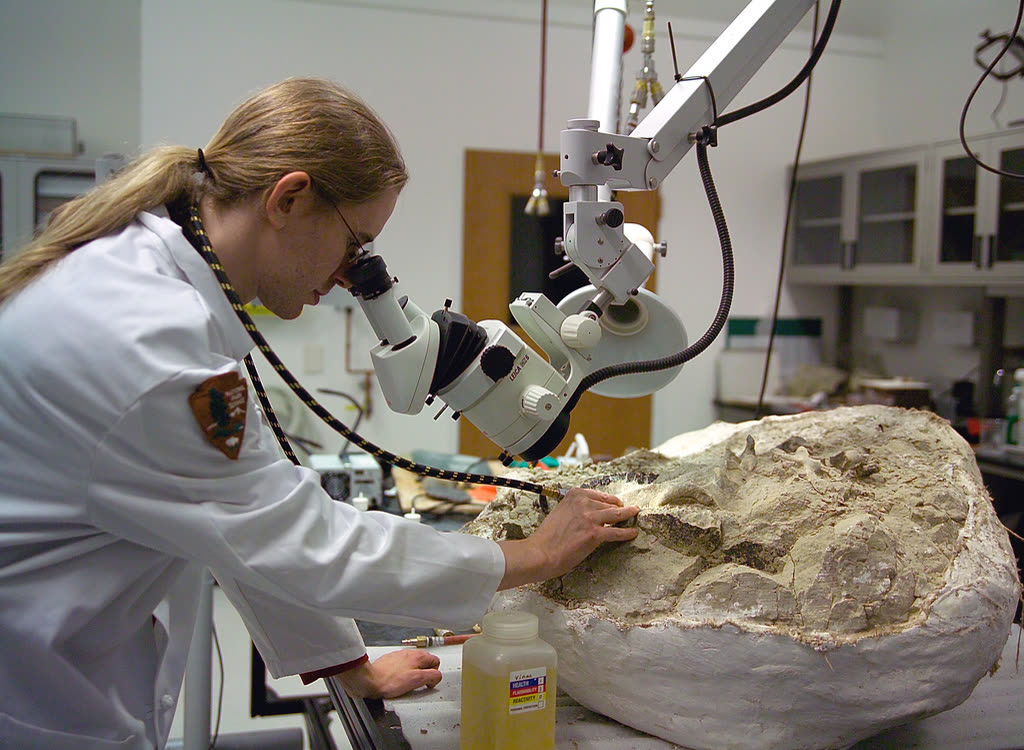
Image context: the cover uses a real Wikimedia Commons photograph of fossil preparation at the Condon Center for Paleontology. It belongs here because the article's claim turns on that middle stage. Quarry work and CT scanning are both essential, but preparation is where a specimen stops being a sealed block and starts becoming something anatomy, storage, and later imaging can actually work on.[7]
Video 1: quarrying is about keeping context intact long enough to move the fossil at all
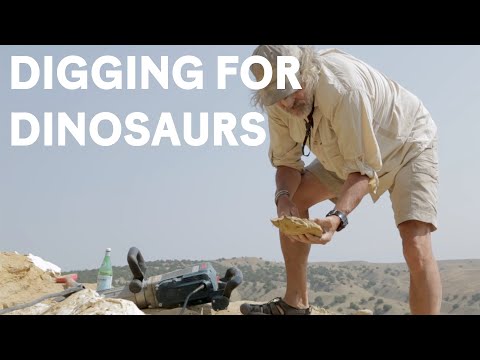
The American Museum of Natural History's Morrison excavation video opens in exactly the right place for this argument: not with a clean skeleton, but with extraction as a logistical problem.[1] One speaker says the basic method still resembles what nineteenth-century collectors did in the Morrison, with the crucial sequence laid out plainly: dig around the fossil, cover it with plaster, roll it over, cover the other side, and bring the whole thing home.[1] That sequence matters because it captures a hard truth often blurred by popular dinosaur footage. The exposed fragment is not yet the specimen in any useful institutional sense. The usable specimen is the field jacket plus its locality data, orientation, and surrounding rock.
The National Park Service page on Petrified Forest research activity helps explain why this first step deserves more respect than it usually gets. Its field photographs show large jackets at the dig site and partially exposed fossils still embedded in matrix, which is exactly the point.[4] Quarry work is not mainly about freeing bone as fast as possible. It is about deciding how much surrounding material must travel with the fossil so that transport does not destroy anatomy or erase contextual clues before the lab ever sees them.[4][5] In that sense, a plaster jacket is a scientific container, not merely a shipping convenience.
The AMNH clip also sharpens a second point. Morrison collecting today is no longer centered only on giant, already famous animals. The museum's description emphasizes renewed work in the relatively understudied northern portion of the formation and a search for material that earlier expeditions overlooked.[1] That matters because fieldwork does more than recover spectacular specimens. It also changes sampling. New questions alter what counts as worth collecting, and that in turn changes the fossil record available for later interpretation. Quarrying is therefore the stage where paleontology secures context, scale, and representativeness before any fine anatomical reading begins.[1][4]
Video 2: preparation is where a fossil finally acquires stable boundaries and a real identity
The AMNH fossil-laboratory video supplies the middle piece of the chain and, in some ways, the most important one.[2] Early in the clip, Roger Benson states the central idea with unusual clarity: many specimens have a field identification, but only after a long time in the lab being prepared and stabilized do researchers recognize that the fossil is something else, sometimes something more exciting than what was first pulled from the ground.[2] That is one of the most useful sentences a museum video can give the public. It places uncertainty where it actually lives. Discovery does not end ambiguity. Preparation is one of the processes that reduces it.
The Smithsonian's teaching guide, built around fossil preparation from field to museum, lays out the same chain in institutional terms. Its key concepts include finding fossils in the field, securing them for transport, cleaning and preparing them, interpreting the data they contain, and understanding the technologies preparators use.[5] That list is valuable because it refuses to isolate preparation as mere cleanup after the scientific work is done. Preparation is one of the places where scientific work happens. A preparator decides how to remove matrix, how to stabilize fragile surfaces, how much support to leave in place, and how to expose anatomy without overcommitting to a mistaken boundary.
The article's lead photograph from the Condon Center makes that visible at working scale: mask, bench, tool, specimen, and a human reading a physical interface between fossil and rock.[7] The point is not romance of craftsmanship. The point is epistemic control. If quarrying preserves context, preparation produces legibility. Only here does the fossil get what the AMNH video calls a face, a name, and an identity within the bigger picture.[2] That does not mean the lab replaces the field. It means the field and the lab perform different scientific jobs. One keeps the object intact enough to move; the other makes it intelligible enough to compare, describe, store, and later image.[2][5]
Video 3: CT scanning extends preparation by opening the inside without sacrificing the specimen
The University of Chicago video closes the collection well because it shows what happens when preparation reaches a limit.[3] Manual work can expose surfaces, but some fossils keep important anatomy locked inside dense rock or within fragile structures that would be risky to chase mechanically. The video's description frames the gain concisely: after a CT scanner was installed in Culver Hall in 2014, researchers used it to see inside fossilized rock and create three-dimensional images of delicate specimens that would otherwise remain inaccessible.[3] The significance is not novelty for its own sake. The significance is access under constraint.
That logic is easy to flatten into a triumphalist "technology solves everything" story, but the stronger reading is narrower. CT scanning does not eliminate the need for preparation; it changes what preparation can hand off to later analysis. The classic Lesothosaurus study by Porro, Witmer, and Barrett is useful here because it shows digital preparation doing real paleontological work rather than serving as flashy illustration. CT scanning and visualization revealed new sutural details and internal structures, while elements obscured by matrix or neighboring bones could be described for the first time.[6] In other words, imaging does not simply decorate a specimen already understood on the bench. It can expose anatomy that manual preparation, by itself, would leave hidden or too risky to pursue destructively.
Placed after the lab video, the UChicago clip clarifies the real sequence. Fieldwork delivers a stable package. Preparation makes the outer geometry readable and the specimen safe enough for handling. CT scanning then pushes inquiry inward, into cavities, sutures, and overlaps that physical removal may not be able to resolve cleanly.[3][6] The result is not a replacement of one stage by another. It is a cumulative chain in which each step changes the questions the next step can ask.
What the three videos reveal together
Watched together, these videos restore a better rhythm to paleontology. Fossils do not arrive as finished facts. They move through a sequence of controlled transformations. Quarrying keeps the find attached to its context while making transport possible.[1][4] Preparation stabilizes the object, exposes anatomy selectively, and narrows the gap between field guess and taxonomic identity.[2][5] CT scanning reaches beyond exposed surfaces and turns hidden structure into analyzable form without demanding the same level of irreversible physical removal.[3][6]
That sequence matters because it changes how we think about certainty. Confidence in paleontology is rarely a single dramatic moment. It accumulates as context is preserved, boundaries are refined, and inaccessible structures become visible under new methods. The public version of discovery usually stops too early, at the first shovel or the first bone weathering from rock. The better version runs longer. A fossil becomes evidence when it survives transport, when it survives preparation, and when later techniques reveal more of what the stone was still withholding. That is why these three videos form a coherent collection instead of a generic playlist. They show paleontology as a staged practice of making ancient material legible.
Sources
- American Museum of Natural History, "Paleontologists dig for Jurassic dinosaur fossils," YouTube video.
- American Museum of Natural History, "Behind the Scenes in a Dinosaur Fossil Laboratory," YouTube video.
- University of Chicago Biological Sciences Division, "Discovering a new side of fossils with CT scanning," YouTube video.
- National Park Service, "Research Activities" at Petrified Forest National Park, with field-jacket and lab images showing the movement from excavation to preparation.
- Smithsonian National Museum of Natural History, "Fossil Preparation from Field to Museum."
- Laura B. Porro, Lawrence M. Witmer, and Paul M. Barrett, "Digital preparation and osteology of the skull of Lesothosaurus diagnosticus (Ornithischia: Dinosauria)," PeerJ (2015).
- Wikimedia Commons file page for the laboratory photograph used as the lead image: "Fossil preparation at the Condon Center lab."