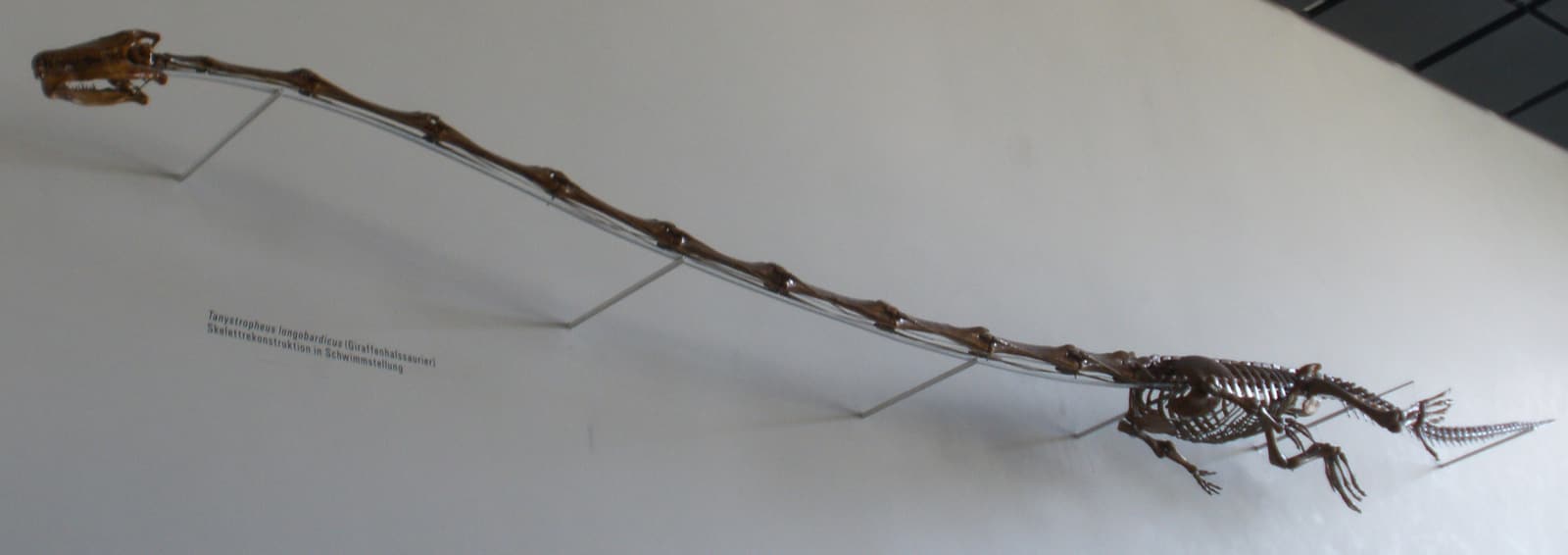
Tanystropheus usually enters the imagination in the wrong order. People see the neck first, treat the animal as a design error second, and only later ask what kind of reptile could afford to carry that much length in front of the shoulders. The stronger profile runs the evidence the other way around. Start with the actual fossils, add the reconstructed skull, add the separation between the large and small Monte San Giorgio forms, and the animal becomes much less absurd. It begins to look like a specialized aquatic hunter whose famous neck only makes sense as part of a full feeding and breathing problem.[1][2][3][4][5]
That shift matters because Tanystropheus spent decades trapped between two easy stories. One story treated it as a shoreline oddity that happened to have an impossible neck. The other treated the neck itself as the whole mystery, as if body function would somehow sort itself out afterward. The more recent literature is better because it keeps the costs visible. A very long airway, a small head, limited evidence for fast propulsion, and a skull tuned toward catching slippery prey all point in the same direction.[1][2][4][5]
Image context: the lead image is a real fossil photograph from the Paleontology Museum of Zurich, sourced via Wikimedia Commons. It suits this article because a mounted specimen makes the central claim visible without help from paleoart. The neck dominates the slab, but the trunk and skull keep reminding the viewer that the animal had to carry, ventilate, and feed through that geometry in real water, not in a museum slogan.[6]
1) The neck was not a pile of extra bones. It was thirteen vertebrae stretched to an extreme.
The first correction is anatomical. Tanystropheus did not achieve its famous proportions by stacking an enormous number of neck bones. Its neck was built from only thirteen extraordinarily elongated cervical vertebrae.[1][5] That matters because the animal was not simply "more snake-like" or "more giraffe-like" than other reptiles. It reached length through a very specific structural bargain: keep vertebral count modest, then stretch each element so far that the neck becomes the dominant feature of the body plan.
The 2019 taxonomic revision is useful here because it cleans up the old Monte San Giorgio material before the 2020 lifestyle arguments arrive.[3] Spiekman and Scheyer showed that the record long grouped under Tanystropheus longobardicus actually preserved two consistent morphotypes, a smaller one and a larger one, with cranial differences stronger than the postcranial skeleton alone had suggested.[3] At that stage the authors were still careful about naming them as separate species, because the crucial overlap needed to eliminate an ontogenetic explanation was incomplete.[3] That caution is important. It reminds the reader that Tanystropheus became clearer by slow sorting, not by one dramatic reveal.
Current Biology supplied the next step.[1] Histology and new skull evidence showed that the smaller Monte San Giorgio animals were not juveniles of the large form but mature representatives of a separate species. That result matters for more than taxonomy. It means the long-necked body plan did not lock the genus into one ecological role. Two closely related animals living in the same Triassic setting could carry the same basic neck architecture and still partition food sources.[1][5]
2) The skull moved the animal decisively into the water
The strongest modern reset came from the skull. Synchrotron work and three-dimensional reconstruction showed that the large species, now named Tanystropheus hydroides, carried a skull with nostrils positioned high on the snout and long, recurved teeth suited to gripping slippery prey.[1][2][5] Once those details are in view, the old picture of Tanystropheus as mainly a terrestrial neck experiment becomes much harder to sustain. The head starts reading like the front end of an aquatic predator.
That does not mean the animal turned into an ichthyosaur-like pursuit machine. The point is narrower and better. A small head held at the end of a very long reach could enter a prey field before the heavier trunk did.[1][2][5] The UZH summary of the 2020 paper makes the logic plain: the large species likely fed on fish and squid, while the smaller species was better suited to small shelled prey such as shrimp.[5] The neck therefore looks less like ornamental excess and more like feeding distance.
This is also why the species split matters so much. If the same bizarre neck could support two nearby feeding niches, then Tanystropheus stops looking like a one-purpose monster and starts looking like a viable marine archosauromorph design with room for specialization.[1][3][5] The genus remains strange, but it is a functional strangeness, not a leftover puzzle waiting for a cartoon answer.
3) The body paid for that neck in airflow and locomotion
The best profile keeps the engineering bill in the frame. Long necks do not only complicate feeding; they also enlarge the dead space of the airway. The 2022 respiratory modeling paper treats this as a central physiological constraint rather than a side note.[4] Based on allometric modeling, de Souza and Klein argued that Tanystropheus could meet its oxygen demands with a reptilian-style multicameral lung system, but only under a breathing regime that handled the long trachea carefully: a relatively narrow airway and lower breathing frequencies help keep ventilation effective when so much neck separates nostrils from lungs.[4]
That is a revealing result because it disciplines the popular image. Once breathing costs are taken seriously, the animal looks less like a hyperactive chaser and more like a reptile whose success depended on moderation, positioning, and controlled strikes.[1][4][5] The same 2020 work that moved Tanystropheus into the water also stressed the lack of obvious limb and tail adaptations for especially efficient high-speed swimming.[1][5] That does not make it clumsy. It makes stealth a better fit than pursuit.
Put those pieces together and the neck changes meaning again. It is not just a bizarre silhouette and not just a prey-capture lever. It is a structure that imposed costs on respiration, body balance, and movement, which means its persistence has to have paid those costs back in feeding advantage.[1][4] The strongest profile therefore reads Tanystropheus as a patient aquatic ambush hunter: small head forward, trunk held back, strike range enlarged, and activity levels constrained by anatomy rather than by myth.
4) What the strongest profile can say in 2026
The secure version of Tanystropheus is now much better than the old legend. It was a Middle Triassic tanystropheid archosauromorph with one of the most extreme necks known among tetrapods, built from thirteen elongated cervicals, represented at Monte San Giorgio by at least two distinct ecological forms, and in its large species by a skull strongly consistent with aquatic prey capture.[1][2][3][5] That is already enough to move the animal out of the category of "prehistoric weird thing" and into the category of highly specific functional experiment.
The useful boundary is speed and posture. The current evidence supports aquatic habits, niche partitioning, and serious physiological consequences for breathing, but it does not license every cinematic reconstruction of the animal slicing through open water like a reptilian spear.[1][4][5] The long neck remained a burden as well as a tool. That is exactly why the profile has become stronger. Modern work does not solve the animal by removing the difficulty. It solves it by showing how the difficulty was managed.
That is the version worth keeping. Tanystropheus was not compelling because its neck was absurd. It was compelling because a real reptile found a way to make that neck pay: through skull shape, prey choice, and a breathing system forced to negotiate distance before every meal.[1][2][4][5]
Sources
- Stephan N.F. Spiekman et al., "Aquatic Habits and Niche Partitioning in the Extraordinarily Long-Necked Triassic Reptile Tanystropheus," Current Biology (2020).
- Stephan N.F. Spiekman et al., "The cranial morphology of Tanystropheus hydroides (Tanystropheidae, Archosauromorpha) as revealed by synchrotron microtomography," PeerJ (2020).
- Stephan Spiekman and Torsten Scheyer, "A taxonomic revision of the genus Tanystropheus (Archosauromorpha, Tanystropheidae)," Palaeontologia Electronica (2019).
- Ray Brasil Bueno de Souza and Wilfried Klein, "Modeling of the respiratory system of the long-necked Triassic reptile Tanystropheus (Archosauromorpha)," The Science of Nature 109, no. 6 (2022).
- University of Zurich, "Long Neck Helped Reptile Hunt Underwater" (2020).
- Wikimedia Commons file page for the photographed Tanystropheus fossil used as the lead image.