
The easiest bad explanation for Alberta's dinosaur fame is that the province simply had more dinosaurs than anywhere else. The Royal Tyrrell Museum's short Cretaceous Q&A works because it points toward a stricter answer.[1] Alberta is fossil-rich in a very particular way. The province preserves the right Late Cretaceous rocks, exposes those rocks unusually well in badlands landscapes, and has spent well over a century building the institutional machinery needed to turn exposed bone into mapped, collected, prepared, and studied evidence.[1][2][3][5]
That distinction matters because paleontology is always a biased sample of the past. Dinosaurs had to die in settings where bones could be buried; those sediments had to survive deep time; erosion then had to reopen them without destroying everything; and later collectors had to notice the fossils and get them out with enough contextual information intact to make them scientifically useful.[2][3][4][5] Alberta looks extraordinarily productive because those stages line up with unusual consistency in southern badlands exposures, especially around Dinosaur Provincial Park and the Red Deer River system.[2][3][4]
The video is only a little over two minutes long, but it compresses that whole chain elegantly.[1] It does not treat Alberta as a magical dinosaur box. It treats fossil abundance as a geological and historical outcome. Once that frame is in place, the familiar public image of the province changes. The hoodoos and gullies stop reading like dramatic scenery attached to museum marketing. They become part of the scientific mechanism itself.[1][2][3]
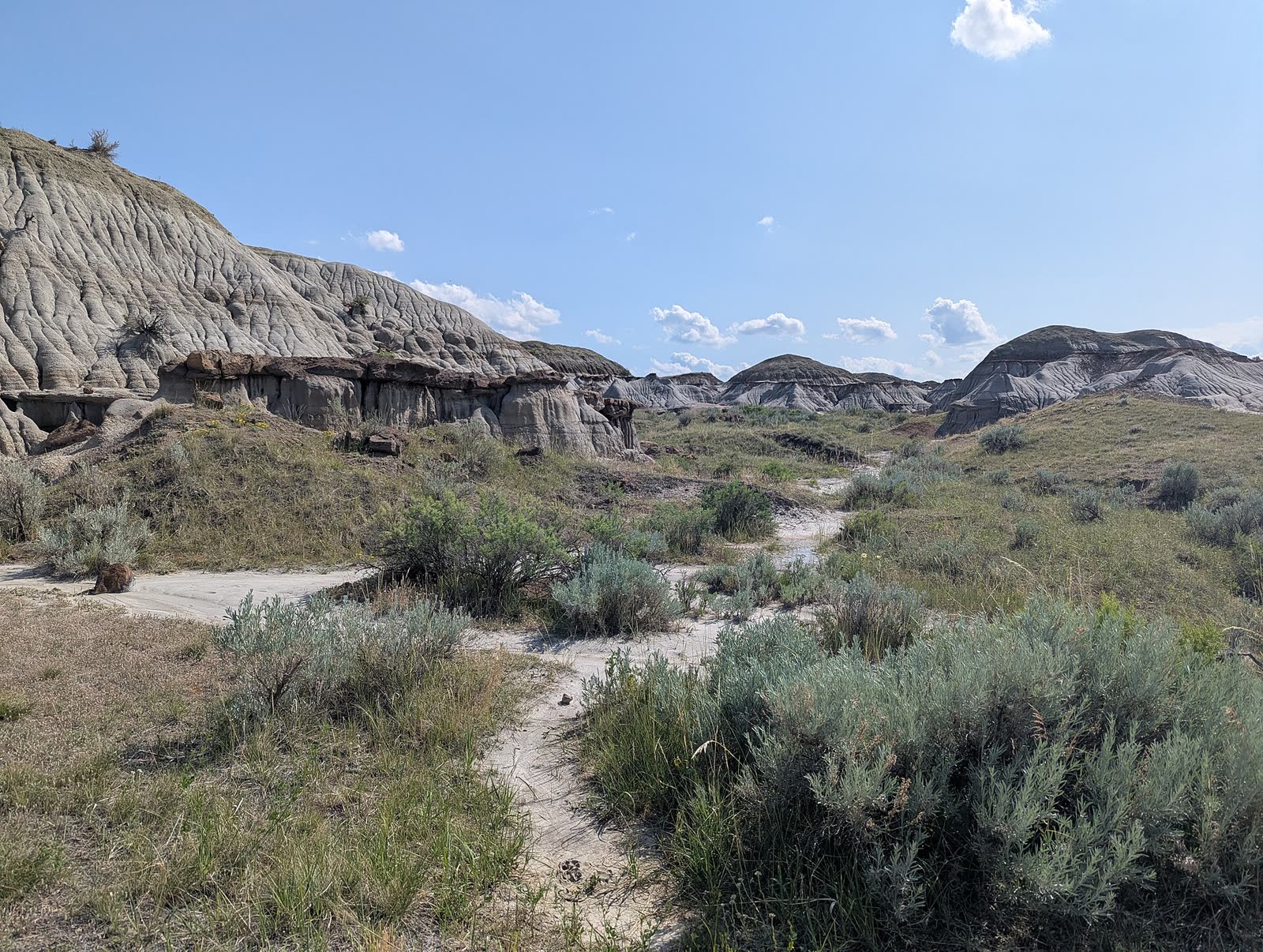
Image context: the cover uses a real Wikimedia Commons photograph of Dinosaur Provincial Park's badlands.[6] That is the right lead image because the article's main claim is not about one celebrity skeleton. It is about the surface conditions that keep Cretaceous rock open enough for dinosaur-bearing layers to be found, revisited, and interpreted.
Around 0:20, the real answer begins with sediment before it begins with skeletons
The video's first useful move is to put Alberta's dinosaurs back into landscape history.[1] Dinosaur Provincial Park and related badlands exposures sit in rocks laid down on a low-lying coastal plain about 75 million years ago, when rivers moved sand and mud across the edge of the Western Interior Seaway.[2][3][4] That is the first condition of abundance. If bodies and bones are going to enter the fossil record at all, there has to be somewhere to bury them.
Alberta Parks states the point in public language: great rivers left the sand and mud deposits that now make up the valley walls, hills, and hoodoos of Dinosaur Provincial Park.[3] The recent Sedimentary Geology study says the same thing in technical terms, describing the Dinosaur Park Formation as exceptionally exposed Campanian meander-belt fluvial systems whose sediments can be analyzed in three dimensions.[4] Those two formulations belong together. One explains the scenery, the other explains why the scenery is scientifically productive.
This is why the province's fossil wealth should not be read as a raw census of dinosaur life. It is a preservation story first. Late Cretaceous Alberta had habitats where bones could be buried in channel belts, overbank muds, and floodplain deposits, then mineralized and stored inside a thick sedimentary package.[2][3][4] The fossils are real evidence of biological abundance, but they are also evidence of depositional luck. The video earns its keep by keeping that distinction visible.[1]
Around 0:55, badlands erosion does half the scientific work
Burial alone would not make Alberta famous if the rocks stayed sealed under soil and forest. The video's second key point is exposure.[1] Parks Canada explains that after the last ice age, huge volumes of meltwater carved into soft sandstone and mudstone, exposing the fossil-bearing sediments and helping create the Red Deer River Valley.[2] Alberta Parks adds the modern continuation of that process: prairie runoff and creek erosion keep sculpting the badlands today, while the dry mixed-grass setting leaves many slopes sparsely vegetated enough for the rock to stay visible.[3]
That matters because paleontologists do not excavate a hidden underground vault. They work where erosion has already done a first pass of discovery. UNESCO's description makes the link explicit when it notes that Late Cretaceous fossil material is closely associated with places where the fossil-bearing formations are exposed by erosional processes.[2] The video condenses that idea into a simple public answer, but the deeper lesson is methodological. Alberta's badlands are not incidental backdrop. They are the exposure window that keeps sedimentary storage legible.
The Sedimentary Geology paper sharpens the same point from the research side. The Dinosaur Park Formation is valuable not only because it contains fossils, but because the badlands-style topography exposes enough of the fluvial architecture for paleontologists and sedimentologists to reconstruct habitat, taphonomy, and river behavior together.[4] That is a much stronger claim than "bones weather out here." It means the outcrop geometry preserves environmental context at the same time that erosion reveals the bones themselves.[4]
Around 1:35, abundance becomes science only when a collecting system stays in place
The last thing the video gets right is that fossil wealth is never just natural. It is institutional.[1] Parks Canada notes that more than 300 first-quality dinosaur skeletons have been recovered from a 27-kilometre stretch along the Red Deer River since work began in the 1880s.[2] Royal Tyrrell's Field Station page adds the modern version of that continuity: even after more than a century of collecting, Dinosaur Provincial Park continues to yield important fossils, and the museum maintains a field station there because the site still repays sustained work.[5]
That continuity is easy to underestimate. A fossil-rich outcrop without permitting, trained crews, preparation labs, collections care, and taxonomic follow-through does not automatically become a world-class scientific record. It becomes a place where bones weather out and are lost. Alberta's exceptional status depends on the way geological opportunity and institutional persistence reinforce one another.[2][5] The video gestures toward museums and scientists; the written sources make clear that this is not decorative credit. It is part of the causal chain.[1][2][5]
This also explains why Alberta's dinosaur fame can survive repeated collecting instead of exhausting itself. New finds do not only add new taxa. They refine faunal turnover, taphonomic pathways, channel histories, and locality-level context inside the same formations.[4][5] A productive badlands landscape keeps giving paleontologists both specimens and questions. That is a better description of Alberta than the tourist shorthand that treats the province as one giant dinosaur graveyard.
What the video leaves behind
Royal Tyrrell's short answer is persuasive because it keeps three clocks moving together.[1] First comes the Late Cretaceous river plain, which supplied the sand and mud capable of burying carcasses.[2][3][4] Then comes badlands erosion, which reopened those rocks after deep time and still keeps them visible today.[2][3] Finally comes the human clock of surveys, field stations, permits, museum collections, and preparation labs that turns exposure into reliable knowledge.[2][5]
Read that way, Alberta's dinosaur abundance stops looking mysterious. The province matters because preservation, exposure, and collection remain aligned in the same region. That is why the badlands deserve to sit at the center of the story. They are not merely where the fossils happen to be found. They are one of the reasons the fossils can still be found at all.[1][2][3][4]
Sources
- Royal Tyrrell Museum of Palaeontology, "Cretaceous Q&A: 'Why do we find so many dinosaurs in Alberta?'," YouTube video.
- Parks Canada, "Dinosaur Provincial Park."
- Alberta Parks, "Nature & History - Dinosaur Provincial Park."
- Katrina Mayo, Ricardo L. Silva, and Paul R. Durkin, "Paleoenvironmental reconstruction of Late Cretaceous rivers, Dinosaur Park Formation, Alberta, Canada," Sedimentary Geology (2023).
- Royal Tyrrell Museum, "Field Station at Dinosaur Provincial Park."
- Wikimedia Commons, "File:Dinosaur Provincial Park Badlands.jpg" (lead image source page).