
Paleontology often gets flattened into a hunt for named animals. The public image is a skull, a claw, a mount, a moment of recognition. Anna K. Behrensmeyer's short Smithsonian video works against that reflex from the first seconds.[1] Her subject is not a spectacular skeleton. It is a living wetland in Virginia, used as an analog for the swampy coastal plain that occupied the Washington, D.C., region roughly 110 million years ago in the Early Cretaceous.[1] The point is methodological. Ancient environments become legible when paleontologists compare fossil-bearing rocks and preserved remains with modern places where burial, transport, decay, and sorting are happening now.
That actualistic move matters because Maryland's dinosaur record is not built out of one perfect quarry. The Maryland Geological Survey notes that central Maryland fossils occur mainly in formations such as the Arundel Clay, where bones, teeth, footprints, shells, and plant remains were buried in low-lying alluvial settings and later lithified.[4] What survives is already a filtered sample. Scavengers, bacteria, erosion, water movement, and burial depth have all been at work before a fossil ever reaches a drawer or a display case.[2][4] A wetland analog therefore does more than set atmosphere. It lets the viewer watch the rules of preservation in action.
The Smithsonian's own fossilization teaching page is explicit about the same framework. Fossilization is governed by preservation conditions, hard-versus-soft tissue differences, and the branch of paleontology called taphonomy, which studies what happens to organisms after death and before discovery.[2] Behrensmeyer's career is closely tied to that field, and the museum's companion page for How Bones Fossilize ... or Don't introduces her precisely as a paleontologist who studies why some remains enter the record while others disappear, using both fossil collections and modern bones in Kenya as evidence.[3] This video compresses that long research program into two minutes, but the intellectual ambition is larger than the runtime. It asks the reader to see a fossil bed not as a frozen snapshot, but as the endpoint of transport, burial, delay, and bias.
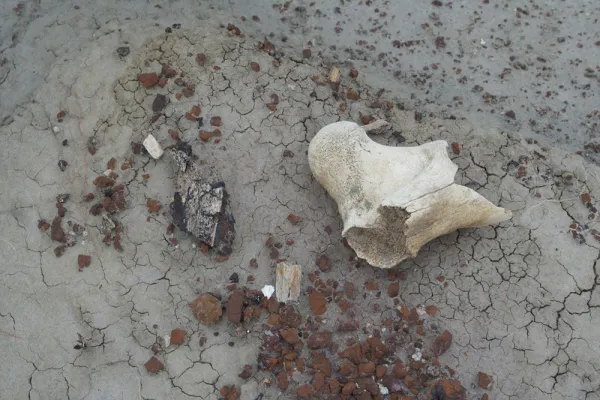
Image context: the lead image comes from the Smithsonian fossilization resource page and deliberately pairs a fossil bone with a modern weathered bone.[2] That pairing belongs here because the article's main claim is comparative. Paleontologists do not reconstruct vanished wetlands from fossils alone. They compare ancient traces with modern remains still moving through decay, burial, and sediment sorting.
Around 0:00, the video makes comparison the real instrument
The opening claim is deceptively simple. Early Cretaceous Washington was a swampy coastal plain crossed by river channels, some faster and some slower, and scientists learned this by comparing ancient rocks and fossils with sediments and remains accumulating in modern swamps and channels.[1] That sentence contains the whole method. Behrensmeyer is not treating the wetland as a scenic backdrop for a fossil story. She is treating it as an explanatory machine.
This is exactly the sort of reasoning that actualistic taphonomy was built to support. Modern death assemblages and depositional settings preserve environmental information before they ever become fossils.[6] In other words, the present is not merely illustrative. It is calibrating. If a modern wetland sorts carcasses, leaves, mud, and sand in patterned ways, then similar associations in the fossil record can be read with more confidence. The video's first strength is that it shows environment reconstruction beginning with process rather than with taxonomic wishful thinking.
Around 0:50, slow water and fine sediment become the key to what can persist
The middle of the video moves to a channel in the wetland and explains why the setting matters.[1] Many channels move quickly and carry sand. This one is moving slowly enough to let silts and clays settle out, and the dark mud already contains plant fragments.[1] That observation is more important than it looks. Fine sediment does two jobs at once: it records low-energy conditions, and it improves the odds that delicate organic material will be buried before surface processes destroy it.[1][2]
Behrensmeyer then states the real condition for plant material to fossilize: deep burial, little disturbance, and enough time for sediment to become rock.[1] The Smithsonian fossilization resource frames the same issue in broader terms by emphasizing preservation conditions and the rarity of soft-tissue survival.[2] Fossils are not granted by age alone. They require the right sedimentary and chemical circumstances, plus enough protection from the ordinary ecology of decay.
That helps explain why the video keeps its attention on mud instead of drama. Slow water is not visually exciting, but it is scientifically decisive. If the viewer understands why clays settle here, why plant matter darkens the mud, and why undisturbed burial matters, then a fossil bed begins to read as a sedimentary argument rather than as a treasure chest.
Around 1:30, the sandstone clue reminds you that one wetland contains multiple preservational lanes
Near the end, Behrensmeyer turns back to the Cretaceous fossils of Maryland and notes that some are preserved in sandstones. That means at least part of the ancient system involved channels where water was moving faster through the wetlands.[1] This is the video's sharpest correction to any single-image view of fossilization. A wetland is not one thing. It includes quiet zones where fine material settles and higher-energy channels that carry coarser sediment, bones, and broken remains differently.[1][4]
That variability matters for interpretation because fossil assemblages inherit it. Behrensmeyer's 1982 paper on fluvial vertebrate assemblages argued that channel samples are built from multiple sources, including floodplain surfaces, floodplain deposits, and the active channel itself, and may represent order-of-magnitude time intervals of 10² to 10⁴ years rather than one instant.[5] Once that is in view, the fossil record looks less like a photograph and more like a layered, time-averaged concentration shaped by transport and depositional energy. The Maryland Geological Survey page points in the same direction in public-facing language: remains in central Maryland were rapidly buried in alluvial sediments in low-lying areas, then lithified and preserved until erosion re-exposed them.[4]
This is why the sandstone line is so valuable. It stops the viewer from imagining one universal fossilization recipe. Different parts of the same landscape sort evidence differently, and those differences survive into the rock record.
What this short video is really teaching
The video's closing claim is that places like Huntley Meadows help scientists reconstruct past environments and understand how fossils were preserved.[1] That is modest phrasing for a large intellectual move. The wetland is not being used to prove that Early Cretaceous Maryland looked exactly the same as northern Virginia today. It is being used to isolate mechanisms: slow settling, channel transport, plant burial, coarse-versus-fine sediment contrast, and the preservational consequences of each.[1][2][5]
That distinction is why the clip works so well in annotated-viewing form. It does not oversell analogy as identity. Instead it shows how paleontologists build a defensible bridge between a living depositional system and an extinct one. The bridge is made of process. Modern bones and carcasses weather, move, and accumulate in patterned ways; modern sediments trap some remains and destroy others; ancient rocks preserve the signatures of those same sorting regimes after immense delay.[3][5][6]
So the article's thesis is narrower and stronger than "wetlands make fossils." A living wetland helps paleontologists read ancient Maryland because it reveals how environment becomes preservation bias. Slow mud, plant-rich burial, and faster sandy channels do not merely house fossils after the fact. They decide, in advance, what kind of past can still be recovered.
Sources
- Smithsonian's National Museum of Natural History, "How do paleontologists reconstruct environments from the ancient past?" YouTube video, published February 6, 2012.
- Smithsonian National Museum of Natural History, "Fossilization - How Fossils Form."
- Smithsonian National Museum of Natural History, "How Bones Fossilize ... or Don't."
- Maryland Geological Survey, "Dinosaur Fossils in Maryland."
- Anna K. Behrensmeyer, "Time resolution in fluvial vertebrate assemblages," Paleobiology 8, no. 3 (1982), Cambridge Core.
- M. Soledad Domingo et al., "Taphonomic information from the modern vertebrate death assemblage of Doñana National Park, Spain," PLoS ONE (2020), via PMC.