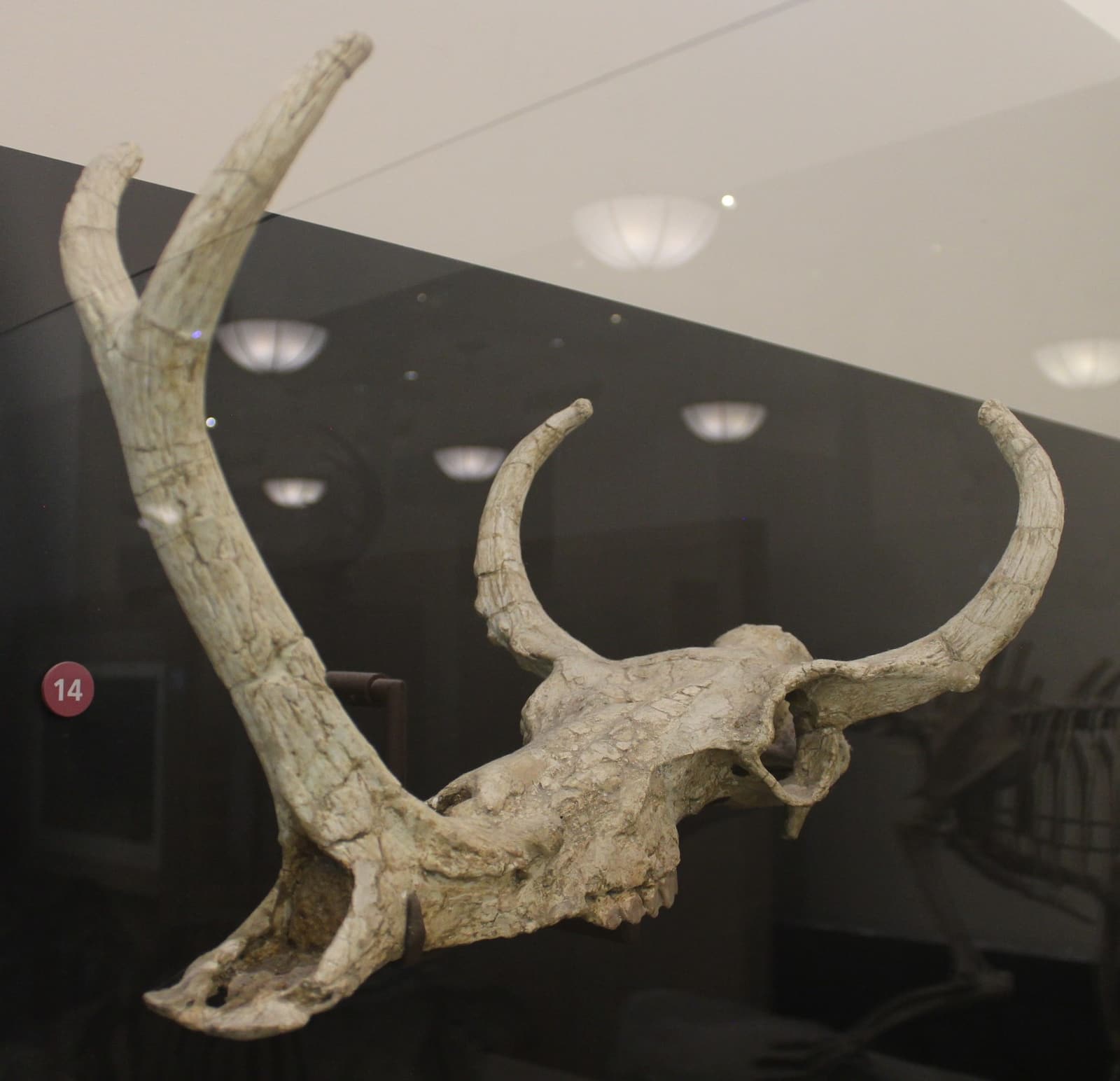
The skull of Synthetoceras tricornatus seems to offer two different introductions. Above the eyes, paired projections invite comparison with an antelope. Farther forward, a long stalk rises from the snout and divides into a fork. The face beneath this apparatus looks almost understated. A photograph of specimen FAM 33407, displayed at the American Museum of Natural History, lets the eye follow that unlikely construction from its base to its spreading tips.[1]
This was a North American hoofed mammal of the late Miocene, living around 10 million years ago. It belonged to the extinct protoceratids, a family whose later members developed elaborate headgear. Yet the spectacular skull is only the beginning of its portrait. Follow the animal down to its feet, and the apparent familiarity starts to unravel.[2]
The architecture of the fork
“Nasal horn” describes position more readily than construction. In these protoceratids, the upper-jaw bones, or maxillae, rise above the nasal region, meet and branch. The pair farther back grows from the frontal bones. The skull itself has grown the ornament.[3]
The Florida Museum reconstructs thickened skin over these bony appendages, rather than a true horn's keratin sheath. Vascular grooves support that interpretation: they mark routes for blood vessels, not surviving skin.[3]
Elaborate appendages are associated with adult males, making display and rivalry plausible functions. The museum discusses possible grappling in the related Kyptoceras, whose horns pointed differently. Transferring that choreography to Synthetoceras would erase the anatomical differences that make the comparison useful.[3]
Below the showpiece
The American Museum's account emphasizes relatively short legs and unfused metapodials: bones between the ankle or wrist and the toes that remained separate. These details interrupt the temptation to furnish the skull with a modern antelope's body. The museum suggests that later protoceratids may have browsed in wet coastal environments, while presenting a partly aquatic lifestyle as a possibility.[2]
There is a more tangible complication in the collections. In his 2019 reassessment of the Lapara Creek fauna of south Texas, Steven May reconsidered several separate foot bones previously assigned to a camel. Their straight, robust form suggested that most probably belonged to Synthetoceras instead. The reassignment was qualified, but it made the animal's identity consequential far beyond its head.[4]
An isolated bone has no forked horn attached to announce its owner. Its proportions and joint surfaces have to do that work. A museum skull can make a species instantly recognizable while the rest of its skeleton remains harder to retrieve from a mixed collection.
A family resemblance without a verdict
Protoceratids have been placed near both camels and ruminants, the group containing deer and cattle. A 2021 study by Selina Robson and colleagues examined the skull base of Protoceras celer, another member of the family, using CT scans. This was evidence from a relative, rather than a scan of Synthetoceras itself.[5]
The study found substantial continuity in the family's internal skull anatomy despite its increasingly elaborate external shapes. It also challenged the identification of a detached ear-region bone used in earlier comparisons. A bone whose identity is uncertain can distort a family tree even when its anatomy has been described meticulously.[5]
The researchers did not resolve the family's relationship to other hoofed mammals. Several features resembling those of ruminants were not exclusive to that group. For Synthetoceras, “antelope-like” remains a useful visual invitation, provided it does not become a settled genealogy.[5]
A conspicuous animal in a changing community
May's Texas study places Synthetoceras in the Goliad Formation, whose fauna indicates a floodplain with woodland, grassland and low-gradient rivers. Within the Ten Mile Waterhole Creek assemblage, it was the most common even-toed hoofed mammal. Across the studied sequence, camels became more diverse; Synthetoceras persisted in the Farish Ranch fauna but was absent from the Buckner Ranch sample.[4]
That pattern documents a changing fossil community. It does not, by itself, demonstrate that camels outcompeted their conspicuously ornamented neighbours. Local absence, ecological replacement and the extinction of an entire lineage are different claims.
The fork remains the feature that catches the eye. The fuller animal emerges through less theatrical evidence: a foot bone reassigned, a skull comparison qualified, an occurrence recorded in one deposit and missing from another. Together, they give Synthetoceras a place in a living landscape, beyond the silhouette that makes it memorable.
Sources
- Jonathan Chen, “Synthetoceras AMNH.jpg,” Wikimedia Commons (2024) — photograph of specimen FAM 33407, museum identification and image provenance.
- American Museum of Natural History, “Synthetoceras tricornatus” — late Miocene context, limb anatomy and proposed habitat.
- Danielle R. Byerley, “Kyptoceras amatorum,” Florida Museum of Natural History (completed 2012; updated 2015) — comparative protoceratid horn construction, inferred covering and proposed function.
- Steven R. May, “The Lapara Creek Fauna: Early Clarendonian of south Texas, USA,” Palaeontologia Electronica 22.1.15A (2019) — Synthetoceras material, reassigned metapodials and faunal distribution.
- Selina V. Robson and colleagues, “The petrosal and basicranial morphology of Protoceras celer,” PLOS ONE (2021) — CT study, specimen attribution and limits of the relationship evidence.