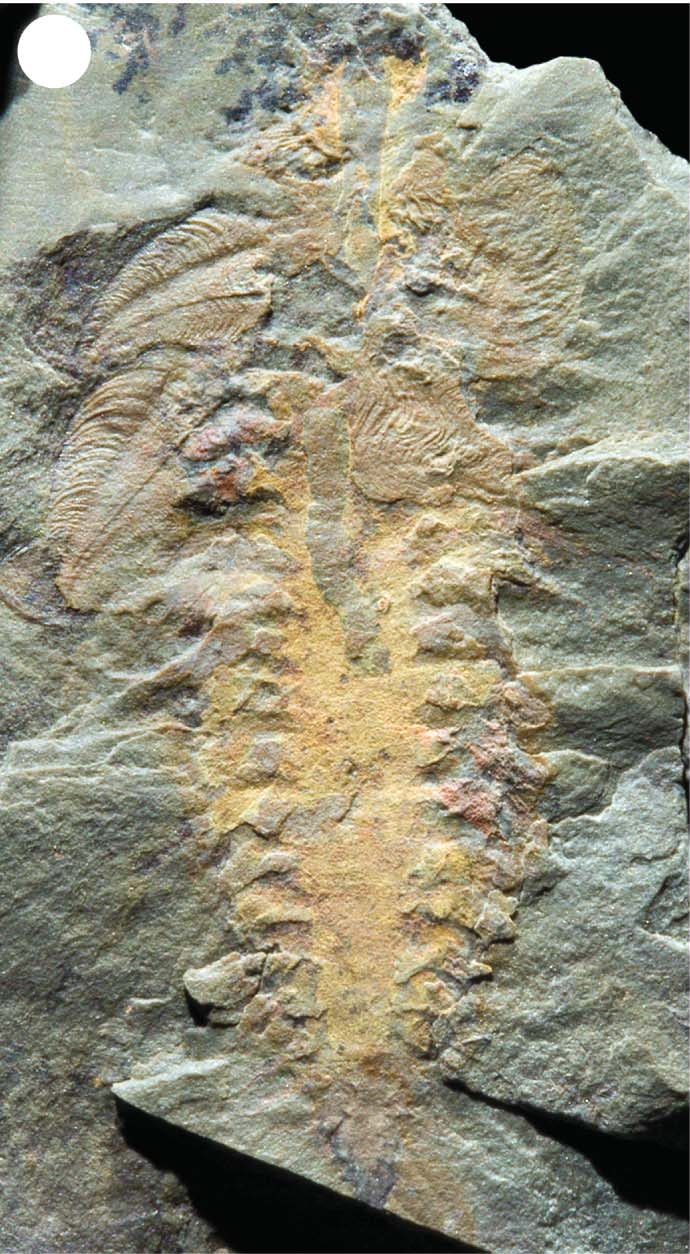
On a small Moroccan slab, ridged plates crowd one end of a tapering body. Fine bristles spread from lobes along its sides. The preserved animal measures about 28 millimeters: enough room for evidence that helped resolve a century and a half of uncertainty. This Early Ordovician animal is Plumulites bengtsoni, described by Jakob Vinther, Peter Van Roy and Derek Briggs in 2008.[1]
It belongs to the machaeridians, extinct animals usually encountered as separated shell plates. Those durable pieces had prompted comparisons with several very different groups. A complete covering was rare; the anatomy beneath it was rarer still.[1][2] The Moroccan fossil made the covering legible by preserving some of its owner.
The body beneath the plates
The specimen, now at Yale's Peabody Museum, lacks its front end and many plates. What survives includes paired appendages called parapodia, carrying bundles of bristles, or chaetae. Their repeated arrangement identifies an annelid: a member of the group containing bristleworms, earthworms and leeches.[1][2]
That identification also had to work beyond Plumulites. Other machaeridians wore their plates differently. In 2009, Anette Högström, Briggs and Christoph Bartels described Lepidocoleus hohensteini from Germany's Lower Devonian Hunsrück Slate. Its armor almost enclosed the soft body, whereas the plumulitid covering lay across the back. One specimen preserved soft anatomy replicated in pyrite, revealing a segmented trunk and plates attached to alternate segments.[2]
This supplied a second anatomical connection between a worm and its shell. It also warned against counting every plate as a body segment. The mineralized covering had its own pattern of construction; recovering the animal required understanding how the two patterns fitted together.[2]
A handful of exceptional specimens could therefore change the interpretation of abundant, ordinary fragments. A loose plate might remain difficult to identify precisely, but it no longer floated among entirely unrelated possibilities.
Armor that could move
Once the animal was recognized, the plates became evidence about movement. Vinther and Briggs's 2009 study interpreted plumulitids as surface dwellers propelled by their parapodia. Their relatives with more enclosing armor were interpreted as burrowers, advancing through waves of contraction along the body.[3]
Overlapping plate edges, and in some forms the ridges on their surfaces, could help resist backward slipping through sediment. A rigid plate could participate in a flexible covering because neighboring plates moved relative to one another. Flexibility belonged to the arrangement as much as to the material.[3][5]
These are functional interpretations drawn from anatomy and comparison. The same study treated an associated Hunsrück trace as an escape movement, rather than a record of routine travel.[3] That distinction matters: a fossil can preserve an animal's capacity to bend without recording its everyday pace or route. The discovery gave researchers a better basis for imagining a living worm, while leaving much of its behavior open.
A smaller clue, a closer relative
Being an annelid still left a large family to search. In 2019, Luke Parry and colleagues described another P. bengtsoni from the Fezouata deposits, held in Prague's National Museum. Near its front lay two tiny triangular structures, each about a quarter of a millimeter across, interpreted as jaw elements. Their position, pairing and growth lines helped distinguish them from stray fragments.[4]
The researchers compared these jaws with those of living worms and analyzed anatomical relationships. Their results placed machaeridians among scaleworm relatives, supporting a connection between the fossil armor and the dorsal scales of that living group. Only one jaw pair was visible; the authors allowed that another might remain hidden in the rock.[4]
The bristles had established the broader identity. The jaws helped refine the relationship. Neither discovery required a flawless, complete animal.
Such findings also travel through museum drawers. In 2010, the Royal Ontario Museum reported an articulated Plumulites canadensis collected from rock excavated for an underground parking facility in Ottawa. Curator David Rudkin had first encountered the specimen through a collector's letter in 1997. The Moroccan discovery subsequently gave him and Vinther a firmer basis for interpreting it.[5]
The Ottawa fossil was a different species and much younger than the Moroccan material. Its importance here is the connection between collections: evidence recovered from one exceptional body can make another specimen intelligible years after it was found. The enduring plates had been waiting for a few fragile anatomical details to give them an animal.
Sources
- Jakob Vinther, Peter Van Roy and Derek E. G. Briggs, “Machaeridians are Palaeozoic armoured annelids,” Nature 451 (2008), 185–188 — original description and holotype photograph; full paper at the Flanders Marine Institute.
- Anette E. S. Högström, Derek E. G. Briggs and Christoph Bartels, “A pyritized lepidocoleid machaeridian (Annelida) from the Lower Devonian Hunsrück Slate, Germany,” Proceedings of the Royal Society B 276 (2009), 1981–1986 — segmented soft anatomy and plate attachments.
- Jakob Vinther and Derek E. G. Briggs, “Machaeridian locomotion,” Lethaia 42 (2009), 357–364 — authors' abstract and publication record at the University of Bristol.
- Luke A. Parry, Gregory D. Edgecombe, Dan Sykes and Jakob Vinther, “Jaw elements in Plumulites bengtsoni confirm that machaeridians are extinct armoured scaleworms,” Proceedings of the Royal Society B 286 (2019), 20191247 — jaw anatomy and phylogenetic analysis.
- Royal Ontario Museum, “ROM Curator Among Scientists to Reveal Secrets of One of the World's Rarest Fossils” (2010) — the Ottawa specimen's collection history and reinterpretation.