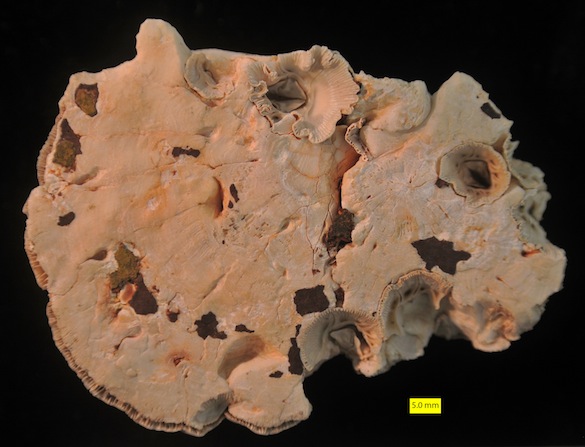
Turn a pair of fossil barnacles upside down and the crowded seafloor comes into view. On specimens from Maryland's Middle Miocene Calvert Formation, the attachment surface contains two smaller barnacles engulfed by the larger ones. Their pointed interiors face the viewer; even the little plates that once opened for feeding remain visible. The original supporting surface has gone.[1]
In Mark Wilson's photographs, the underside looks almost like a relief map. Some winding impressions may record soft-bodied organisms, although Wilson leaves that identification open. The smaller barnacles are the more secure witnesses: other animals occupied this patch before the larger skeletons spread across it.[1]
That spreading edge could become an unlikely instrument of preservation. An organism without a durable skeleton could leave its shape in a neighbor that had one.
A skeleton with someone else's shape
Paleontologists call preservation through organic overgrowth bioimmuration. An oyster, a tube-building worm or a bryozoan colony expands over an occupied surface. Its mineralized skeleton follows the contours underneath. When the covered organism decays, an impression can remain on the attachment surface. Later minerals may fill that hollow, producing a natural cast.[2]
Paul Taylor's 1990 review assembled examples involving algae, hydroids, marine flowering plants and bryozoans without mineralized skeletons. Their prospects for fossilization depended partly on the construction work of other organisms.[2]
This changes what deserves attention in a collection. A shell's outer outline helps identify its maker. Its underside may preserve an entirely different animal. The two records share one object, but they reached it by different routes.
The oyster's record continued as it grew
Jonathan Todd's 1993 study of the Late Jurassic oyster Deltoideum delta showed how much information shell growth could capture. This broad, relatively flat oyster lived in muddy settings in Europe; some individuals cemented themselves to others, forming small clusters. Their attachment areas preserved delicate encrusting organisms.[3]
Todd also examined impressions made between successive growth lamellae—the thin projecting layers of shell. A small organism settling on an exposed layer could later be covered by the oyster's advancing growth. Preservation was therefore possible beyond the original attachment patch.[3]
The detail depended on the contact itself. Cement associated with attachment could reproduce minute contours, yet a surviving cement layer could also conceal them. Some specimens exposed their contents through small natural openings; others required preparation.[3]
The familiar distinction between a fossil and its surrounding material becomes awkward here. The covering that hides the evidence is also the structure that made the evidence durable.
Egg capsules where the recorder happened to pass
A Late Cretaceous specimen from Maastricht makes that selectivity unusually clear. In 2013, Michał Zatoń and colleagues described roughly millimeter-wide outlines inside what had been the final whorl of a large marine snail shell. Their shape, clustering and resemblance to modern examples supported an interpretation as gastropod egg capsules, probably belonging to neritoids.[4]
Bryozoan colonies had grown across the capsules. Later, the original snail shell dissolved, exposing the colony undersides on the hardened sediment filling. Crucially, capsule outlines appeared where the bryozoans had covered them; the adjacent coarse sediment preserved no comparable detail.[4]
This is a small experiment supplied by geological circumstance. One surface offered two recording materials, with different results. The absence of capsule impressions outside the colonies cannot establish that no capsules were laid there. Nor do the impressions identify a particular parent species. They recover a reproductive trace through the geometry of overgrowth.[4]
A missing animal appears in New Zealand
The consequences can extend from one shell to a lineage's known geography. Emanuela Di Martino and colleagues described Buskia waiinuensis in 2017 from the Nukumaru Limestone at Waiinu Beach, New Zealand. The deposit dates to approximately 2.29–2.08 million years ago. The single known colony survived as a mold beneath another bryozoan that had overgrown it.[5]
The impression retained branching connections, individual body compartments and small appendages: enough anatomy to distinguish a species of this soft-bodied bryozoan. It was the first fossil Buskia reported outside Europe. The four fossil species already described from Europe had likewise been preserved through bioimmuration.[5]
One colony established presence in an ancient sea. It could not establish how abundant the animal was, or turn the previous lack of fossils elsewhere into evidence of geographical absence.
These examples invite a different way of looking at a fossil shell. Its durable structure belongs to one organism, while some of its most revealing details belong to others. The resulting record is intimate and selective: a neighbor had to arrive, a skeleton had to spread, and the contact had to survive. Beneath an ordinary-looking shell, a few millimeters of overlap can preserve a life that would otherwise have left almost nothing.
Sources
- Mark Wilson, “Wooster's Fossils of the Week: Large Miocene barnacles with bioimmurations from Maryland,” Wooster Geologists (2014) — specimens, photograph and qualified interpretation of soft-bodied traces.
- Paul D. Taylor, “Preservation of soft-bodied and other organisms by bioimmuration—a review,” Palaeontology 33 (1990), 1–17 — preservation mechanism and recorded organisms.
- Jonathan A. Todd, “The bivalve shell as a preservation trap, as illustrated by the Late Jurassic gryphaeid, Deltoideum delta,” Scripta Geologica, Special Issue 2 (1993), 417–433 — attachment cement, growth lamellae and exposure of impressions.
- Michał Zatoń, Paul D. Taylor and John W. M. Jagt, “Late Cretaceous gastropod egg capsules from the Netherlands preserved by bioimmuration,” Acta Palaeontologica Polonica 58 (2013), 351–355 — capsule identification and preservation beneath bryozoans.
- Emanuela Di Martino, Paul D. Taylor, Dennis P. Gordon and Lee Hsiang Liow, “New bryozoan species from the Pleistocene of the Wanganui Basin, North Island, New Zealand,” European Journal of Taxonomy 345 (2017), 1–15 — Buskia waiinuensis description and fossil distribution.