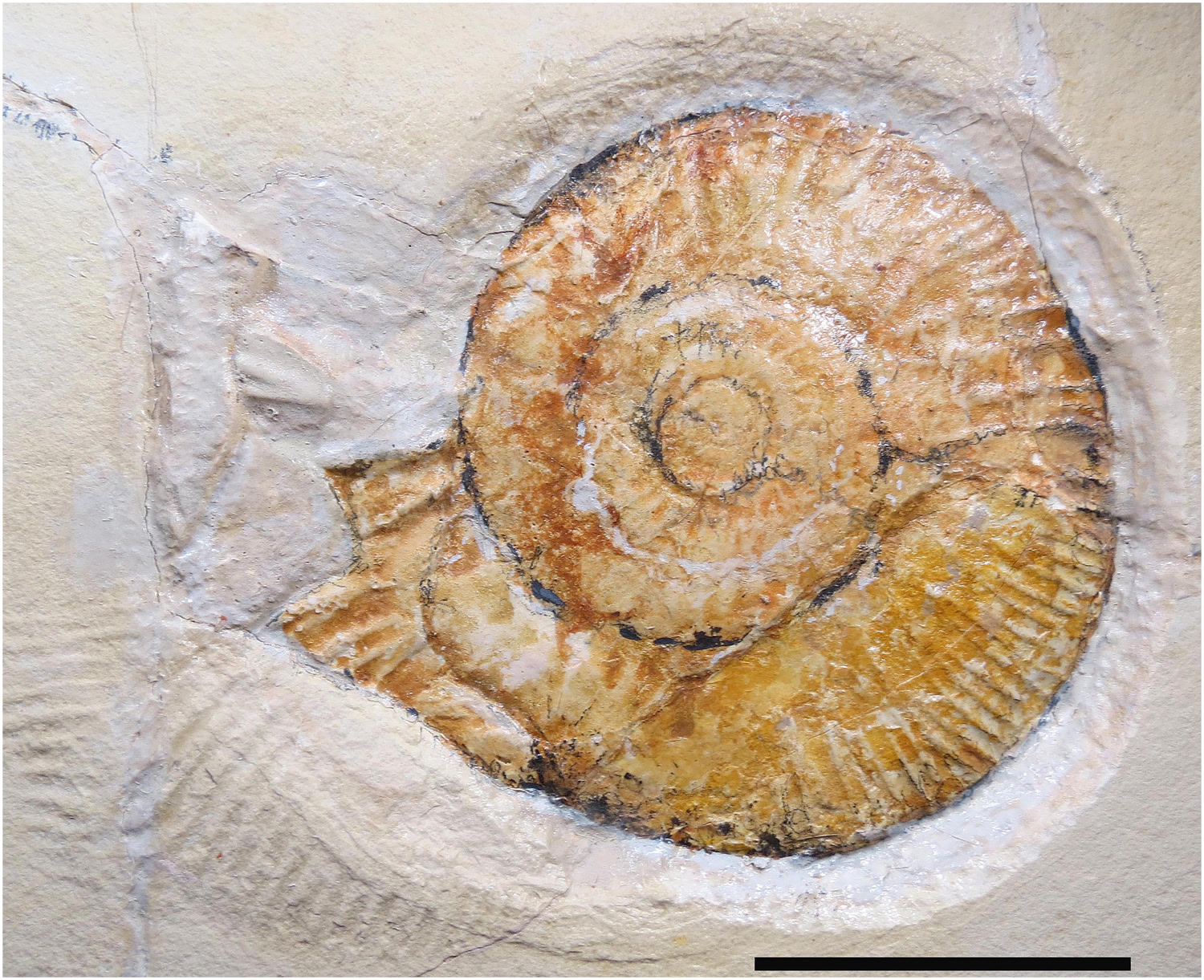
At one end of a strip of Bavarian limestone, two fine ridges run side by side. At the other lies a ribbed ammonite shell about the width of a hand. The distance between them is 8.5 metres. A quarry worker who saved only the handsome coil would have left almost the whole fossil behind. The limestone records what happened to the shell of Subplanites rueppellianus after the animal inside it died. [1]
Where the lines turn
Start at the shell and work backwards. Immediately beside the coil, the mud took an impression of eighteen ridges. Their spacing matches the ribs on the shell, much as you could match a comb to the lines it leaves in wet sand. Here the impressions run almost crosswise to the long groove. A few centimetres back, they run along it. That turn is the most informative detail in the photograph. It catches the shell changing its angle as it settled onto its side. [1]
Farther back the imprint narrows. Extra ridges appear, fade, then show up again. At the farthest preserved point the whole band measures less than six millimetres across. Much of the coil must have ridden clear of the mud for just a sliver of its ribbed surface to draw such a fine line. The continuous furrows also help distinguish a sliding shell from one that bounced along the bottom. A bounce would leave a gap each time the shell lifted clear. [1]
The slabs came from the Late Jurassic Solnhofen limestones of southern Germany, probably from a quarry near Langenaltheim. Preparators fitted the pieces together in 1998. For their 2017 study, Dean Lomax and colleagues used 645 photographs to build a digital model of the assembled fossil. One end of this seemingly complete journey is missing. The groove already crosses the edge of the first surviving piece, so 8.5 metres measures only the part of the drift that the quarry yielded. [1][2]
What held the shell up?
In life the ammonite occupied the outermost chamber of its coil. Behind its body lay a succession of sealed-off spaces connected by a tube. The balance of fluid and gas in those chambers helped support the animal in the water. Death removed the animal’s control over that balance. In the Barcelona specimen even the hard part of the lower jaw is missing from the body chamber, one reason the researchers concluded that decay was well advanced by the time the shell touched bottom. [1][3]
Imagine a current just strong enough to carry a partly buoyant shell. The lowest ribs brush soft carbonate mud while the surrounding surface stays smooth. As the shell tips, another rib catches and the band widens. Lomax and colleagues favoured a gentle, steady current for this reason. A downslope slide could also have helped move the shell, but the quarry records are too imprecise to establish the slope of this particular patch of lagoon floor. The grooves preserve the contact far better than they preserve the force behind it. [1]
How far might the shell have travelled before those first two ridges? A chambered shell can retain buoyancy after death, but the shape of the coil matters. Margaret Yacobucci compared experimental buoyancy results with fossil shell shapes and found that relatively plump shells had the best prospects for prolonged flotation. An ammonite found far from shore need not have drifted there from some distant habitat. Here the limestone lets us say something much more exact about one shell. Roughly 150 million years ago, it skimmed a particular patch of mud. We can follow it almost to the centimetre where it tipped over. Its journey before that lies beyond the broken edge. [1][2][4]
Sources
- Dean R. Lomax and colleagues, “An 8.5 m long ammonite drag mark from the Upper Jurassic Solnhofen Lithographic Limestones, Germany,” PLOS ONE (2017). Specimen description, measurements and photograph.
- University of Manchester, “Palaeontologists create 3D digital model of ‘death drag’ left by prehistoric squid” (2017). The researchers describe assembling the photographic record.
- British Geological Survey, “Ammonites.” Shell anatomy, body chamber and buoyancy.
- Margaret M. Yacobucci, “Postmortem transport in fossil and modern shelled cephalopods,” PeerJ (2018). OpenAlex record and abstract.