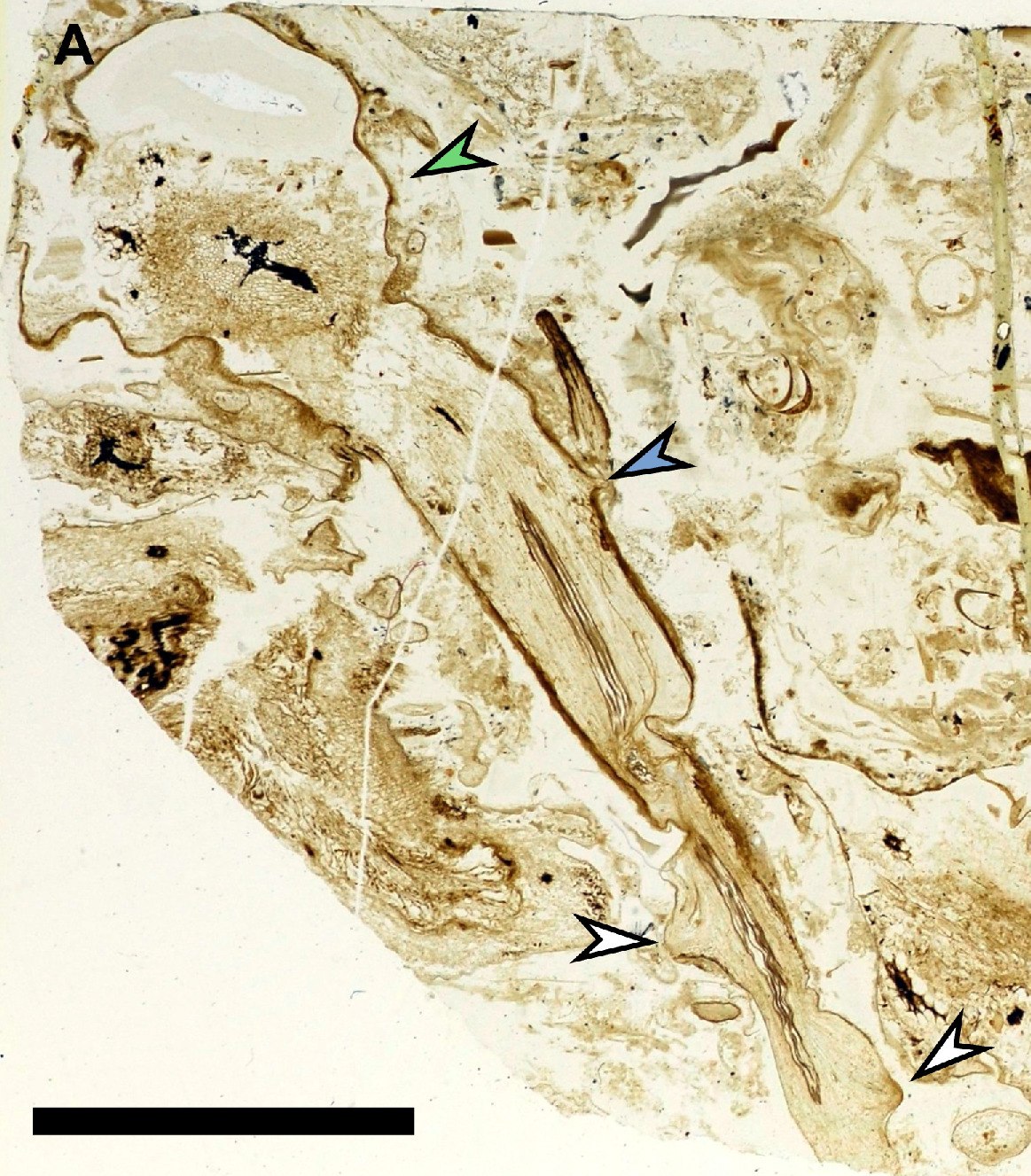
Start at the green arrowhead in the photograph below. It points to a dark star inside a stem. That star is xylem, the tissue that carried water through a plant growing near hot springs in what is now Aberdeenshire, Scotland, about 407 million years ago. Follow the stem to the attached branch and there are two much smaller marks, picked out in white. Each marks the growing tip of an underground organ. In this one slice of Rhynie chert, you can trace the plumbing of Asteroxylon mackiei from a leafy shoot almost to the point where the plant met the soil. [1]
A shoot that carried its spores along its sides
Asteroxylon belonged to the lycophyte branch of the plant family tree, which today includes clubmosses. Its fertile shoots would reward a close look. Among the small pointed leaves sat pairs of kidney-shaped valves, each pair enclosing spores. A short stalk held each case close against the stem. Along a single shoot, stretches with spore cases alternated with stretches bearing leaves alone. A slice across one of those leafy stretches could easily give the impression of a plant that had yet to reproduce. Another cut farther along the same stem could catch the spores still inside their case. [1][2]
The leaves and spore cases also shared a pattern. Holly-Anne Turner and colleagues mapped their positions around fossil shoots and found that a row spiraling up a stem could take in both kinds of organ. Some shoots carried whorls. Others carried spiral arrangements whose counts in opposite directions departed from the familiar Fibonacci numbers of a sunflower head. To give the plant a convincing silhouette, a fossil illustrator would have to decide which particular shoot to draw. The species used more than one arrangement. [3]
Where the branch changed jobs
Down near the ground, a leafy shoot gave rise to a narrower branch that grew steeply downward. Even here the plant could produce a little scale leaf, like the one marked in blue in the photograph. Farther along came another fork. One arm continued the thicker branch. The other grew into a slender, bare strand that split repeatedly. The thicker branch took the plant deeper, while the fine forks spread its surface through the surrounding sediment. [1]
How did the fine strand get started? A junction seen in a single slice can be deceptive. A new organ growing out from deep inside a stem will eventually look like a branch attached to its side. So will one arm of a fork that grew more slowly than its partner. In sections through young Asteroxylon junctions, researchers could follow rows of cells from the parent tissue into the little tip. The outer tissues continued across the fork. An organ pushing out from within would have had to break through those layers. The unequal division of a growing tip accounts for what the slides preserve. [1]
At the far end of a strand, the puzzle gets smaller still. On a living clubmoss root, a cap of cells covers the delicate growing tissue as it pushes through the ground. Alexander Hetherington and Liam Dolan searched 641 slices of Rhynie chert for the equivalent part of Asteroxylon. They found five rooting tips. A cap might have fallen away from a damaged tip, but here the outer skin could be followed right over the end. Beneath it, small cells near the tip gave way to larger ones farther back, a sign that the organ had been growing when it was preserved. [4]
Those five tips let us picture something a drawing of the whole plant would scarcely show. Beneath the spore-bearing shoots was a network broad enough to fork again and again. At its advancing edge, the cells facing the soil belonged to the skin of the growing organ itself. The ground around Rhynie once held a plant that could send a growing tip deep into the sediment with only that thin skin at its leading edge. [1][4]
Sources
- Alexander J. Hetherington and colleagues, “An evidence-based 3D reconstruction of Asteroxylon mackiei, the most complex plant preserved from the Rhynie chert,” eLife (2021).
- Hans Kerp and colleagues, “Reproductive Organs and In Situ Spores of Asteroxylon mackiei Kidston & Lang, the Most Complex Plant from the Lower Devonian Rhynie Chert,” International Journal of Plant Sciences (2013).
- Holly-Anne Turner and colleagues, “Leaves and sporangia developed in rare non-Fibonacci spirals in early leafy plants,” Science (2023).
- Alexander J. Hetherington and Liam Dolan, “Stepwise and independent origins of roots among land plants,” Nature (2018).