Two scraps of limber pine from a packrat den in Nevada’s Eleana Range still had their growth rings. Under magnification, the rings averaged less than a fifth of a millimetre wide. The two pieces gave radiocarbon ages of roughly 14,300 and 15,300 years. Each preserved a run of years when the tree added scarcely a sliver of wood. For paleobotanist W. Geoffrey Spaulding, the wood also held a fact you could read without a microscope. It had turned up a long way downhill from the living pines. [1]
Packrats carry twigs, leaves and other loose objects back to their dens. Material discarded there accumulates with droppings, and the animals urinate over the heap. In a dry rock shelter the urine hardens into a glossy cement called amberat. A rat can leave a twig with enough of its original structure intact for a botanist to identify it thousands of years later. The same shelter may appeal to generations of rats, each collecting whatever grows within reach during its own lifetime. [2][3]
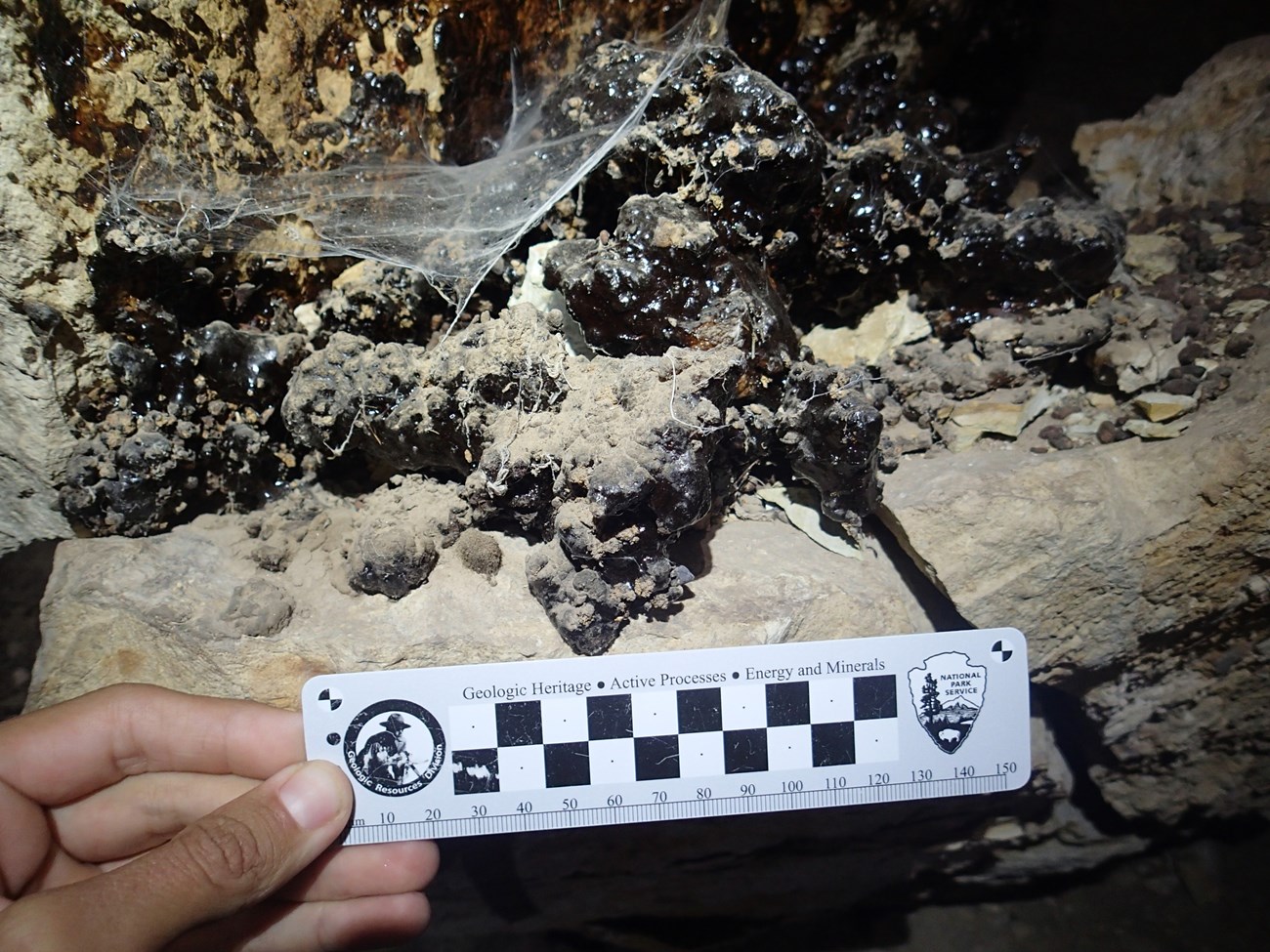
The layers worth taking home
A particularly handsome fragment can be a poor fossil to build a history around. In his southern Nevada survey, Spaulding passed over middens lodged in vertical cracks. Something growing above the opening could shed a twig into a much older deposit below. A radiocarbon measurement on the twig would give a perfectly good age for the wood and a misleading age for its neighbours. [1]
At a site with orderly layers, the fieldwork included recording what grew outside the shelter. Then came a photograph, a sketch and the removal of the midden’s weathered face. At Eleana Range–2, nails driven into the exposed sampling column marked ten-centimetre intervals. Each block taken away could be traced back to a place in that face. In the lab, warm water undid the cement. Sieves caught the debris, and a researcher with a microscope and modern comparison specimens could give many of the fragments names. Some grasses survived the whole journey only to end up recorded as grass, their distinguishing parts missing. [1]
That sorting leaves two quite different sorts of gaps in a plant list. A rat may have ignored a plant growing by its door, or a botanist may have handled a piece and been unable to name it. Presence is easier to establish. Even so, a heap of needles from one branch can make a single pine loom large in a tally. Across the thousands of samples in the US Geological Survey’s midden database, researchers have recorded abundance in different ways. It is much easier to ask which shelters yielded pine than to calculate what fraction of a hillside stood under its shade. [1][4]
How far downhill?
At Basin Canyon in the Sheep Range, limber pine turned up in quantity at about 1,635 metres. A few scraps at the foot of a cliff might have tumbled a considerable distance. The terrain around this shelter offered little scope for such a fall. Two other sites also yielded low-elevation records within about fifty vertical metres of this one. It would take more than a single rat with unusual collecting habits to account for that agreement. During the last glaciation, limber pine grew more than a kilometre below its modern lower limit in the region. [1]
Turning that kilometre into a summer temperature takes another assumption. Cooler air reduces the water a tree loses in summer, so a pine can survive farther down a dry mountain. Greater rainfall could also help. Spaulding looked for other trees that a much wetter climate might have brought into the area, among them spruce. The regional fossil record gave him little reason to reconstruct such a wet woodland. Cooler summers made better sense of the company the pine kept. [1]
The next time someone measures those two scraps from the Eleana Range, the rings will still be there. A different estimate of Ice Age rainfall might change how we explain the trees’ success downhill. It would still have to account for the wood a packrat found close enough to carry home.
Sources
- W. Geoffrey Spaulding, Vegetation and climates of the last 45,000 years in the vicinity of the Nevada Test Site, south-central Nevada. USGS Professional Paper 1329 (1985), sampling methods, figure 23 and discussion of elevational displacement.
- National Park Service, “Studying the Past and Predicting the Future Using Rat Nests,” on collecting behaviour and the reuse of dens.
- National Park Service, “Preserved Remains,” packrat midden preservation and field photograph PB030595.
- US Geological Survey, North American Packrat Midden Database, on plant identification and differences in abundance reporting.