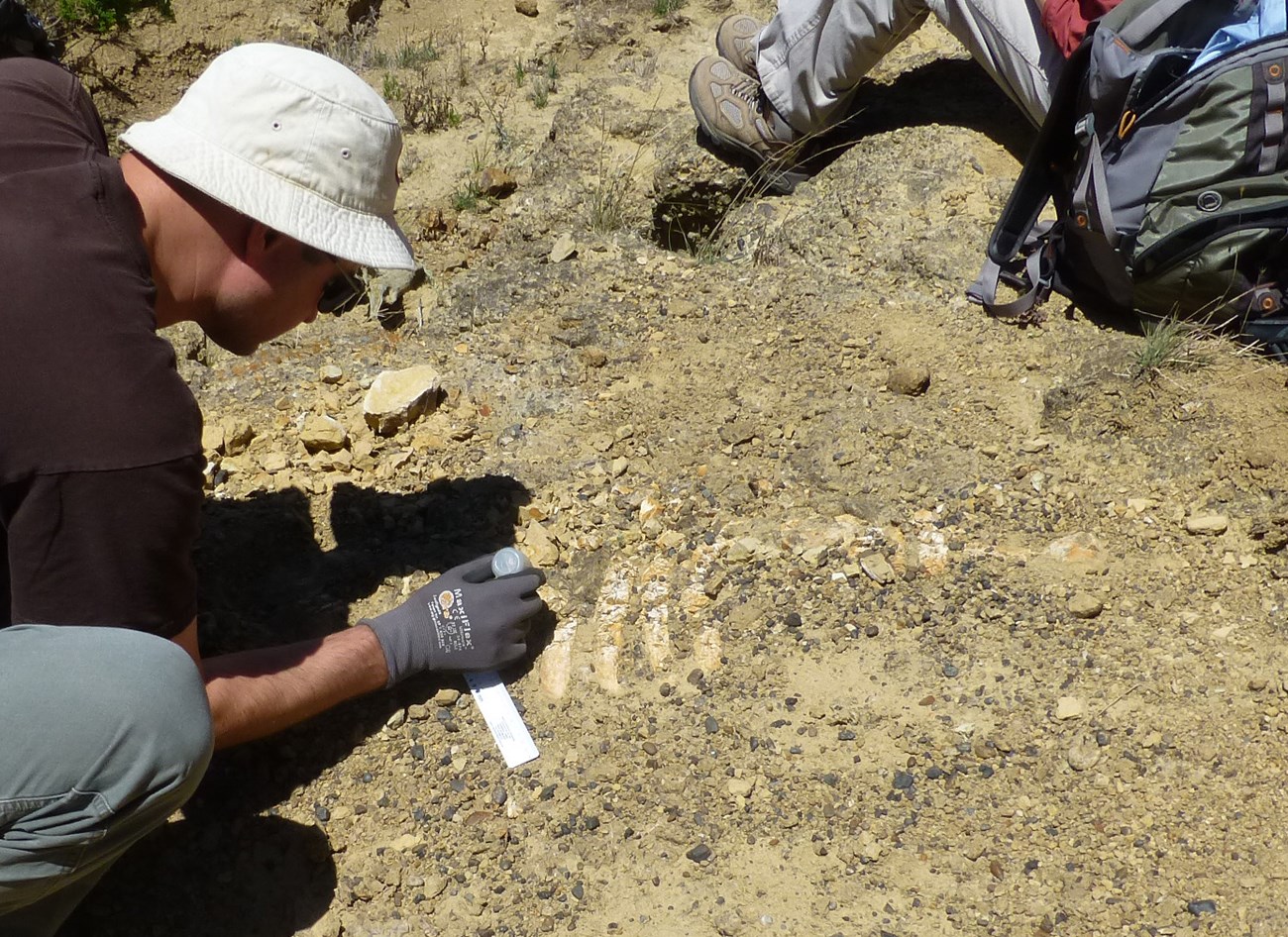
The sea cow needed a crate and a helicopter. In August 2018, a team led by Jonathan Hoffman of the Santa Barbara Museum of Natural History excavated its fossil skeleton on Santa Rosa Island. Park staff packed the specimen for an airlift out of a ravine, followed by a boat journey to the mainland. The National Park Service's account placed it somewhere between 20 and 25 million years old.[1]
That broad interval left a quieter problem after the spectacular recovery: where, within those millions of years, did the animal belong? An answer would come from the chemistry of shells in the surrounding beds.[5]
A chemical signature shared by the sea
A shell records more than its owner's shape. Strontium incorporated into marine carbonate carries an isotope ratio: the relative abundance of strontium-87 and strontium-86, written 87Sr/86Sr. In a foundational 1985 paper, Donald DePaolo and B. Lynn Ingram described the useful combination: the ocean's ratio is effectively uniform at a given time, yet changes over millions of years. Shells can retain the value of the water in which they grew.[2]
That makes a small fragment potentially useful across a very large distance. Two animals need not belong to the same species, or have lived beside the same shoreline, for their preserved carbonate to record the same ocean. Chemistry offers a way to connect marine deposits whose familiar fossils may differ.[2]
The age comes from comparison with a calibrated history of seawater composition. The procedure is called strontium isotope stratigraphy. Its essential question is: when did the ocean have this ratio?[3]
Choosing the part that still remembers
The difficulty begins before the measurement. Burial can change a fossil's chemistry while leaving a recognizable shell. Sampling must therefore distinguish surviving original mineral from material altered or added later.
A study by Hubert Vonhof and colleagues provides a practical example. Working with Late Cretaceous belemnites from the Maastrichtian type area in the southeastern Netherlands, they found partial alteration but also well-preserved calcite. Precise milling let them extract suitable material from within the fossils. Their strontium pattern could then be compared with records from northern Germany, Tunisia and an Antarctic ocean-drilling site.[4]
The important unit was a selected portion of the fossil. Calling an entire specimen “well preserved” would have hidden the difference between its usable and altered regions. The resulting pattern also carried more information than a solitary measurement: several values in stratigraphic order could help connect distant sections.[4]
When neighboring shells disagree
On Santa Rosa Island, Jeffrey Paces and colleagues tested oysters, scallops and barnacles from the sirenian-bearing sequence. Their 2023 USGS report shows how misleading an indiscriminate average could have been. Apparent ages spanned roughly 31.9 to 20.0 million years, although the samples came from an interval only about 13 metres thick. The authors attributed the older results to chemical alteration after deposition.[5]
The scallop Lyropecten supplied the consistent evidence. Ten analyses clustered around a seawater signature that yielded 20.08 ± 0.11 million years, with the uncertainty reported as a 95 percent confidence interval. The team assigned statistically indistinguishable ages to the two sirenian fossils at the site. This placed them near the beginning of the Miocene and sharpened the evidence for sea cows' early presence in the northeastern Pacific.[5]
The narrow result depended on explaining the disagreement. More measurements alone would not have made the altered shells reliable witnesses.
The limits travel with the number
John McArthur and Richard Howarth's 2024 assessment emphasizes two further dependencies. A shell influenced by river water can carry a local mixture rather than the open-ocean ratio. And the calibration curve needs reliable ages of its own; measurement precision cannot repair a weak reference chronology. Comparisons between laboratories also require correction against common standards.[3]
These dependencies explain why an impressive string of decimal places is only one part of an age estimate. The route from fossil to date runs through the animal's water, the mineral's burial history and the reference record used for comparison. Each can be investigated separately.
The Santa Rosa excavation photograph captures the conspicuous work: hands protecting a large skeleton before it leaves the ground. The dating work gives the less conspicuous fossils a second role. A shell beside the bones can help locate the animal in evolutionary history—provided its chemistry still belongs to the sea in which it lived.
Sources
- National Park Service, “Mountaintop Sea Cows?” (2018) — excavation, transport, initial age estimate and photograph.
- Donald J. DePaolo and B. Lynn Ingram, “High-resolution stratigraphy with strontium isotopes,” Science 227 (1985), 938–941 — seawater uniformity, change through time and shell records.
- John M. McArthur and Richard J. Howarth, “Strontium isotope stratigraphy of the Cretaceous,” Geological Society, London, Special Publications 544 (2024) — calibration, sample preservation, non-marine influences and laboratory standards; open published paper.
- Hubert B. Vonhof and colleagues, “Belemnite-based strontium, carbon and oxygen isotope stratigraphy of the type area of the Maastrichtian Stage,” Netherlands Journal of Geosciences 90 (2011), 259–270 — selective sampling and comparison between distant marine sections.
- Jeffrey B. Paces, Scott A. Minor, Kevin M. Schmidt and Jonathan Hoffman, “Strontium isotope chronostratigraphic age of a sirenian fossil site on Santa Rosa Island, Channel Islands National Park, California,” USGS Scientific Investigations Report 2023–5026 (2023) — shell screening, age calculations and uncertainty.