
In a photograph from the Carnegie Quarry in Utah, two men are loading a fossil for a pair of mules to haul. The bulky parcel is easy to pick out. Look behind it and there is another piece of excavation equipment, one the mules will never have to pull. Someone has painted a grid across the rock face. The parcel can deliver a bone to a museum in Pittsburgh. The grid lets the people who took it out say where it came from. [2]
In Welcome to the Quarry Exhibit Hall, a National Park Service ranger visits the part of the quarry where those two pieces of evidence stayed together. Roughly 1,500 bones lie exposed inside the building near Jensen. As you watch, follow the sandstone between them. Its steep slope, the gap between two bones, even the amount of stone left around a vertebra have different authors. A river accounts for some of what you see. Mountain building and the people who prepared the exhibit account for the rest. [1][3]
Turn the wall back into a riverbed
Around 3:52 the ranger asks us to imagine the river running dry. In the park’s reconstruction, animals died as water dwindled. Carcasses lay exposed long enough to reach different stages of decay. Returning water carried bones and bodies downstream, where sediment buried them. More than one such episode could add material to the same stretch of channel. The sandstone belongs to the Morrison Formation and records a Late Jurassic landscape about 150 million years old. [1][4]
Try following one rib through that sequence. While attached to a carcass, it could travel with the rest of the animal. Once loose, it could come to rest beside a limb from a different dinosaur. Each arrangement gives the preparator a pair of adjacent bones to uncover. Only the first offers a reason to expect the pair to belong to one skeleton. That distinction matters when the film introduces the long-necked plant eaters and the carnivores that shared the floodplain. Finding their bones close together can put both kinds of animal within reach of the river. To read a particular encounter between them into that patch of sandstone would take another clue. [1][4]
At 4:27 the film gives the riverbed its present tilt. As the Rocky Mountains rose, layers that had accumulated close to horizontal tipped upward. Picture lowering the wall like a tabletop. Two bones that appear one above the other in the hall could have lain alongside each other on the bed. To decide which was buried earlier, you would need to look through successive sediment layers. Measuring height from the visitor gallery answers a different question. [1][3]
Eight bones still in order
At 5:22 the ranger reads Earl Douglass’s account of finding a row of tail vertebrae on August 17, 1909. What made eight bones of Apatosaurus worth singling out? Each vertebra followed the next in anatomical order. Someone finding eight loose pieces could count them and identify them. Douglass could also see how a length of one animal’s tail fitted together. Whatever had happened to the carcass on its way into the sandstone, that much of it had held together through burial. [1][2]
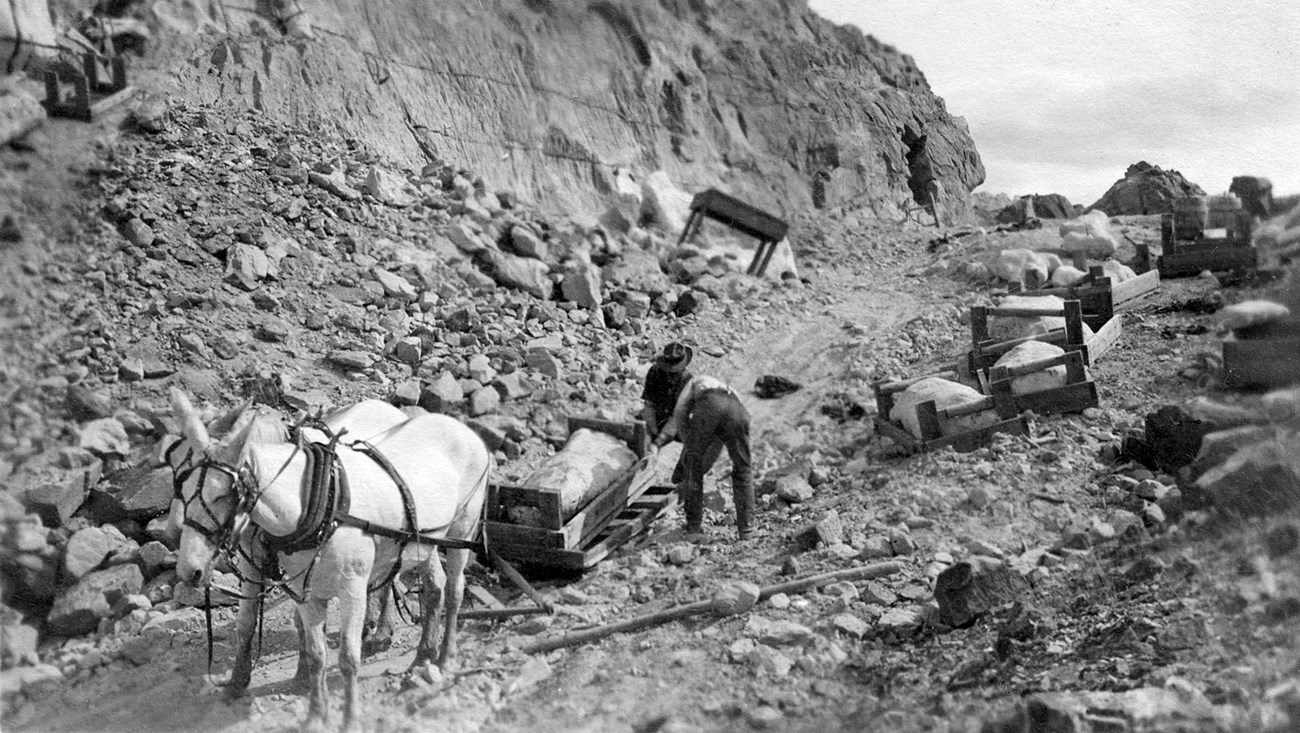
Return to the grid in the photograph. A collector could record a location before wrapping the specimen for transport, and another worker could use the same squares to place the next find. For a researcher comparing bones in different museum drawers, those notes could restore a neighborhood that the excavation had physically taken apart. At the surviving quarry face, a visitor can make a related observation firsthand. Pick out a joint and look at what touches its other end. Even without knowing the animal’s name, you can see the difference between a continuous run of bones and a jumble. [2][3]
Where a preparator stopped
Around 6:31 the film turns to the change in the quarry crew’s assignment. Douglass had wanted visitors to see fossils still bedded in the hillside. Making that possible took another generation of workers. Crews widened the space in front of the quarry in the 1930s. Excavation on the wall resumed in 1952, and the permanent hall opened around it in 1958. For decades afterward, visitors could watch preparators expose more bone. [1][2][3]
The preparator working toward a shipping crate needed to get around and eventually underneath the find. The one working on this exhibit had a reason to stop earlier. Clearing stone from the upper surface lets light catch the curve of a bone. Leaving stone beneath keeps its position available for anyone to inspect. The price is a hidden underside. A museum drawer lets a researcher turn a specimen over. At Jensen you can stand back, take in a whole slope, then move close enough to see just where one bone disappears into the sand that buried it. [2][3]
Sources
- Dinosaur National Monument, Welcome to the Quarry Exhibit Hall, ranger film.
- National Park Service, Historic Carnegie Quarry, excavation history and Douglass Collection photographs.
- National Park Service, See Park Fossils “In Situ”, including the steeply dipping bed at Dinosaur National Monument.
- National Park Service, Lagerstätten, including the Carnegie Quarry’s concentration of fossils in the Morrison Formation.