A short bone beside the wrist makes the fossil hand look unexpectedly familiar. It belongs to Simocyon batalleri, a puma-sized relative of the red panda from Spain's Late Miocene. Its teeth suited meat eating, yet its hand carried an enlarged radial sesamoid: the structure usually called a panda's false thumb. Manuel Salesa and colleagues described the combination in 2006, using fossils from Batallones-1, south of Madrid.[1]
That combination changes the question. Watching a red panda hold bamboo makes the enlarged bone seem readily explained by its dinner. A carnivorous relative with the same unusual equipment asks us to look elsewhere in the animal's life.
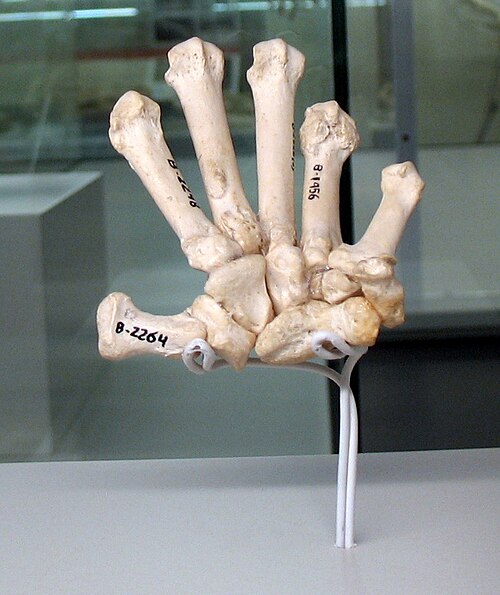
A wrist recruited into the grip
The name conceals an anatomical distinction. A false thumb is an enlarged wrist bone, not an extra finger with a finger's chain of joints. In the red panda, it contributes to a grasping system involving the palm, ligaments and muscles. Its ordinary first digit remains aligned with the other fingers; the sesamoid helps the hand close around an object despite that limitation.[3]
Mauricio Antón and colleagues examined this system through dissection, CT imaging and skeletal comparisons in a separate 2006 study. The red panda's muscle attachments and wrist relationships pointed toward gripping narrow branches. They interpreted bamboo handling as a later use of equipment already useful for climbing.[3]
This is an example of exaptation: an existing feature acquires an additional function. The attraction of that explanation is its economy. A hand capable of securing its owner on a branch already possesses part of the machinery needed to secure a meal.
Reading beyond the small bone
The larger skeleton makes the climbing interpretation more persuasive. Before the Batallones finds, Simocyon was chiefly represented by skull and tooth material. The Spanish fossils added enough of the neck, lower back and limbs to ask how the animal moved. Salesa and colleagues' detailed 2008 study drew on at least two individuals, including a complete forelimb and parts of the hindlimb.[4]
They found climbing capabilities in the forelimb and lumbar region as well as the false thumb. Their proposed animal foraged mainly on the ground but could reach safety in trees when threatened by larger carnivores. That is a reconstruction of a possible lifestyle, not a preserved chase. The bones provide evidence of movement capacity; they cannot tell us what frightened a particular animal into climbing.[4]
Later work adjusted the balance between ground and branches. In 2015, Anne-Claire Fabre and colleagues compared the three long bones of the fossil forelimb with three-dimensional shapes from living musteloids, the broader group containing red pandas and weasel relatives. They tested locomotor classifications against the living comparison sample. Their results suggested that Simocyon could have been more arboreal than earlier interpretations allowed.[5]
The individual bones also gave different functional signals. An inference based only on the upper arm could therefore differ from one based on the forearm. That disagreement is useful: it tells researchers to examine the limb as a whole before assigning an extinct animal a habitual way of moving.[5] The false thumb gains meaning from its anatomical company.
A family branch, not a stepping stone
The evolutionary claim does not require Simocyon to be a direct ancestor of living red pandas. The 2006 fossil study proposed that the two branches inherited their enlarged sesamoids from a shared ancestor, with climbing preceding specialized plant feeding. It also noted herbivory-related teeth in older red panda relatives. Consequently, the argument depends on reconstructed relationships and inherited anatomy; simply placing the Spanish fossil before a living panda on a timeline would not establish it.[1]
The living hand supplies a separate check. Antón's anatomical study found differences between the grasping apparatus of red and giant pandas, despite their similar use of bamboo. Giant pandas are bears; red pandas belong to Ailuridae. Their specialized false thumbs represent independent evolutionary developments.[3]
We therefore need two histories. Within the red panda family, a climbing structure could be inherited and later recruited into feeding. Between red and giant pandas, similar food handling emerged along separate branches.
Another panda, another compromise
The bear branch has its own fossil evidence. In 2022, Xiaoming Wang and colleagues described an enlarged radial sesamoid assigned to Ailurarctos from Shuitangba in Yunnan, China. The Late Miocene material, about six to seven million years old, supported a functional grasp associated with bamboo feeding.[6]
Its shape also raised a different problem: the hand had to carry the animal's weight while walking. The researchers proposed that competing demands from feeding and weight bearing help explain why the modern giant panda's false thumb remained comparatively short. A longer projection would not necessarily make a better all-purpose hand.[6]
Neither fossil offers an evolutionary destination. Ailurarctos helps explain a compromise in the bear lineage; Simocyon preserves a combination that the living red panda no longer displays. Together they make present-day usefulness an invitation to investigate history, rather than a complete account of it. The small bone beside the Spanish fossil's wrist opens that history because its owner had a different dinner.
Sources
- Manuel J. Salesa, Mauricio Antón, Stéphane Peigné and Jorge Morales, “Evidence of a false thumb in a fossil carnivore clarifies the evolution of pandas,” PNAS 103 (2006), 379–382 — fossil anatomy and the proposed ancestral function.
- PePeEfe, “Simocyon batalleri hand — Batallones 1 fossil site, Torrejón de Velasco, Madrid, Spain” (2018), Wikimedia Commons — original museum photograph and attribution, CC BY-SA 4.0.
- Mauricio Antón and colleagues, “Implications of the functional anatomy of the hand and forearm of Ailurus fulgens (Carnivora, Ailuridae) for the evolution of the ‘false-thumb’ in pandas,” Journal of Anatomy 209 (2006), 757–764 — dissections, wrist mechanics and exaptation.
- Manuel J. Salesa and colleagues, “Functional anatomy and biomechanics of the postcranial skeleton of Simocyon batalleri (Viret, 1929) (Carnivora, Ailuridae) from the Late Miocene of Spain,” Zoological Journal of the Linnean Society 152 (2008), 593–621 — skeletal evidence and the proposed ground-foraging, tree-climbing lifestyle.
- Anne-Claire Fabre and colleagues, “Quantitative inferences on the locomotor behaviour of extinct species applied to Simocyon batalleri (Ailuridae, Late Miocene, Spain),” The Science of Nature 102 (2015), article 30 — forelimb comparisons and uncertainty across bones.
- Xiaoming Wang and colleagues, “Earliest giant panda false thumb suggests conflicting demands for locomotion and feeding,” Scientific Reports 12 (2022), article 10538 — Ailurarctos and the proposed balance between grasping and weight bearing.