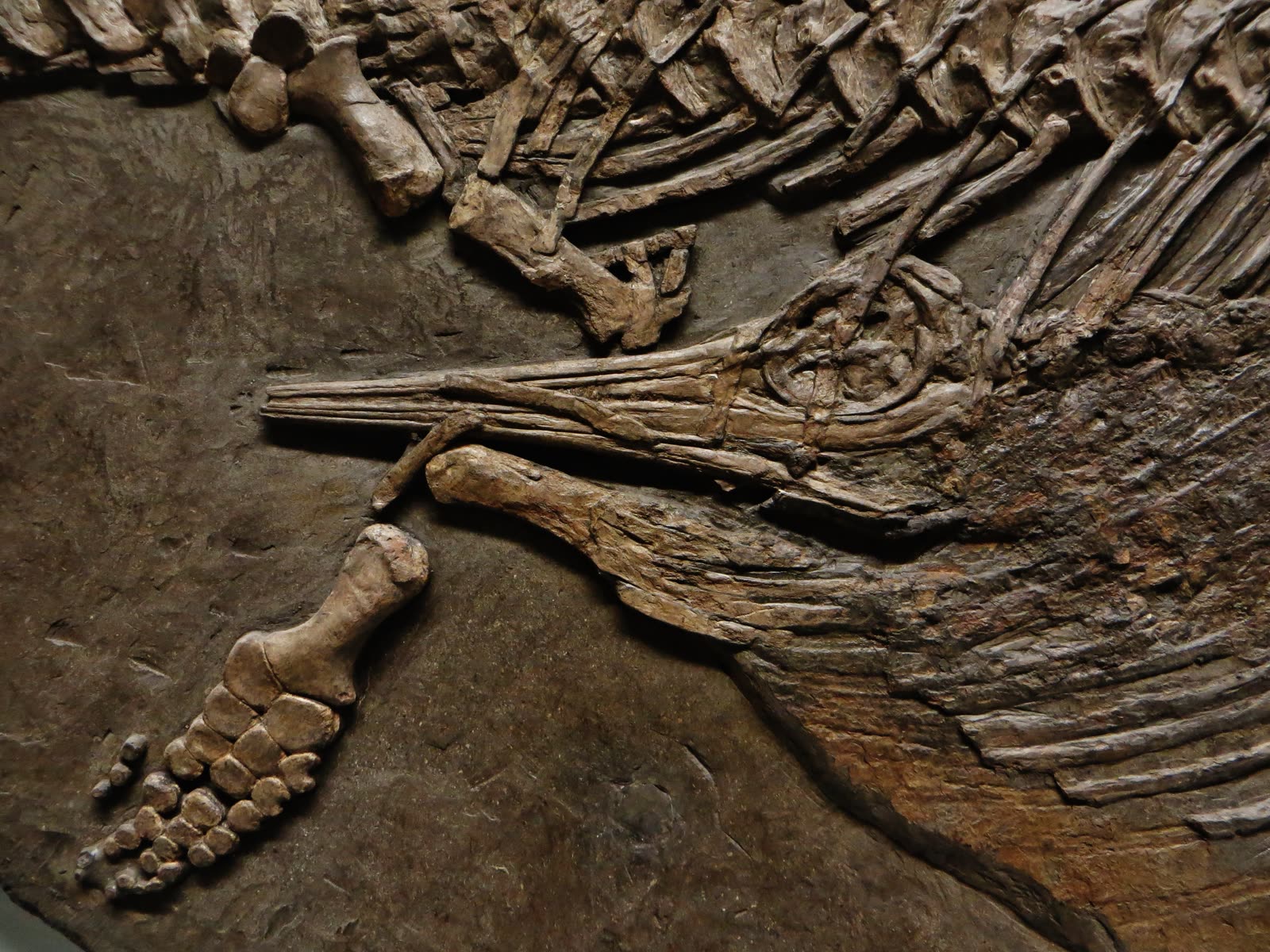
Stenopterygius is often remembered through a single dramatic image: an ichthyosaur mother with a baby halfway out.[1][2] That image deserves its fame, but it becomes clearer when it is read less as prehistoric melodrama and more as a bounded piece of evidence. The famous Jurassic slab matters because it secures several claims at different strengths. It secures viviparity in a derived ichthyosaur lineage. It secures the fact that embryos can be preserved both inside the maternal body and at the pelvic outlet in the same individual. And, when read beside the wider Stenopterygius sample, it helps show that tail-first delivery became a genuine preference in these more streamlined ichthyosaurs.[1][2][3][4][5]
The same fossil is valuable because it does not settle everything. A fetus at the birth canal is not automatically a photograph of death during labor. That older reading has been challenged for years, because decomposition gases and postmortem expulsion can also move embryos into striking positions after the mother's death.[4][5] The specimen therefore works best when it is asked the right question. It is not a perfect obstetric movie frame. It is a fossil that pins down reproductive mode and birth orientation while keeping the precise final moment open.
Image context: the lead image uses a real museum photograph of a Stenopterygius specimen with embryo from Stuttgart.[6] That choice matters because this article depends on a physical relationship you can actually inspect: the adult outline, the pelvic region, and the small body preserved where interpretation has to tighten rather than drift into a generic marine-reptile birth story.
1) The slab matters because it belongs to a real sample, not a one-off miracle
The first discipline is to keep the specimen inside its population context. The State Museum of Natural History Stuttgart notes that it holds several beautiful pregnant ichthyosaurs, all belonging to the genus Stenopterygius, and that one specimen on permanent display shows a fetus emerging from the birth canal.[2] The 2022 Scientific Reports study on Stenopterygius quadriscissus pushes that point further into research practice. Miedema and Maxwell examined about 30 specimens spanning all ontogenetic stages at Stuttgart and the Urweltmuseum Hauff, and their prenatal stage 4 includes the well-known gravid specimen SMNS 6293.[3]
That context matters because it keeps the fossil from turning into a carnival object. A single pregnant slab could be dismissed as a spectacular accident, a preservational oddity, or a museum favorite that got detached from ordinary comparative work. Stenopterygius is harder to dismiss because pregnancy, embryos, and prenatal material recur across a broader Holzmaden sample.[2][3][5] The slab is famous, but it is not isolated.
This is one reason the specimen still reads strongly in 2026. It is not just a beautiful body outline from the Early Jurassic Posidonienschiefer. It sits inside one of paleontology's rare reproductive archives, where multiple individuals let researchers compare embryo position, ossification, and developmental stage instead of improvising from one lucky association.[3][5]
2) What the famous specimen fixes is reproductive structure before drama
The next step is to ask what the slab actually secures. The Stuttgart museum summary gives the public version plainly: a fetus is visible coming out of the birth canal.[2] The deeper scientific use appears when that specimen is folded into comparative work. In the 2022 prenatal-development paper, SMNS 6293 is treated as one of the key perinatal-stage records, meaning it helps anchor the late end of the prenatal sequence rather than merely serving as a dramatic display fossil.[3]
The 2014 PLOS ONE paper on Chaohusaurus makes the comparative value even clearer. When Motani and colleagues reconstructed their much older Early Triassic specimen, they explicitly used a derived Stenopterygius with one embryo in birth position and three in the body cavity as the contrast case for later ichthyosaurs.[4] That matters because it shows what the Jurassic slab had already become in the literature: a reference point. The specimen is not only proving that some ichthyosaurs carried young internally. It is helping define what a derived ichthyosaur pregnancy looks like when embryos are preserved in different positions within one maternal body.[4]
This is the strongest part of the fossil. It turns live birth from a vague marine-reptile necessity into visible arrangement. Maternal body, body cavity, pelvic exit, embryo orientation: these are not four separate ideas glued together after the fact. They are one preserved geometry.[2][3][4]
3) Tail-first birth is real in Stenopterygius, but it is a preference, not a universal law
For a long time, the public version of the story hardened into something too tidy: ichthyosaurs gave birth tail-first because marine animals had to, otherwise the fetus would drown.[1][2] The 2023 fetal-orientation paper revises that sharply. Miedema and colleagues reviewed fetal orientation across ichthyosaurs and concluded that Stenopterygius does show a preference for tail-first birth, but that head-first births also occur often enough that the old drowning story is too simple.[1]
The Stuttgart museum's own science-news summary states the revision cleanly. After re-examining Stenopterygius, the authors found that tail-first birth is preferred, head-first births occur on a regular basis, and birth orientation across living and extinct viviparous animals does not support the older assumption that underwater birth mechanically requires one universal orientation.[2] Instead, the authors suggest that tail-first birth in streamlined forms such as ichthyosaurs and dolphins may relate more to maternal mechanics or trim control during pregnancy than to a single all-purpose anti-drowning rule.[1][2]
That correction gives the famous slab a better role. It is not a lone exhibit proving a biological absolute. It is one especially legible specimen inside a broader dataset that lets paleontologists distinguish preference from law.[1][2] The specimen matters because it helps stabilize that distinction.
4) The birth slab is also a warning against over-reading the last minute
This is the part of the story that keeps the fossil scientifically honest. Motani and colleagues, while discussing the older Chaohusaurus embryo specimen, explicitly warned that a Jurassic ichthyosaur such as Stenopterygius preserved with an embryo at the outlet may represent postmortem expulsion rather than death during labor.[4] Their wording is careful: abdominal gas from decomposition can push an embryo outward after death, producing a vivid but ambiguous final pose.[4]
The 2012 review by Lomax and Massare keeps that same caution in view. They note that Stenopterygius is the classic ichthyosaur genus for embryo-bearing fossils, with more than a hundred reported specimens, and they summarize the longstanding interpretation that normal birth position was probably tail-first.[5] But the review also shows why posture alone cannot carry every narrative burden. A preserved embryo near the pelvis is already extremely valuable evidence. It becomes weaker only when it is forced to answer the more cinematic question of exactly how the mother died.[5]
That limit is not a defect. It is the reason the fossil is useful. Paleontology gets stronger when a specimen is allowed to say the thing it can really say. In this case, the slab securely records viviparity, late prenatal development, and an orientation problem that fits a tail-first preference in derived ichthyosaurs.[1][2][3][4][5] It does not owe us a perfect freeze-frame of fatal labor.
That is why the Stenopterygius birth slab still holds the center of the argument. It preserves reproduction as structure rather than as legend. The adult body is there. The embryo is there. The exit path is there. The boundary is there too.
Sources
- Feiko Miedema, Nicole Klein, Daniel G. Blackburn, P. Martin Sander, Erin E. Maxwell, and Eva M. Griebeler, "Heads or tails first? Evolution of fetal orientation in ichthyosaurs, with a scrutiny of the prevailing hypothesis," BMC Ecology and Evolution 23 (2023).
- State Museum of Natural History Stuttgart, "Heads or tails first? New insights into fetal orientation in ichthyosaurs" (April 26, 2023).
- Feiko Miedema and Erin E. Maxwell, "Ontogenetic variation in the skull of Stenopterygius quadriscissus with an emphasis on prenatal development," Scientific Reports 12 (2022).
- Ryosuke Motani, Da-yong Jiang, Andrea Tintori, Olivier Rieppel, and Guan-bao Chen, "Terrestrial Origin of Viviparity in Mesozoic Marine Reptiles Indicated by Early Triassic Embryonic Fossils," PLOS ONE 9, no. 2 (2014).
- Dean R. Lomax and Judy A. Massare, "An ichthyosaur embryo from the Lower Lias (Jurassic: Hettangian) of Somerset, England, with comments on the reproductive biology of ichthyosaurs," Paludicola 8, no. 4 (2012).
- Wikimedia Commons, "File:Stenopterygius quadriscissus with embryo.jpg" - source page for the fossil photograph used as the article image.